Listen to this Post
Introduction
In the high-stakes arena of cybersecurity, the discovery of a vulnerability is merely the first step—the true measure of an ethical hacker lies in how that discovery is communicated and resolved. Responsible disclosure represents the critical bridge between finding a flaw and ensuring it is remediated before malicious actors can exploit it, transforming a potential catastrophe into a security victory. When a security researcher receives acknowledgment—and a €500 bounty—it validates not just the finding, but the entire disciplined process of ethical vulnerability research, reporting, and coordinated remediation.
Learning Objectives
- Understand the complete lifecycle of responsible vulnerability disclosure, from discovery to public acknowledgment
- Master the technical components of a high-quality bug bounty report that accelerates remediation
- Learn practical reconnaissance, exploitation, and reporting techniques used by professional ethical hackers
- Identify common vulnerability classes and their mitigation strategies across web, API, and cloud environments
You Should Know
- The Responsible Disclosure Lifecycle: From Discovery to Reward
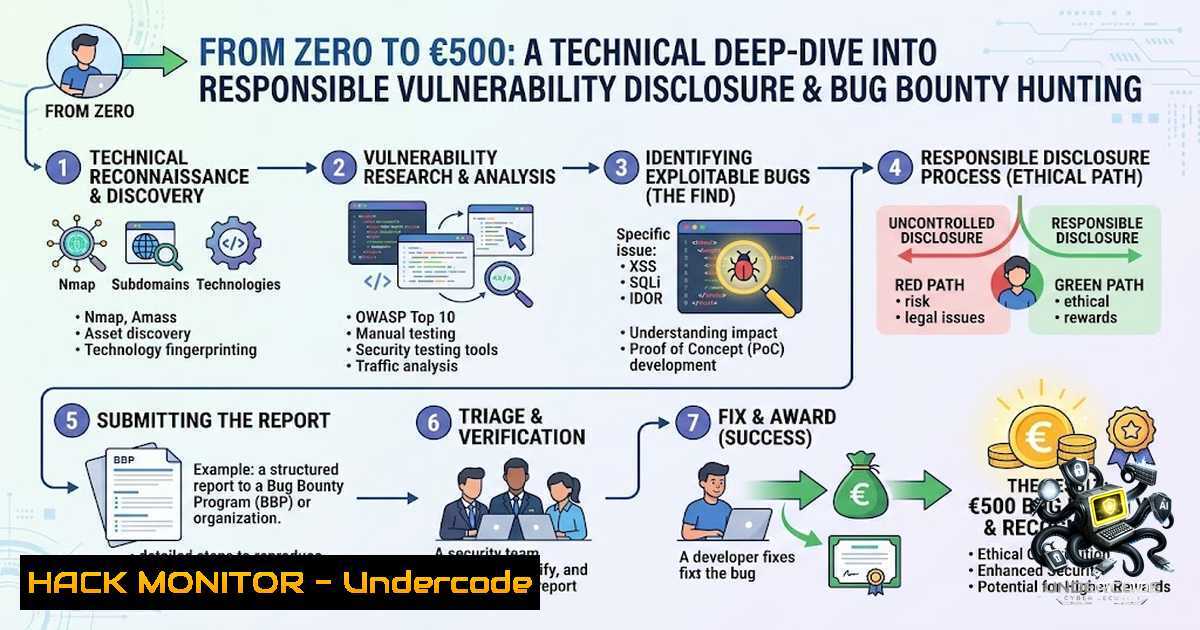
Responsible disclosure—also known as Coordinated Vulnerability Disclosure (CVD)—is a structured process designed to protect users while giving organizations time to patch flaws. The workflow typically follows these stages:
Discovery and Initial Assessment: The researcher identifies a vulnerability through manual testing, automated scanning, or reconnaissance. This phase requires deep technical knowledge—understanding how applications process input, manage sessions, handle authentication, and interact with back-end systems.
Secure Reporting: The researcher privately contacts the affected organization through official channels—often a dedicated security email, a bug bounty platform like HackerOne or Bugcrowd, or a vulnerability disclosure program portal. Many programs require PGP-encrypted communication for sensitive findings.
Acknowledgment and Verification: The organization confirms receipt and begins triaging the report. Professional programs commit to acknowledging reports promptly—often within 24–48 hours.
Coordination and Remediation: The researcher and organization collaborate to understand the vulnerability’s root cause, impact, and appropriate fix. This phase may involve multiple exchanges, additional testing, and validation of the patch.
Public Disclosure: Once the patch is deployed—and often after a 90-day standard window—details may be published, giving the researcher public credit while ensuring users have had time to update.
The €500 bounty awarded to Muhammad Nadeem represents not just a financial reward but organizational validation of this entire disciplined process. Programs vary widely in payout structures, but the underlying principle remains constant: rewarding researchers who follow responsible disclosure practices strengthens the entire ecosystem.
2. Vulnerability Discovery: Reconnaissance and Hunting Techniques
Professional bug bounty hunters employ a methodical approach to discovery. The reconnaissance phase alone can determine success or failure.
Passive Reconnaissance:
- Subdomain enumeration using tools like
Sublist3r,Amass, or `dnsrecon`
– Google dorking to uncover exposed endpoints and sensitive files - Analyzing JavaScript files for hardcoded API keys, endpoints, and hidden parameters
- Reviewing public archives (Wayback Machine) for historical endpoints
 Subdomain enumeration with Amass
amass enum -d target.com -o subdomains.txt

HTTP probing with httpx
cat subdomains.txt | httpx -status-code -title -tech-detect -o live_hosts.txt

JavaScript endpoint extraction
cat js_files.txt | while read url; do
curl -s $url | grep -Eo "(http|https)://[a-zA-Z0-9./?=_-]" >> endpoints.txt
done
Active Discovery:
- Directory and parameter fuzzing using `ffuf` or `dirb`
– Port scanning with `nmap` to identify exposed services - HTTP fingerprinting to detect technologies and versions
 Directory fuzzing with ffuf
ffuf -u https://target.com/FUZZ -w /usr/share/wordlists/dirb/common.txt -o fuzz_results.json

Parameter discovery
ffuf -u https://target.com/page.php?FUZZ=test -w params.txt -fs 1234

Nmap service detection
nmap -sV -sC -p- target.com -oA full_scan
Common high-impact vulnerability classes include:
- IDOR (Insecure Direct Object References) : Manipulating object identifiers to access unauthorized data
- SSTI (Server-Side Template Injection) : Injecting template expressions leading to RCE
- Business Logic Flaws: Exploiting application workflows for unauthorized actions
- API Security Issues: Broken object-level authorization, excessive data exposure, and mass assignment
Windows Command Equivalents:
 Port scanning with Test-1etConnection
1..1024 | ForEach-Object { Test-1etConnection target.com -Port $_ -WarningAction SilentlyContinue }

DNS enumeration
Resolve-DnsName target.com -Type A
Resolve-DnsName target.com -Type CNAME
3. Writing the Perfect Bug Bounty Report
A vulnerability is only as valuable as the report that communicates it. High-quality reports accelerate remediation and increase the likelihood of rewards.
Essential Report Components:
- Clear, Descriptive Summarize the vulnerability specifically—”IDOR in User Profile Endpoint Allows Account Takeover” is far more effective than “Security Issue Found”.
-
Executive Summary: A 2–3 sentence overview of the vulnerability, its impact, and affected components.
-
Technical Description: Detailed explanation of the vulnerability’s root cause, including code snippets or request/response examples.
-
Reproduction Steps: Step-by-step instructions that allow any security engineer to replicate the issue.
-
Proof of Concept (PoC): Concrete evidence—screenshots, video, or exploit code demonstrating the vulnerability.
-
Impact Assessment: What an attacker could achieve—data exfiltration, privilege escalation, account takeover, etc.
-
Remediation Recommendations: Specific, actionable fixes—input validation, access controls, rate limiting, etc.
Example Report Structure:
Stored XSS in Comment Section via SVG Payload — Session Hijacking Risk

Summary: The comment submission endpoint fails to sanitize SVG files,
allowing attackers to inject JavaScript that executes when any user views
the comment.

Steps to Reproduce:
1. Navigate to https://target.com/post/123
2. Submit comment with the following SVG payload:

<

svg xmlns="http://www.w3.org/2000/svg" onload="alert(document.cookie)">
3. View the comment—JavaScript executes in victim's browser

Impact: An attacker can steal session cookies, perform actions on behalf
of victims, or redirect users to phishing pages.

Remediation: Implement strict Content Security Policy, sanitize SVG uploads,
and use a well-vetted HTML sanitization library.

CVSS Score: 6.1 (Medium) — AV:N/AC:L/PR:N/UI:R/S:C/C:L/I:L/A:N
Reports that include all necessary information to understand, replicate, and resolve the vulnerability are classified as “high quality” and receive priority handling.
4. Exploitation and Mitigation: Common Vulnerability Classes
Understanding both exploitation and mitigation is essential for any serious bug bounty hunter.
Cross-Site Scripting (XSS):
- Exploitation: Injecting malicious scripts into web pages viewed by other users
- Mitigation: Output encoding, Content Security Policy, input validation
// Vulnerable code
document.getElementById('output').innerHTML = userInput;

// Mitigated code
document.getElementById('output').textContent = userInput;
// Or use DOMPurify: DOMPurify.sanitize(userInput)
SQL Injection:
- Exploitation: Manipulating SQL queries through unsanitized input
- Mitigation: Parameterized queries, stored procedures, input validation
 Vulnerable (Python)
cursor.execute(f"SELECT  FROM users WHERE username = '{username}'")

Mitigated
cursor.execute("SELECT  FROM users WHERE username = %s", (username,))
Server-Side Request Forgery (SSRF):
- Exploitation: Abusing server functionality to make requests to internal resources
- Mitigation: Allowlisting allowed URLs, blocking private IP ranges, validating input
 Testing for SSRF
curl -X POST https://target.com/api/fetch \
-d "url=http://169.254.169.254/latest/meta-data/"  AWS metadata endpoint
Insecure Direct Object References (IDOR):
- Exploitation: Modifying object IDs in requests to access unauthorized data
- Mitigation: Proper authorization checks, using indirect references, UUIDs instead of sequential IDs
 Vulnerable request
GET /api/user/123/profile

If user 456 can access this, it's IDOR
 Mitigation: Server must verify that the authenticated user owns ID 123
- Tooling and Environment Setup for Bug Bounty Hunting
A well-configured toolkit is the foundation of effective vulnerability research.
Essential Tools:
| Tool | Purpose | Platform |
|||-|
| Burp Suite | Web proxy, intercept, repeater, intruder | Windows/Linux/Mac |
| OWASP ZAP | Open-source web application scanner | Cross-platform |
| Nmap | Network discovery and port scanning | Cross-platform |
| ffuf | Fast web fuzzer | Linux/Mac/Windows (WSL) |
| Sublist3r | Subdomain enumeration | Python (cross-platform) |
| nuclei | Vulnerability scanner | Cross-platform |
| Metasploit | Exploit development and testing | Cross-platform |
Linux Setup:
 Install essential tools
sudo apt update && sudo apt install -y \
nmap ffuf burpsuite zaproxy \
python3-pip git curl wget

Install Python tools
pip3 install sublist3r nuclei

Clone wordlists
git clone https://github.com/danielmiessler/SecLists.git
Windows Setup (WSL2 recommended):
 Enable WSL2
wsl --install -d Ubuntu

Then follow Linux setup inside WSL
 For native Windows tools:
winget install -e --id PortSwigger.BurpSuite.Community
winget install -e --id OWASP.ZAP
winget install -e --id Insecure.Nmap
Browser Extensions:
- Wappalyzer: Technology stack detection
- Retire.js: Detects vulnerable JavaScript libraries
- HackBar: Quick request manipulation
- FoxyProxy: Proxy management for Burp/ZAP
6. API Security Testing: The Modern Attack Surface
With microservices and mobile applications dominating the landscape, API security has become paramount.
Common API Vulnerabilities:
- Broken Object Level Authorization (BOLA): IDOR in API endpoints
- Broken Authentication: Weak token generation, JWT vulnerabilities
- Excessive Data Exposure: APIs returning more data than necessary
- Mass Assignment: Exploiting hidden parameters in API requests
Testing API Endpoints:
 JWT token analysis
 Decode JWT (without verification)
echo "eyJhbGciOiJIUzI1NiIsInR5cCI6IkpXVCJ9..." | cut -d. -f2 | base64 -d

Testing for BOLA
curl -X GET https://api.target.com/v1/users/123 \
-H "Authorization: Bearer $TOKEN"

Try changing 123 to other user IDs

Rate limit testing
for i in {1..1000}; do
curl -X POST https://api.target.com/v1/login \
-d '{"username":"test","password":"pass"}' &
done
API Security Headers to Verify:
Content-Security-Policy: default-src 'self'
X-Content-Type-Options: nosniff
Strict-Transport-Security: max-age=31536000; includeSubDomains
X-Frame-Options: DENY
7. Cloud and Infrastructure Hardening
Modern applications increasingly rely on cloud infrastructure, introducing new attack vectors.
Common Cloud Misconfigurations:
- Publicly exposed S3 buckets
- Overly permissive IAM roles
- Exposed cloud metadata endpoints
- Hardcoded credentials in source code
AWS-Specific Testing:
 Check for public S3 buckets
aws s3 ls s3://bucket-1ame --1o-sign-request

Enumerate IAM permissions
aws sts get-caller-identity
aws iam list-attached-user-policies --user-1ame $USER

Check metadata endpoint (SSRF target)
curl http://169.254.169.254/latest/meta-data/
curl http://169.254.169.254/latest/user-data/
Mitigation Strategies:
- Implement principle of least privilege for all IAM roles
- Enable S3 block public access
- Use AWS Secrets Manager or HashiCorp Vault for credentials
- Regular infrastructure scanning with tools like `Prowler` or `ScoutSuite`
Install and run Prowler for AWS security assessment
pip3 install prowler
prowler aws -f us-east-1
What Undercode Say
- Responsible disclosure is not just about finding bugs—it’s about the entire lifecycle of communication, collaboration, and coordinated remediation. The €500 bounty is a validation of this process, not merely a reward for the finding itself.
-
The quality of the report often matters as much as the severity of the vulnerability. A well-documented, reproducible finding with clear remediation guidance accelerates fixes and builds trust with the organization.
The ethical hacking community thrives on a culture of responsible disclosure. Muhammad Nadeem’s experience exemplifies the ideal scenario: a researcher discovers a vulnerability, reports it privately, receives acknowledgment and reward, and contributes to a safer internet. Organizations that embrace responsible disclosure programs benefit from the collective intelligence of the global security community, catching vulnerabilities before they can be weaponized.
The €500 bounty, while modest compared to some programs, represents something far more valuable: professional recognition and the satisfaction of knowing that one’s work directly protects users. As bug bounty programs continue to mature, we can expect more organizations to adopt structured disclosure policies, creating a virtuous cycle where security researchers are incentivized to find and report vulnerabilities responsibly.
Expected Output
Introduction:
Responsible disclosure represents the critical bridge between discovering a security flaw and ensuring it is remediated before malicious actors can exploit it. When a security researcher receives acknowledgment—and a €500 bounty—it validates not just the finding, but the entire disciplined process of ethical vulnerability research, reporting, and coordinated remediation.
What Undercode Say:
- Responsible disclosure is not just about finding bugs—it’s about the entire lifecycle of communication, collaboration, and coordinated remediation. The €500 bounty validates this process.
- The quality of the report often matters as much as the severity of the vulnerability. Well-documented, reproducible findings with clear remediation guidance build trust and accelerate fixes.
Prediction
- +1 The bug bounty economy will continue to expand, with organizations increasingly recognizing that crowdsourced security testing offers superior coverage compared to traditional penetration testing alone.
-
+1 AI-assisted vulnerability discovery tools will augment—not replace—human researchers, enabling faster identification of complex, multi-step vulnerabilities that automated scanners miss.
-
-1 As bug bounty programs grow, so will the sophistication of attackers targeting the same vulnerabilities—the window between disclosure and exploitation will shrink, demanding faster patch cycles.
-
+1 Regulatory frameworks will increasingly mandate responsible disclosure policies, making bug bounty programs a compliance requirement rather than a voluntary security investment.
-
-1 The skill gap in cybersecurity means demand for qualified bug bounty hunters will outpace supply, driving up rewards but also increasing competition and pressure on researchers.
-
+1 Organizations that embrace transparency—acknowledging and rewarding researchers publicly—will build stronger security cultures and attract top-tier talent to their programs.
-
-1 The rise of automated vulnerability scanning tools may lead to an increase in low-quality, duplicate reports, forcing programs to implement stricter triage processes.
▶️ Related Video (78% Match):
https://www.youtube.com/watch?v=4ofNelpMIKE
🎯Let’s Practice For Free:
🎓 Live Courses & Certifications:
Join Undercode Academy for Verified Certifications
🚀 Request a Custom Project:
Secure, high-velocity infrastructure and disruptive technological engineering. Contact our engineering team for high-tier development and proprietary systems:
[email protected]
💎 Smart Architecture | 🛡️ Secure by Design | ⭐ Trusted by Thousands
IT/Security Reporter URL:
Reported By: Muhammad Nadeem – Hackers Feeds
Extra Hub: Undercode MoN
Basic Verification: Pass ✅


