Listen to this Post
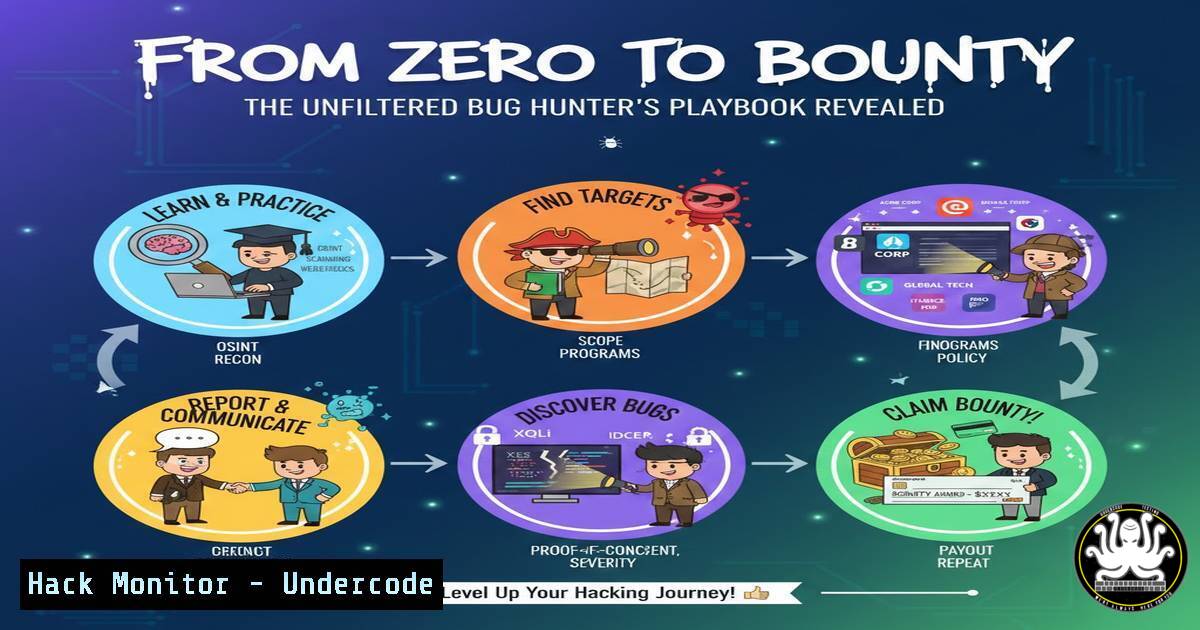
Introduction:
The world of bug bounty hunting represents a critical frontier in modern cybersecurity, where ethical hackers leverage their skills to identify vulnerabilities in exchange for monetary rewards and recognition. For aspiring security researchers, breaking into this competitive field requires more than just theoretical knowledge; it demands a practical, methodical approach grounded in real-world techniques. This guide distills the actionable strategies shared by successful hunters into a concrete roadmap for your first submission and beyond.
Learning Objectives:
- Understand the foundational mindset and methodology of a professional bug bounty hunter.
- Build and execute a technical reconnaissance and vulnerability discovery workflow.
- Learn to document and report findings effectively to maximize validation and reward.
You Should Know:
1. The Hunter’s Mindset: Methodology Over Luck
Successful bug hunting is a systematic process, not a game of chance. It begins with scope analysis and asset enumeration, treating each target as a unique puzzle.
Step‑by‑step guide explaining what this does and how to use it.
Step 1: Define Scope & Rules of Engagement. Always review the target’s public bug bounty program policy (e.g., on HackerOne, Bugcrowd, or Intigriti). Note the in-scope domains, subdomains, and types of vulnerabilities they reward. Ignoring the scope leads to wasted effort.
Step 2: Passive Reconnaissance. Use tools to map the attack surface without touching the target servers.
Command (Linux): `subfinder -d target.com -silent | httpx -silent` – Discovers subdomains and finds live HTTP servers.
Tool: Use `amass` for in-depth DNS enumeration and `waybackurls` to gather historical URLs and parameters.
Step 3: Technology Stack Fingerprinting. Identify the technologies (frameworks, CMS, servers, APIs) in use. This directs your testing efforts.
Command: `whatweb target.com –color=never` – Quickly identifies web technologies.
Tool: Wappalyzer (browser extension) provides a quick visual stack analysis.
2. Automated Discovery: Casting a Wide Net
Automation handles the breadth, allowing you to focus on the depth of analysis. The goal is to filter thousands of endpoints down to a handful of interesting targets.
Step‑by‑step guide explaining what this does and how to use it.
Step 1: Massive Enumeration. Combine subdomain discovery with content crawling.
Workflow: Use `gau` (GetAllUrls) to fetch URLs from AlienVault OTX and Common Crawl, then filter for parameters: gau target.com | grep "?" | qsreplace.
Step 2: Screening for Common Vulnerabilities. Use automated scanners with a light touch to avoid overloading targets or getting your IP blocked.
Command: `nuclei -u https://target.com -t ~/nuclei-templates/http/exposures/ -silent` – Runs targeted vulnerability checks using the vast Nuclei template library. Crucially, always use the `-rate-limit` flag to limit requests per second.
Tool: Configure `ffuf` for directory fuzzing: `ffuf -w /path/to/wordlist.txt -u https://target.com/FUZZ -fs 4242` (where `-fs` filters out a specific response size).
3. Manual Exploitation: The Art of the Hunt
True critical vulnerabilities are often found through manual testing, logical flaw analysis, and chaining smaller issues.
Step‑by‑step guide explaining what this does and how to use it.
Step 1: Analyze Authentication & Authorization. Test for Broken Access Control (OWASP Top 10 1). For a user ID parameter, try changing it to another user’s ID.
Example: If a request fetches GET /api/user/12345/profile, try GET /api/user/67890/profile. Use Burp Suite’s Repeater tool to manipulate and replay these requests.
Step 2: Test Business Logic Flaws. These aren’t caught by scanners. Example: Add a negative item quantity to a cart to see if it increases the total credit. Automate parameter tampering with Burp Intruder using a “Sniper” attack.
Step 3: Examine API Endpoints. Modern apps rely heavily on APIs (GraphQL, REST). Test for excessive data exposure, insecure direct object references (IDOR), and mass assignment.
Tool: Use `inql` (for Burp) to introspect GraphQL endpoints and find hidden queries/mutations.
4. Proof-of-Concept (PoC) Development
A valid report requires a clear, reproducible PoC. It must demonstrate impact without causing damage.
Step‑by‑step guide explaining what this does and how to use it.
Step 1: Isolate the Vulnerability. Craft the minimal set of requests needed to trigger the flaw. Save all HTTP traffic as a `.har` file or Burp project.
Step 2: Document with Precision. Write a simple script or curl commands that the triager can run.
Example for a Reflected XSS: `curl -i -s -k -X GET ‘https://vulnerable.target.com/search?q=‘`
For a Local File Inclusion (LFI): Show how to read /etc/passwd: `https://target.com/page?file=../../../etc/passwd`
Step 3: Demonstrate Impact. For an XSS, show it executes in the context of the target domain. For sensitive data exposure, show the extracted data clearly.
5. The Report: Your Ticket to the Bounty
A poorly written report can get a critical bug closed as “N/A” or “Informative.” Structure is key.
Step‑by‑step guide explaining what this does and how to use it.
Step 1: Use a Clear Template.
1. Concise (e.g., “IDOR in /api/v1/user/[bash] leads to PII disclosure”).
2. Vulnerability Type: CWE classification.
3. Affected URL/Endpoint: Exact location.
4. Steps to Reproduce: Numbered, detailed, and idiot-proof.
5. Proof of Concept: Screenshots, videos, or code snippets.
6. Impact: Explain what an attacker could achieve.
7. Suggested Remediation: Provide a concrete fix (e.g., “Implement proper authorization checks on the server-side”).
Step 2: Submit Through Proper Channels. Always use the vendor’s designated reporting platform. Never disclose details publicly before the bug is fixed and you have permission.
6. Toolchain Setup & Environment Hardening
A stable, secure, and organized testing environment is non-negotiable.
Step‑by‑step guide explaining what this does and how to use it.
Step 1: Use a Virtual Machine or Isolated Environment. Kali Linux, Parrot OS, or a custom Ubuntu VM. This protects your host machine and allows for snapshots.
Step 2: Configure Proxies and Certificate Authorities. To intercept HTTPS traffic, install the Burp Suite or OWASP ZAP Certificate Authority certificate into your browser’s and system’s trust store.
Linux (Firefox): Import the certificate via Preferences > Privacy & Security > Certificates > View Certificates > Import.
Step 3: Manage Wordlists and Tools. Keep your tools updated. Use `apt update && apt upgradefor system packages. Clone and update niche tools from GitHub regularly (e.g.,git pull`).
7. From Submission to Payout: The Waiting Game
As noted in the source post, even valid reports to major firms like Booking or Spotify can sit “awaiting payment” due to triage and administrative processes.
Step‑by‑step guide explaining what this does and how to use it.
Step 1: Patience and Professional Follow-up. Program policies outline response times. If a deadline passes, use the platform’s private communication channel to politely inquire about the report’s status. Never be adversarial.
Step 2: Learn from Every Interaction. If a report is marked as a duplicate, study the original report to understand what you missed. If it’s closed as “Informative,” understand the triager’s perspective to refine your approach.
Step 3: Build Reputation. High-quality reports build a positive reputation on platforms, which can lead to invitations to private, more lucrative programs.
What Undercode Say:
- The Barrier to Entry is a Filter, Not a Wall. The initial struggle with methodology and tooling is universal. Overcoming it through structured practice is what separates hobbyists from professionals.
- Success is a Product of Volume and Technique. Submitting many well-researched reports across diverse targets statistically increases your chances of a find. It’s a numbers game played with skilled precision.
The analysis from the source material highlights a critical, often overlooked aspect: the operational delay between finding a bug and receiving a bounty. This underscores that bug hunting is also a test of patience and business process navigation. The hunter’s technical skill gets the find, but their professionalism in follow-through ensures the reward. The community aspect—shared through groups like the one linked—is invaluable for overcoming these non-technical hurdles and staying motivated during the “awaiting payment” phases.
Prediction:
The future of bug bounty hunting will be shaped by AI-assisted tooling, increasing the baseline speed of reconnaissance and initial analysis. However, this will elevate, not eliminate, the need for human creativity. The most sought-after hunters will be those who can find complex, logic-based vulnerabilities that AI cannot yet reliably replicate, and who can chain multiple lower-severity issues into a critical exploit path. Furthermore, as programs mature, we will see a standardization of payout timelines and clearer communication channels, reducing the current friction in the reward process. The community-driven knowledge sharing, as evidenced by the post, will remain the bedrock of the field’s evolution.
▶️ Related Video (88% Match):
🎯Let’s Practice For Free:
IT/Security Reporter URL:
Reported By: Alexandre Rodrigo – Hackers Feeds
Extra Hub: Undercode MoN
Basic Verification: Pass ✅


