Listen to this Post
Introduction:
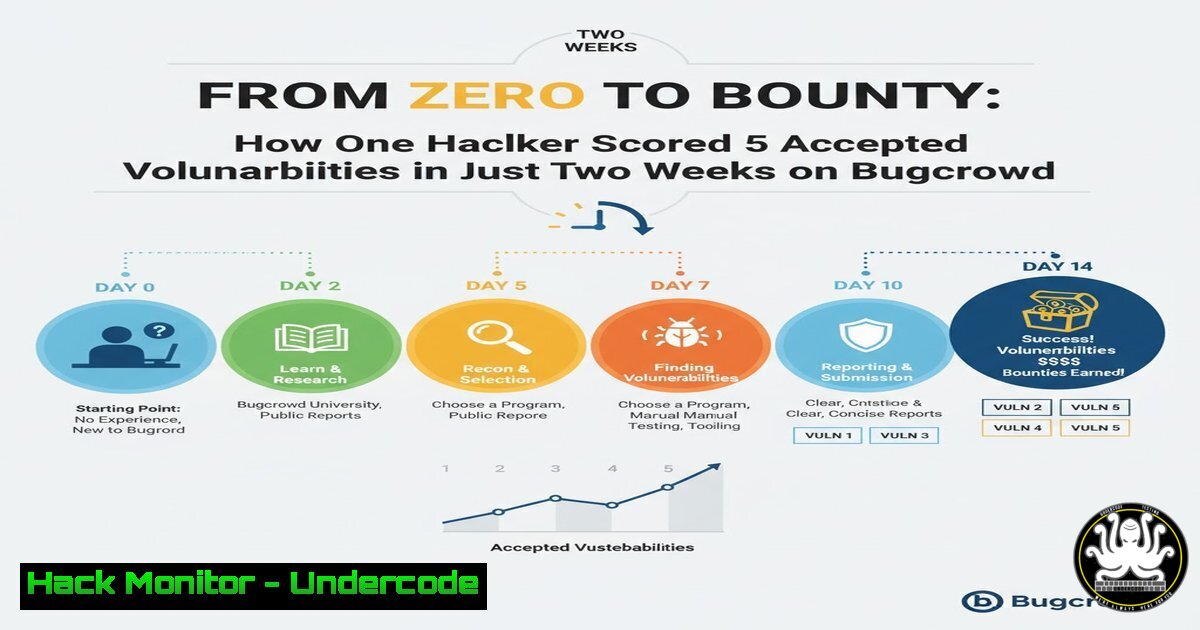
Bug bounty platforms like Bugcrowd offer a legitimate and lucrative pathway for cybersecurity professionals to test their skills against real-world systems. This article deconstructs a recent success story where a penetration tester, Amir Abdelnaby, joined Bugcrowd and within two weeks had five vulnerabilities accepted, demonstrating a rapid and effective methodology for modern bug bounty hunting.
Learning Objectives:
- Understand the foundational setup and strategy for launching a successful bug bounty campaign on a platform like Bugcrowd.
- Master the core reconnaissance and vulnerability scanning techniques used to identify low-hanging fruit and critical security flaws.
- Learn how to craft high-quality, actionable vulnerability reports that get accepted and lead to monetary rewards.
You Should Know:
1. Platform Selection and Target Scoping
The first step to bug bounty success is choosing the right platform and defining your target scope. Platforms like Bugcrowd, HackerOne, and Open Bug Bounty host numerous programs with varying rules and rewards.
Step‑by‑step guide explaining what this does and how to use it.
– Step 1: Platform Onboarding. Create an account on your chosen platform (e.g., Bugcrowd). Complete your profile, verify your identity, and familiarize yourself with the platform’s terms of service and code of conduct.
– Step 2: Program Selection. Filter programs by their “reward,” “scope,” and “difficulty” tags. For beginners, look for programs with a broad scope, public visibility, and a history of rewarding low to medium-severity bugs. Avoid programs marked “Invite Only” initially.
– Step 3: Scope Analysis. Once you select a program, meticulously read its security policy. The scope defines which domains, subdomains, and application types are in-bounds. For example, a policy might state: `.example.com` is in-scope, but `api.example.com` and `admin.example.com` are out-of-scope. Testing out-of-scope assets can lead to disqualification.
2. The Reconnaissance Phase: Unearthing Hidden Attack Surfaces
Reconnaissance is the most critical phase, where you gather intelligence about your target to identify potential entry points. A broad recon leads to more potential vulnerabilities.
Step‑by‑step guide explaining what this does and how to use it.
– Step 1: Subdomain Enumeration. Use tools to discover all subdomains associated with the target root domain.
– Command (Linux): `subfinder -d example.com -o subdomains.txt`
– Tool: Amass can be used for deeper enumeration: `amass enum -passive -d example.com -o subdomains_amass.txt`
– Step 2: Probing for Live Hosts. Filter your list of subdomains to find which ones are actively running web services.
– Command (Linux): `cat subdomains.txt | httpx -silent > live_hosts.txt`
– Step 3: URL Discovery. Crawl the live hosts to find all endpoints, parameters, and files.
– Command (Linux): `cat live_hosts.txt | waybackurls > urls.txt`
– Tool: Use `gau` (GetAllUrls) for a similar result: `gau example.com > urls.txt`
3. Automated Scanning for Low-Hanging Fruit
While manual testing is crucial, automated scanners can quickly identify common vulnerabilities, freeing you up for more complex analysis.
Step‑by‑step guide explaining what this does and how to use it.
– Step 1: Vulnerability Scanning. Run a scanner like Nuclei against your list of live hosts.
– Command (Linux): `nuclei -l live_hosts.txt -t /path/to/nuclei-templates/ -o nuclei_scan_results.txt`
– What it does: Nuclei uses community-powered templates to check for thousands of known CVEs and misconfigurations.
– Step 2: JavaScript Analysis. Modern web apps hide endpoints and API keys in JavaScript files. Use a tool to analyze them.
– Tool: `subjs` can fetch JavaScript files from a list of URLs: `cat urls.txt | subjs | sort -u > jsfiles.txt`
– Next Step: Use a tool like `LinkFinder` on these JS files to find hidden endpoints: `python3 linkfinder.py -i https://example.com/script.js -o cli`
4. Manual Exploitation and Proof-of-Concept (PoC) Development
Automated tools provide clues, but manual testing confirms the vulnerability and demonstrates its impact. Common starting points include Cross-Site Scripting (XSS), SQL Injection, and IDOR.
Step‑by‑step guide explaining what this does and how to use it.
– Example: Testing for IDOR (Insecure Direct Object Reference).
– Step 1: Log into an application and note a resource you can access, like https://example.com/invoice?id=1001`.1002
- Step 2: Change the `id` parameter to `1000` or. If you can access another user's invoice, you have found a critical IDOR vulnerability.
- Step 3: Document the exact request and response using a proxy like Burp Suite or OWASP ZAP. Show the request with your user's session token accessing another user's data.
- Example: Testing for XSS.
- Step 1: Identify all user-input fields (forms, URL parameters).
- Step 2: Inject a basic payload:. If an alert box pops up, the site is vulnerable.`.
- Step 3: Craft a more sophisticated PoC that demonstrates impact, like stealing a user's cookie:
5. Crafting the Perfect Bug Bounty Report
A well-written report is the difference between a bounty and a “Duplicate” or “Not Applicable” label. It must be clear, concise, and actionable for the triage team.
Step‑by‑step guide explaining what this does and how to use it.
– Step 1: Structure Your Report.
1. Clear and specific (e.g., “IDOR on /api/v1/user/[bash] endpoint allows viewing any user’s PII”).
2. Vulnerability Description: Briefly explain the flaw.
- Steps to Reproduce: A numbered, step-by-step guide the triager can follow exactly. Include URLs, request/response pairs (with headers), and screenshots.
- Impact: Explain what an attacker could achieve (e.g., “This allows any authenticated user to access the full name, address, and tax ID of any other user on the platform”).
- Suggested Remediation: (e.g., “Implement proper authorization checks that verify the user making the request owns the resource ID being requested”).
– Step 2: Proofread and Submit. Ensure there are no typos and all links/images work. Then submit through the platform’s portal.
What Undercode Say:
- Consistency Over Speed: A methodical, in-depth approach to reconnaissance and testing will yield more valid, high-severity bugs than a frantic, superficial one.
- Quality of Report is King: A medium-severity bug with a perfectly documented report will be accepted faster than a critical bug with a confusing, poorly written report.
Analysis:
Amir’s reported results—13 rejected, 5 accepted, 3 duplicates—are a textbook example of a successful initial foray into bug bounties. The high number of duplicates indicates he is on the right track, finding real vulnerabilities that others are also discovering, a common occurrence on popular programs. The 13 rejected submissions are a critical learning tool; they often result from misinterpreting a program’s scope, reporting intended functionality, or submitting low-quality reports. The key is to analyze the feedback for each rejection to refine techniques and reporting skills. This cycle of test, report, learn, and adapt is the core loop of a proficient bug bounty hunter.
Prediction:
The bug bounty ecosystem will increasingly leverage AI to augment human hunters. We predict the emergence of AI-powered reconnaissance assistants that can automatically correlate data from various sources to suggest novel attack vectors, and NLP models that can help draft initial bug reports from a hunter’s notes. Furthermore, platforms will integrate more automated scanning directly into their triage process, forcing hunters to focus on more complex, business-logic flaws that machines cannot easily find, thereby raising the skill ceiling and value of expert manual testers.
🎯Let’s Practice For Free:
IT/Security Reporter URL:
Reported By: Amir Abdelnaby – Hackers Feeds
Extra Hub: Undercode MoN
Basic Verification: Pass ✅


