Listen to this Post
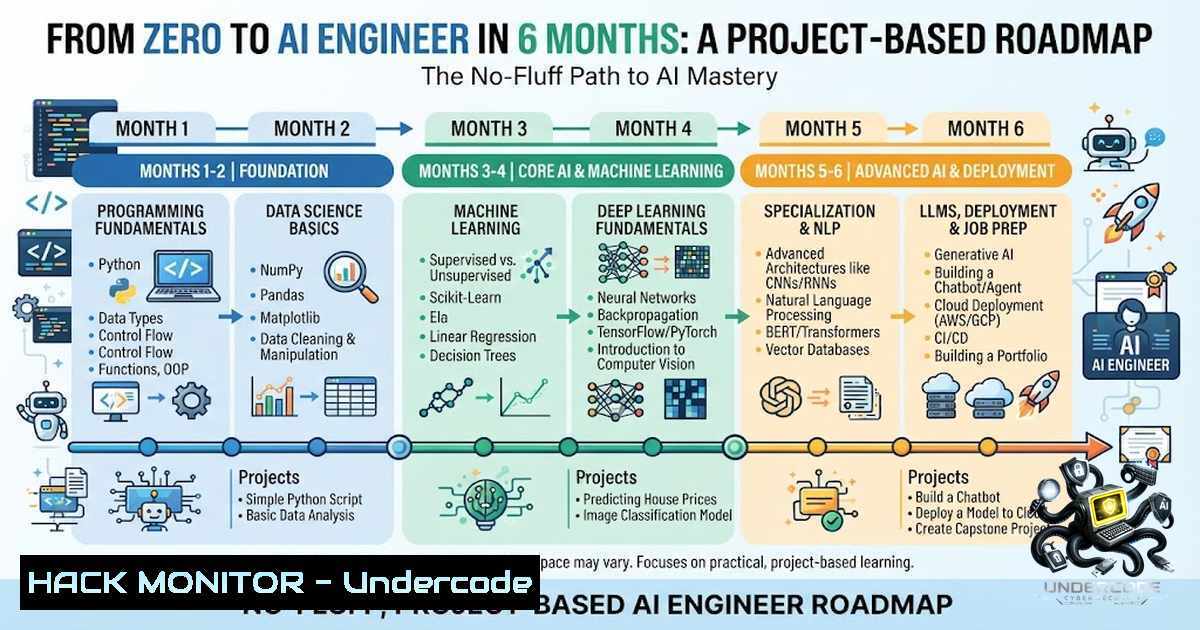
Introduction:
The demand for AI Engineers has skyrocketed, but the path to entering this field is often obscured by overwhelming amounts of theoretical content and lengthy courses that lead to “tutorial hell.” A practical, project-focused roadmap prioritizes building functional applications over passive learning, ensuring that every concept mastered is immediately applied to a tangible output. This approach transforms foundational knowledge into marketable skills, enabling developers to create, deploy, and iterate on AI-powered solutions rapidly.
Learning Objectives:
- Master the foundational programming and data handling skills required for AI development within the first month.
- Learn to effectively prompt, configure, and integrate Large Language Models (LLMs) for specific tasks and outputs.
- Build, evaluate, and deploy production-ready AI applications, including RAG systems and autonomous agents.
1. Month 1: Establishing the Core Foundation
The first month is not about AI but about the robust engineering practices that make AI possible. You must become proficient in Python, Git, and API interactions. Begin by setting up your development environment with `venv` or `conda` to manage dependencies. Practice using `requests` to handle HTTP methods (GET, POST, PUT, DELETE) and parse JSON responses. This is crucial as every interaction with an LLM is an API call. Simultaneously, learn to structure data with `pandas` and build a simple REST API using FastAPI, which will serve as the backbone for your future applications.
Step-by-Step Guide for Month 1:
- Installation & Setup: Install Python 3.10+, Git, and VS Code. Create a project folder.
- Virtual Environment: Run `python -m venv ai_venv` and activate it (source `ai_venv/bin/activate` on Linux/macOS or `ai_venv\Scripts\activate` on Windows).
- Core Libraries: Install essential packages using
pip install requests pandas fastapi uvicorn. - API Practice: Write a Python script to call a public API (e.g., a weather or news API), parse the JSON response, and print specific fields.
- FastAPI Project: Create a file `main.py` with a basic FastAPI app. Run it locally with `uvicorn main:app –reload` and test the `/docs` endpoint.
2. Month 2: Interacting with Large Language Models
This month shifts focus to the cognitive engine of AI. You will learn to design system instructions that define the AI’s persona and constraints and craft user prompts to elicit specific responses. Master the concept of structured outputs by using function calling or JSON mode to force the model to return data in a predictable format. You must also understand token costs and how to manage conversation memory within context windows. This phase is about controlled generation and handling edge cases like model failures.
Step-by-Step Guide for Month 2 (API Security & Configuration):
1. Environment Variables: Securely store your API keys. Create a `.env` file and use `python-dotenv` to load them into your scripts.
2. Basic Prompting: Use the OpenAI SDK to send a `system` and `user` message and print the response.
3. Structured Outputs: Use `response_format={“type”: “json_object”}` to get JSON data back.
4. Tool Calling: Define a tool (like a function to get current weather) in your API call. Let the LLM decide to call this tool, parse the response, execute the function, and send the result back to the model to generate a final answer.
5. Conversation Memory: Manage messages in a list (messages.append()) to simulate a conversation history.
3. Month 3: Mastering Retrieval-Augmented Generation (RAG)
RAG is the solution to grounding LLMs in private data and reducing hallucinations. You will learn the nuances of chunking—splitting documents into digestible pieces—and embedding them into a vector space. Using a vector database like Pinecone or ChromaDB, you’ll implement metadata filtering to narrow the search scope before generating a response. Re-ranking is critical for optimizing retrieval quality; you’ll learn to apply cross-encoders to reorder the top retrieved chunks for relevance.
Step-by-Step Guide for RAG:
- Data Preparation: Load a PDF or text document. Use `langchain` or `llama-index` to split it into overlapping chunks.
- Embedding & Storage: Use an embedding model (e.g.,
text-embedding-3-small) to create vectors and store them in a vector database (ChromaDB). - Retrieval: Implement code to perform a similarity search on the database based on a user query.
- Augmentation & Generation: Create a prompt that includes the retrieved context. Send this prompt to the LLM to generate the final grounded response.
- Citation: Structure the output to include source references from the retrieved documents.
4. Month 4: Building and Deploying AI Agents
Moving beyond simple chat, this month introduces cognitive architectures where agents plan, use tools, and execute multi-step workflows. You’ll build agentic systems using frameworks like LangGraph or AutoGen, allowing them to manage their own state and decide which tool to use next. This involves defining a set of functions (tools), giving the agent a loop to decide, and evaluating its performance. You will also learn to identify when an agent is overkill and a simpler workflow would suffice, a key optimization skill.
Step-by-Step Guide for Agent Workflows:
- Tool Definition: Write Python functions for
get_weather,send_email, orsearch_web. - Agent Setup: Use `langgraph` to define a state graph for the agent. Set up nodes like “Agent” and “Tools” and edges to define the flow.
- Executor & Loop: Create a `ToolExecutor` and run the agent in a loop until it decides to stop (usually until no more tool calls are required).
- State Management: Use the state dictionary to track intermediate steps and results.
- Performance Evaluation: Implement a simple evaluator to check if the agent’s final output meets the criteria of the initial user input.
5. Month 5: Productionizing and Shipment
This crucial phase transitions your code from a Jupyter notebook to a live, secure, and reliable web application. You will learn containerization with Docker to ensure environment consistency. Implement authentication (JWT) to secure your APIs, robust logging for debugging, and background job queues with Celery for long-running tasks. Handling rate limits and implementing caching with Redis will prevent you from exceeding API quotas, while prompt versioning ensures you can roll back to previous LLM behaviors.
Step-by-Step Guide for Production:
- Dockerize Your App: Create a `Dockerfile` that installs dependencies and runs your FastAPI app. Build the image `docker build -t my-ai-app .` and run it.
- Implement Caching: Use `redis-py` to cache responses for specific prompts to reduce latency and cost.
- Authentication: Add a dependency in FastAPI to validate JWT tokens before allowing access to endpoints.
- Logging & Monitoring: Set up `logging` to output structured logs to stdout. Integrate simple monitoring by logging model usage and latency.
- Background Jobs: Implement a `Celery` worker to handle tasks like document processing (chunking/embedding) so they don’t block the main API.
6. Month 6: Choosing Your Specialization
General knowledge gets you started, but expertise gets you hired. This month is about depth. If you choose “AI Product Engineer,” focus on user experience and system design, building a full-featured SaaS application. If you choose “Applied LLM Engineer,” dive deep into `transformers` libraries, quantization, parameter-efficient fine-tuning (LoRA), and working with open-source models like Llama 3 or Mistral. For “AI Automation Engineer,” focus on connecting AI agents to CRM systems, email workflows, and building robust integration pipelines using tools like n8n.
Step-by-Step Guide for Fine-Tuning (Linux/Windows WSL):
- Library Installation:
pip install transformers datasets accelerate peft trl bitsandbytes. - Dataset Prep: Format your data for instruction fine-tuning (user/assistant pairs).
- Quantization: Load the base model in 4-bit mode (
load_in_4bit=True) to reduce VRAM usage. - LoRA: Use `peft` to attach adapters to the model, targeting attention layers.
- Training: Use `Trainer` from Hugging Face to run the training loop, adapting the model to your specific dataset.
- Inference: Load the base model and merge the trained adapter weights for deployment.
What Undercode Say:
- Key Takeaway 1: The “Learn by Building” methodology is non-1egotiable; theoretical knowledge without a portfolio is effectively invisible to employers.
- Key Takeaway 2: Mastering AI engineering is less about algorithms and more about robust software engineering, API design, and infrastructure management.
The roadmap presented is not just a list of topics but a chronological system designed to build complexity. The deliberate avoidance of 500-hour courses in favor of practical projects—like building a chatbot, RAG app, and agent—forces the learner to solve real-world problems, like handling API rate limits, managing state, and optimizing for cost. The final specialization phase is crucial because it acknowledges that the field of AI engineering has fragmented; a generalist is less valuable than a specialist who deeply understands one domain, be it product design, model optimization, or business automation. This approach ensures that at the end of six months, the individual possesses not just knowledge, but a proven track record of shipping functional AI solutions.
Prediction:
+1 The “AI Engineer” role will continue to diverge into specialized sub-roles (Product, Applied, Automation), making defined roadmaps like this one essential for targeted career development.
+1 Automated evaluation and monitoring of AI systems will become the next major frontier, creating a new category of tools and engineers focused on “AI Ops” and guardrails.
-1 As automation becomes more accessible, the market will be flooded with low-tier AI products, raising the bar for true engineering excellence and system design.
-1 The rapid pace of framework evolution (LangChain, LlamaIndex) means the specific tools learned today may be obsolete, requiring engineers to focus on core principles that remain consistent.
▶️ Related Video (84% Match):
🎯Let’s Practice For Free:
🎓 Live Courses & Certifications:
Join Undercode Academy for Verified Certifications
🚀 Request a Custom Project:
Secure, high-velocity infrastructure and disruptive technological engineering. Contact our engineering team for high-tier development and proprietary systems:
[email protected]
💎 Smart Architecture | 🛡️ Secure by Design | ⭐ Trusted by Thousands
IT/Security Reporter URL:
Reported By: Abhirajyadav How – Hackers Feeds
Extra Hub: Undercode MoN
Basic Verification: Pass ✅


