Listen to this Post
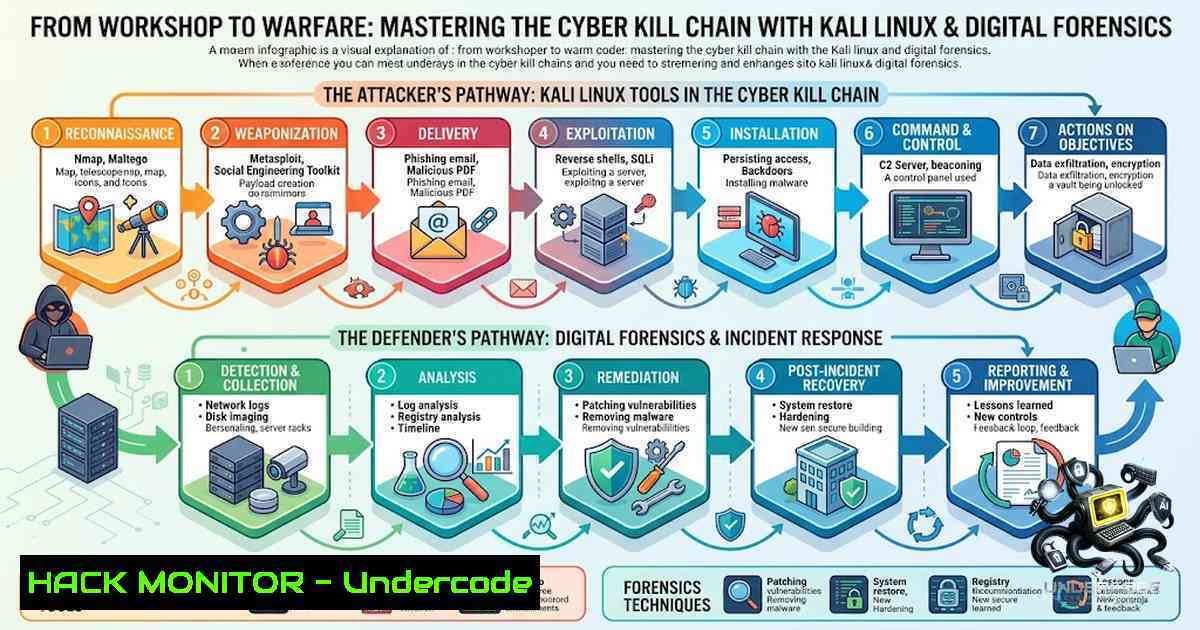
Introduction:
In an era where cyber threats are not just evolving but accelerating at an unprecedented pace—with AI-powered phishing now representing over 80% of global social engineering activity—understanding the foundational pillars of cybersecurity has never been more critical. The recent Cybersecurity Workshop conducted by Dr. Sara Shuttari at MRCET illuminated the interconnected nature of hacking, vulnerabilities, data breaches, and the CIA Triad, while providing students a glimpse into the powerful world of Kali Linux and digital forensics. This article expands on those core concepts, offering a technical deep-dive into the tools, commands, and methodologies that security professionals use daily to defend, investigate, and penetrate modern IT infrastructures.
Learning Objectives:
- Understand the CIA Triad as the foundational security model and its practical implementation through access controls, encryption, and redundancy.
- Master essential Kali Linux commands and tools for reconnaissance, scanning, exploitation, and post-exploitation.
- Apply the five-stage digital forensics process—from identification to reporting—using both Linux and Windows command-line utilities.
- Recognize emerging AI-driven threats and implement defensive measures against ransomware, phishing, and DDoS attacks.
You Should Know:
- The CIA Triad: The Bedrock of Information Security
The CIA Triad—Confidentiality, Integrity, and Availability—forms the cornerstone of information security, guiding how organizations protect their systems and data. Confidentiality ensures that information is accessible only to those authorized to access it, typically enforced through encryption (AES-GCM), access control lists (ACLs), and multi-factor authentication. Integrity guarantees that data is accurate, complete, and untampered—both in storage and in transit—achieved via digital signatures, cryptographic hashing (SHA-256), and write-protected logs. Availability ensures that systems and data are accessible to authorized users when needed, supported by load balancing, rate limiting, and redundancy.
Practical Implementation:
- Linux (Verify File Integrity): `sha256sum /path/to/file` – generates a cryptographic hash to detect tampering.
- Windows (Check File Hash): `Get-FileHash -Algorithm SHA256 C:\path\to\file` (PowerShell).
- Linux (Set File Permissions – Secure): `chmod 644 file` (owner read/write, others read-only) and `chmod 755 directory` (owner full, others read+execute). Avoid the dangerous `chmod 777` in production environments.
2. Kali Linux: The Penetration Tester’s Arsenal
Kali Linux is the industry-standard platform for penetration testing, equipped with over 600 pre-installed tools for every phase of the ethical hacking lifecycle. The workshop’s introduction to Kali Linux highlighted its role in footprinting, vulnerability assessment, and exploitation. Below is a curated command reference organized by the penetration testing methodology.
System & Network Basics (Kali Linux):
| Command | Function | Example |
||-||
| `sudo apt update && sudo apt upgrade -y` | Update system and tools | `sudo apt install nmap -y` |
| `ifconfig` or `ip addr` | View network interfaces | `ip addr` |
| `ping -c 4
| `nmap -sV -p-
| `netstat -tulpn` | List open ports and listening services | `netstat -tulpn` |
Reconnaissance & Footprinting:
Footprinting is the systematic process of blueprinting a target’s network, systems, and exposure surface. This passive and active information gathering phase is critical—experts suggest that 90% of a successful penetration test is achieved through footprinting and reconnaissance.
- DNS Enumeration: `dnsrecon -d target.com` or
dig target.com ANY. - Web Reconnaissance: `whatweb target.com` – identifies web technologies.
- OSINT Gathering: Use `theHarvester -d target.com -b google` to collect emails and subdomains.
Vulnerability Scanning & Exploitation:
- Web Application Scanning: `nikto -h http://
` or owasp-zap -quickurl http://target.com -quickout results.html. - SQL Injection Testing:
sqlmap -u "http://target.com/page?id=1" --dbs. - Exploitation Framework: Launch Metasploit with
msfconsole. Start PostgreSQL and Metasploit services:service postgresql start && service metasploit start. - Password Brute Force:
hydra -l admin -P /usr/share/wordlists/rockyou.txt ssh://<target-IP>.
Wireless & Post-Exploitation:
- Wireless Recon: `airmon-1g start wlan0` followed by
airodump-1g wlan0mon. - Post-Exploitation Shell Handler: `penelope` – a shell handler for post-exploitation.
⚠️ Critical Warning: All Kali Linux commands should be executed only on systems you own or have explicit written authorization to test. Unauthorized scanning is illegal in most jurisdictions.
3. Digital Forensics: The Five-Stage Investigative Process
Digital forensics is the scientific process of collecting, preserving, analyzing, and presenting digital evidence to support legal proceedings or security investigations. The workshop emphasized the full lifecycle: from identification and preservation to analysis, documentation, and presentation. The universally recognized digital forensics process comprises five basic stages:
- Identification – Recognize an incident from indicators and determine its type. Identify potential sources of relevant evidence (servers, workstations, mobile devices, network logs).
- Preservation – Isolate, secure, and preserve the state of physical and digital evidence. This includes capturing visual images of the scene and documenting all relevant information.
- Collection/Acquisition – Collect digital information using forensically sound methods. Create bit-for-bit disk images using write-blocking devices.
- Analysis – Conduct an in-depth systematic search of evidence. Reconstruct fragments of data and draw conclusions.
- Reporting – Summarize findings using proven techniques and methodology. Reports must be reproducible by other competent forensic examiners.
Forensic Commands & Tools:
- Linux Disk Imaging:
dd if=/dev/sda of=/mnt/evidence/disk.img bs=4K status=progress. - Linux Memory Dump: Access via `/proc/kcore` or use the LiME kernel module.
- Network Traffic Capture: `tcpdump -i eth0 -w capture.pcap -s 0 -C 100` (captures full packets, splits at 100MB).
- Windows Forensic Artifacts: Use `wevtutil qe System /c:50 /rd:true /f:text` to query the last 50 System event logs in reverse chronological order.
- File Recovery: `photorec /dev/sda` – recovers deleted files by scanning unallocated space.
- Timeline Analysis: Use `Timesketch` to visualize file system timestamps and identify anomalous sequences.
Chain of Custody: Every action must be documented contemporaneously—notes should be detailed enough for another examiner to reproduce the work from the notes alone. Cryptographic hashing (SHA-256) ensures evidence integrity throughout the investigation.
- Defending Against Modern Threats: Ransomware, Phishing, DDoS, and AI-Driven Attacks
The threat landscape has shifted dramatically. Ransomware remains the most financially impactful threat, while phishing and vulnerability exploitation account for over 80% of initial access routes. DDoS attacks dominated reported incidents, accounting for 77% of all incidents in 2025. Most concerning, AI-supported phishing campaigns reportedly represented more than 80% of observed social engineering activity worldwide by early 2025.
DDoS Mitigation (Linux – iptables/nftables):
 Enable SYN cookies to protect against SYN flood attacks
sysctl -w net.ipv4.tcp_syncookies=1
sysctl -w net.ipv4.tcp_max_syn_backlog=65536

Drop invalid connection states
iptables -A INPUT -m conntrack --ctstate INVALID -j DROP

Rate-limit ICMP echo requests (ping floods)
iptables -A INPUT -p icmp --icmp-type echo-request -m limit --limit 1/second -j ACCEPT
iptables -A INPUT -p icmp --icmp-type echo-request -j DROP
Phishing & Social Engineering Defense:
- Implement DMARC, DKIM, and SPF email authentication records.
- Deploy email filtering with AI-powered threat detection.
- Conduct regular security awareness training—human error remains the primary vector.
- Use Windows Defender (PowerShell):
Set-MpPreference -EnableNetworkProtection AuditMode.
Ransomware Prevention:
- Maintain offline, versioned backups (3-2-1 backup strategy).
- Restrict privileged access using the principle of least privilege.
- Deploy Endpoint Detection and Response (EDR) solutions.
- On Windows, audit local user groups: `net user` and
lusrmgr.msc. Check active connections:netstat -ano.
5. AI in Cybersecurity: The Double-Edged Sword
Artificial intelligence is reshaping both offense and defense. Attackers now use generative AI to create hyper-personalized phishing emails, deepfake audio and video for social engineering, and automated vulnerability discovery. Conversely, defenders leverage AI for threat detection, automated incident response, and predictive analytics.
Defensive AI Capabilities:
- AI-assisted command generation: Tools like `shell-gpt` assist security professionals with command suggestions.
- Automated vulnerability scanning: Nuclei offers fast, customizable scanning based on YAML templates.
- Behavioral analysis: Machine learning models detect anomalies in network traffic and user behavior.
Recommendation: Organizations should invest in AI-driven security operations centers (SOCs) while simultaneously preparing for AI-enhanced adversarial tactics. The cybersecurity workforce must develop skills in both traditional security practices and AI/ML fundamentals.
What Undercode Say:
- Key Takeaway 1: The CIA Triad remains the universal foundation of information security—Confidentiality, Integrity, and Availability are not just theoretical concepts but practical principles implemented through encryption, hashing, access controls, and redundancy. Every security control can be mapped to one of these three pillars.
-
Key Takeaway 2: Kali Linux is an indispensable platform for security professionals, but with great power comes great responsibility. Mastery of its 600+ tools requires systematic learning—starting with reconnaissance (Nmap, DNSRecon), progressing through vulnerability assessment (Nikto, sqlmap, OWASP ZAP), and advancing to exploitation (Metasploit) and post-exploitation. All testing must be conducted with explicit authorization.
-
Key Takeaway 3: Digital forensics is a rigorous scientific discipline, not ad-hoc investigation. The five-stage process—Identification, Preservation, Collection, Analysis, and Reporting—must be followed meticulously to ensure evidence admissibility in court. Chain of custody, cryptographic hashing, and contemporaneous note-taking are non-1egotiable requirements.
-
Key Takeaway 4: The threat landscape is evolving faster than ever. AI-powered phishing now dominates social engineering, ransomware continues to cause financial devastation, and DDoS attacks are increasingly sophisticated. Defenders must adopt layered security strategies—combining technical controls (firewalls, rate limiting, EDR) with human-centric defenses (awareness training, incident response planning) and AI-enhanced detection.
Prediction:
-
-1 The democratization of AI-powered attack tools will lower the barrier to entry for cybercriminals, leading to a surge in sophisticated, automated attacks that traditional signature-based defenses cannot detect. Organizations that fail to adopt AI-driven defense mechanisms will face disproportionate risk.
-
+1 Conversely, the same AI advancements will empower defenders with unprecedented capabilities—automated threat hunting, predictive analytics, and real-time incident response will become standard features of next-generation security operations centers, shifting the balance of power back toward defenders.
-
-1 Ransomware-as-a-Service (RaaS) and AI-enhanced social engineering will converge, creating a new class of highly personalized, automated extortion campaigns that bypass traditional email filters and exploit human psychology at scale.
-
+1 The growing emphasis on cybersecurity education—as demonstrated by workshops like the one conducted by Dr. Sara Shuttari at MRCET—will cultivate a new generation of security professionals equipped with both theoretical knowledge and practical skills in Kali Linux, digital forensics, and AI security. This talent pipeline is essential for closing the global cybersecurity skills gap.
-
-1 Regulatory frameworks will struggle to keep pace with AI-driven threats, creating a window of vulnerability where organizations operate in legal and operational gray areas. Compliance-based security will prove insufficient against adaptive, AI-powered adversaries.
-
+1 The integration of AI into security training platforms (e.g., AI-assisted command generation, simulated attack environments) will accelerate skill development, enabling professionals to master complex tools like Metasploit, Nmap, and forensic suites more rapidly than traditional learning methods allow.
-
-1 Critical infrastructure—energy grids, healthcare systems, financial networks—will become prime targets for AI-enhanced attacks, as adversaries leverage automation to identify and exploit vulnerabilities at machine speed. The cost of inaction will be measured in both financial losses and human lives.
-
+1 Collaborative threat intelligence sharing, powered by AI and blockchain for integrity verification, will enable real-time, global defense coordination—transforming cybersecurity from a reactive discipline into a proactive, predictive science.
▶️ Related Video (78% Match):
https://www.youtube.com/watch?v=19hw_CHO0X8
🎯Let’s Practice For Free:
🎓 Live Courses & Certifications:
Join Undercode Academy for Verified Certifications
🚀 Request a Custom Project:
Secure, high-velocity infrastructure and disruptive technological engineering. Contact our engineering team for high-tier development and proprietary systems:
[email protected]
💎 Smart Architecture | 🛡️ Secure by Design | ⭐ Trusted by Thousands
IT/Security Reporter URL:
Reported By: https://lnkd.in/p/eswiCRw5 – Hackers Feeds
Extra Hub: Undercode MoN
Basic Verification: Pass ✅


