Listen to this Post
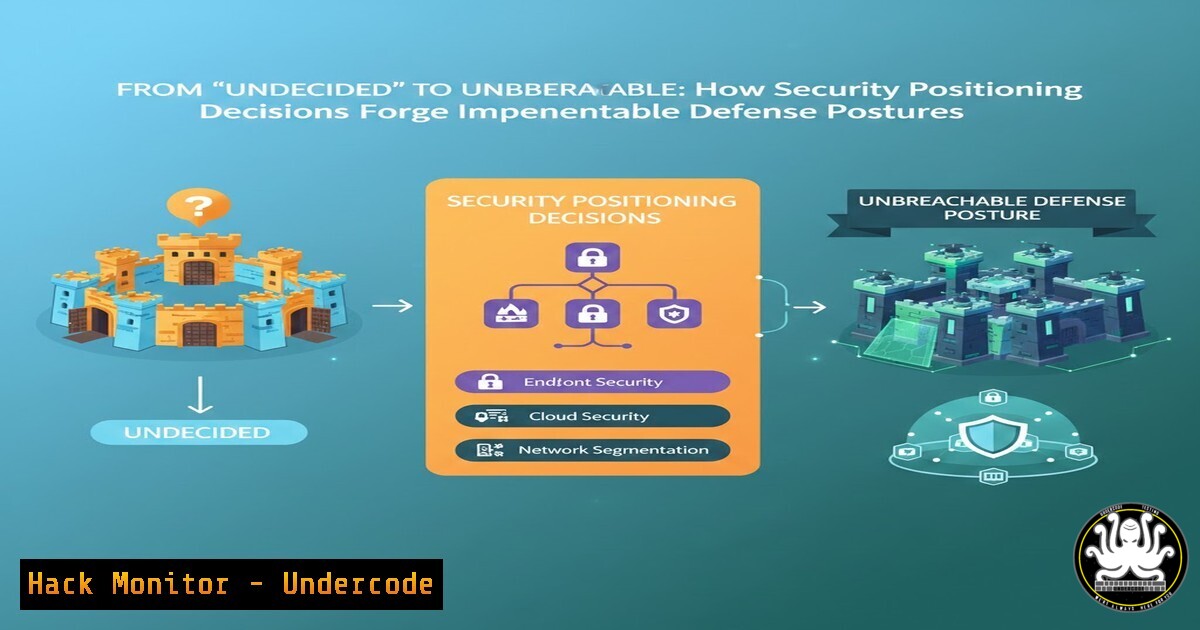
Introduction:
In cybersecurity, indecision is not merely a strategic gap—it is the vulnerability most frequently exploited. Just as tech founders dilute their brand by refusing to make core positioning choices, security leaders cripple their defense by failing to define, specialize, and enforce clear security postures. This article translates the critical business decisions of “what to be known for,” “who to disappoint,” and “where to say no” into actionable frameworks for building a decisive, memorable, and resilient security program that withstands both technical and boardroom pressure.
Learning Objectives:
- Translate abstract positioning concepts into concrete security architecture and policy decisions.
- Implement technical controls that enforce your chosen security specialization and “no” zones.
- Develop communication strategies to justify security trade-offs to stakeholders and manage disappointment.
You Should Know:
- Defining Your Security Legacy: The One Problem You Own
A team claiming expertise in “cloud, network, endpoint, and AI security” is often master of none. True power lies in being the automatic answer to a specific, critical problem. Your “legacy” should be a technical capability so refined it becomes your identity.
Step‑by‑step guide:
- Audit & Acknowledge: Analyze your last five major incidents or penetration test reports. Identify the common root cause (e.g., misconfigurations, insufficient IAM hygiene, slow patch cycles).
- Declare Your Specialty: Formally decide your core battleground. Example: “We are the team that guarantees identity is never the breach vector.”
- Implement Specialty Tooling & Baselines: Enforce this decision with configuration.
For an “Identity-First” Posture (Linux/Windows):
 Linux: Audit sudoers and SSH authorized_keys with strict ownership
 Find world-writable authorized_keys files
find /home /root -name authorized_keys -type f ( -perm -g+w -o -perm -o+w ) -ls
 Enforce sudoers syntax check and secure path
visudo -c && echo "Defaults secure_path=\"/usr/local/sbin:/usr/local/bin:/usr/sbin:/usr/bin:/sbin:/bin\"" >> /etc/sudoers.d/secure
 Windows: Audit for Kerberoastable accounts and enforce LAPS
 Requires PowerShell ActiveDirectory Module
Get-ADUser -Filter {ServicePrincipalName -ne "$null"} -Properties ServicePrincipalName, LastLogonDate | Where-Object {$_.LastLogonDate -lt (Get-Date).AddDays(-30)}
 Verify LAPS is operational
Get-ADComputer -Identity $ComputerName -Properties ms-Mcs-AdmPwd, ms-Mcs-AdmPwdExpirationTime
For a “Config-Hardening” Posture: Automate benchmarks with CIS-CAT or deploy infrastructure-as-code scanning in CI/CD pipelines.
- Strategic Disappointment: Architecting Your “No” Through Technical Policy
You cannot secure everything equally. “Who you are okay to disappoint” translates to which risks you consciously accept and which user demands you technically deny. This is enacted through granular, unforgiving policies.
Step‑by‑step guide:
- Create a “Deny-by-Default” Matrix: Document accepted risks for low-impact systems vs. zero-tolerance policies for crown jewels.
- Enforce with Technical Guards: Use policy-as-code to automate disappointment.
Cloud Example (AWS SCP to “disappoint” lax requests):{ "Version": "2012-10-17", "Statement": [ { "Sid": "DenyNonCompliantEC2", "Effect": "Deny", "Action": "ec2:RunInstances", "Resource": "", "Condition": { "BoolIfExists": {"ec2:InstancePublicIp": "true"} } }, { "Sid": "DenyDisablingSecurityTools", "Effect": "Deny", "Action": [ "guardduty:DeleteDetector", "securityhub:DisableSecurityHub", "config:DeleteConfigRule" ], "Resource": "" } ] } - Communicate Proactively: Document these technical denies in an internal “Security Position” wiki, explaining the risk they mitigate.
-
The Fortified “No”: Scripting Resistance to Pressure-Driven Deals
When a lucrative business deal requires disabling security controls, your pre-defined technical “no” must be unyielding. Automate compliance checks that fail decisively and transparently.
Step‑by‑step guide:
- Integrate Security Gates into Procurement/SDLC: Mandate that any new vendor integration or product feature pass automated security tests.
- Build Irreversible Checks: Create scripts that evaluate requests against policy and provide a clear, technical “FAIL” outcome.
Example Pre-Commit Hook for a Risky API Integration:!/bin/bash pre-commit hook: scan for hardcoded secrets and non-compliant API endpoints SECRETS_FOUND=$(grep -r "api[_-]?key[[:space:]]=" --include=".py" --include=".js" .) if [[ ! -z "$SECRETS_FOUND" ]]; then echo "COMMIT REJECTED: Hardcoded secrets detected." echo "$SECRETS_FOUND" exit 1 fi Check for HTTP (non-HTTPS) endpoint calls HTTP_CALLS=$(grep -r "http://" --include=".py" --include=".js" . | grep -v "http://localhost") if [[ ! -z "$HTTP_CALLS" ]]; then echo "COMMIT REJECTED: Non-secure HTTP calls detected." exit 1 fi
-
Blame the Code: Use the output of these automated checks as the reason for denial. “The deployment pipeline failed at the security gate due to non-compliant configuration. Here is the log.”
-
From Undecided to Unified: Building a Coherent Security Message
Indecision leads to fragmented tools and mixed signals. Your chosen position must unify your toolchain, documentation, and internal messaging.
Step‑by‑step guide:
- Tool Consolidation: Audit your security stack. Do you have five different agents performing overlapping functions? Rationalize to tools that directly support your declared specialty.
- Create Unified Runbooks: Ensure every incident response (IR) playbook starts with checks aligned to your core posture (e.g., “Step 1: Verify IAM roles and keys for the compromised asset”).
- Train Relentlessly: Conduct tabletop exercises where the scenario directly challenges your core position, reinforcing the “right” response muscle memory.
5. Continuous Validation: Proving Your Position is Correct
A position is not a static declaration. It must be continuously validated through offensive testing that specifically attempts to break your proclaimed strength.
Step‑by‑step guide:
- Scope Red Teams & Pen Tests: Mandate that 40% of every penetration test focuses on your specialty area. If you’re “identity-first,” testers must prioritize credential theft, lateral movement via Kerberos, and privilege escalation.
- Measure and Report on Specialty KPIs: Track and broadcast metrics unique to your position.
Identity-First KPI: “Mean Time to Revoke (MTTR) compromised credentials.”
Patch-First KPI: “Percentage of critical systems patched within SLA.” - Review and Adapt Quarterly: Use data from breaches (internal and industry) to ask: “Does our chosen position still mitigate the most relevant threats?”
What Undercode Say:
- Indecision is a Configurable Vulnerability. The failure to make explicit strategic choices in security architecture creates implicit, exploitable weaknesses that are far more dangerous than a known technical flaw. Clarity in what you defend and how is your primary control.
- Automated Policy is Your Unwavering Ambassador. Human security practitioners will face immense pressure to bend. Code will not. Your security position must be encoded into immutable infrastructure policies, CI/CD gates, and runtime checks that execute your “no” without emotional compromise.
The analysis reveals that high-performing security teams mirror resilient startups: they possess a vivid, narrow focus. They accept that saying “no” to certain features (open S3 buckets, local admin rights) is essential to brilliantly saying “yes” to their core promise (data confidentiality, endpoint integrity). This technical decisiveness, often seen as inflexibility, is what builds profound trust with both the board and the engineering organization. It transforms security from a perceived bottleneck into the clear, reliable foundation upon which risky innovation can safely be built.
Prediction:
Within the next 3-5 years, regulatory frameworks and cyber insurance underwriters will move beyond checklist compliance. They will increasingly assess the clarity and consistency of an organization’s security positioning decisions through automated policy audits. Organizations that cannot demonstrate a coherent, codified, and specialized security posture—evidenced by their toolchain consistency and enforcement automation—will face significantly higher premiums or be deemed uninsurable. The market will financially reward decisive, memorable security postures while penalizing generic, diluted ones, forcing a strategic maturation of the entire industry.
▶️ Related Video (84% Match):
🎯Let’s Practice For Free:
IT/Security Reporter URL:
Reported By: Rajeevmamidanna There – Hackers Feeds
Extra Hub: Undercode MoN
Basic Verification: Pass ✅


