Listen to this Post
Introduction:
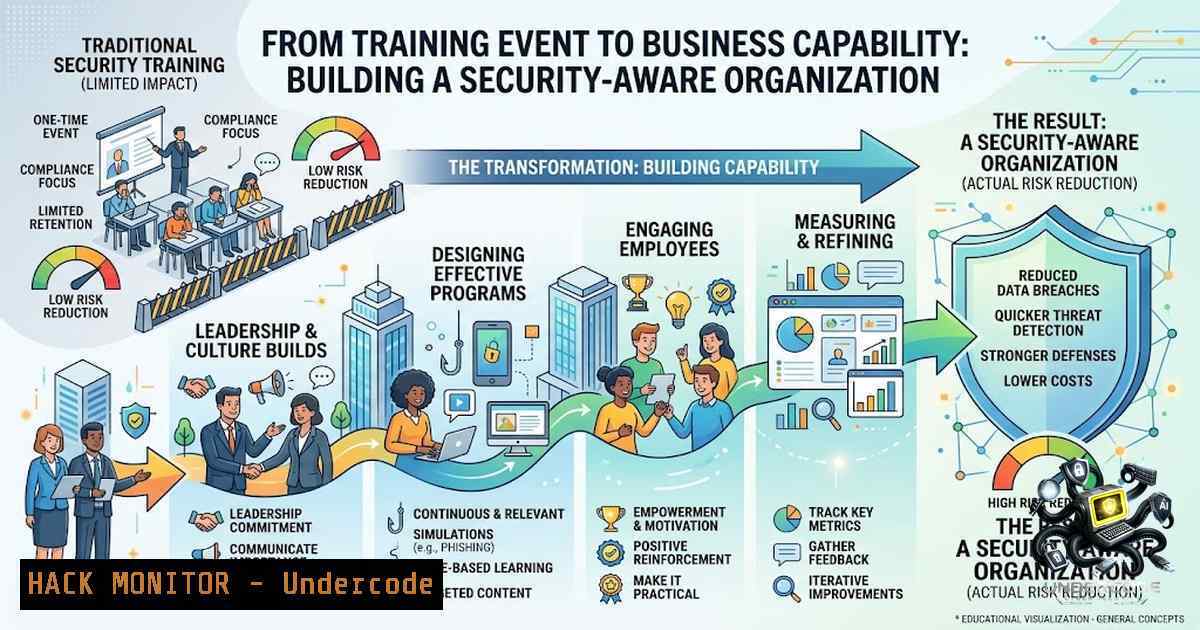
Cybersecurity awareness is fundamentally misunderstood when treated as an annual compliance checkbox or a one-time training event. In reality, it represents an ongoing business capability that transforms organizational risk posture by empowering every employee to recognize, respond to, and report security threats in real time. A mature awareness program shifts the paradigm from viewing employees as the “weakest link” to cultivating a human firewall—where staff at all levels become active contributors to organizational resilience rather than passive targets for social engineering attacks.
Learning Objectives:
- Understand the five core practices that constitute a mature, continuous security awareness program
- Learn how to design and implement role-based security training tailored to executives, developers, administrators, and end users
- Master the technical implementation of phishing simulation campaigns, including setup, measurement, and iteration
- Develop metrics frameworks that move beyond click rates to measure true behavioral change and risk reduction
- Acquire practical Linux and Windows commands for security hardening and monitoring that reinforce awareness training
You Should Know:
- Continuous Awareness Training: Moving Beyond the Annual Event
The cornerstone of any security-aware organization is continuous, contextual training that reflects current threats and business risks. Annual generic training sessions have proven largely ineffective because they fail to address the evolving tactics of adversaries and the specific vulnerabilities of different roles within an organization. Continuous awareness training operates on the principle that security is a habit, not a lecture.
Step-by-Step Guide to Implementing Continuous Awareness Training:
Step 1: Establish a Baseline. Before deploying any training, assess your organization’s current security posture. Conduct an initial phishing simulation to establish a baseline click rate. Run a security culture survey to understand employee attitudes toward reporting and security practices. Document these metrics as your starting point.
Step 2: Develop a Content Calendar. Design a 12-month training curriculum that covers core topics such as phishing识别, password hygiene, social engineering, physical security, and incident reporting. Monthly microlearning sessions (5–10 minutes) are more effective than half-day annual sessions. Align content with current threat intelligence—if ransomware attacks are spiking, prioritize ransomware-specific training.
Step 3: Deploy a Learning Management System (LMS) or Security Awareness Platform. Tools like KnowBe4, Proofpoint, or SoSafe automate training delivery, track completion, and integrate with phishing simulation engines. Configure the platform to deliver training in digestible modules.
Step 4: Integrate Just-in-Time Coaching. When a user fails a phishing simulation or exhibits risky behavior, trigger an immediate micro-learning module that explains exactly what they missed and how to recognize similar threats in the future. This reinforcement approach converts mistakes into learning opportunities rather than punitive events.
Step 5: Measure and Iterate. Track training completion rates, phishing simulation performance, and reporting behavior monthly. Use this data to refine content and targeting.
Linux Commands for Security Awareness Monitoring:
To reinforce awareness training with technical monitoring, security teams can use these Linux commands to audit user activity and system integrity:
 Check recent user logins and failed authentication attempts
last -a | head -20
sudo lastb | head -20

Monitor active network connections for suspicious outbound traffic
sudo netstat -tunap | grep ESTABLISHED

Audit sudo commands executed by users
sudo grep "sudo" /var/log/auth.log | tail -50

Check for unauthorized changes to critical system files
sudo aide --check
Windows PowerShell Commands for Security Monitoring:
 Get recent security event logs (failed logins - Event ID 4625)
Get-EventLog -LogName Security -InstanceId 4625 -1ewest 50

List all running processes with network connections
Get-1etTCPConnection | Where-Object {$_.State -eq "Established"}

Check for recent user account changes
Get-EventLog -LogName Security -InstanceId 4720,4722,4726 -1ewest 30

Audit local group membership (Administrators group)
Get-LocalGroupMember -Group "Administrators"
- Phishing Simulations: Building Muscle Memory Through Real-World Scenarios
Phishing simulations are the practical application of awareness training—they test whether employees can apply what they’ve learned in a safe, controlled environment. Effective simulation programs treat these exercises as teaching tools, not “gotcha” traps.
Step-by-Step Guide to Running Effective Phishing Simulations:
Step 1: Define Objectives and Scope. Determine what you want to measure: click rates, credential submission rates, reporting rates, or time-to-report. Decide which user groups to target and how frequently. High-risk users (executives, finance staff, IT administrators with privileged access) should receive more frequent and sophisticated simulations.
Step 2: Select or Build Simulation Templates. Use templates that mirror real-world threats relevant to your industry. For example, if your organization uses Office 365, simulate credential harvesting campaigns that mimic Microsoft login pages. If you’re in healthcare, simulate business email compromise (BEC) scenarios targeting billing departments.
Step 3: Configure Simulation Platform. Most security awareness platforms include built-in phishing simulation engines. Configure the following:
– Sending frequency: continuous, risk-based cadence rather than rigid quarterly schedules
– Landing pages: safe pages that educate users when they click
– Reporting buttons: enable one-click reporting directly from email clients
Step 4: Launch and Monitor. Send simulations in small batches to avoid overwhelming the help desk. Monitor real-time metrics: opens, clicks, credential entries, and reports.
Step 5: Deliver Immediate Feedback. When a user reports a simulation correctly, provide positive reinforcement. When a user clicks, deliver an immediate training module explaining the indicators they missed.
Step 6: Analyze and Report. After each campaign, generate reports showing:
– Click rate (target: below 5% after 6 months of training)
– Reporting rate (target: above 80% of simulations reported)
– Time-to-report (target: under 5 minutes)
– Repeat clickers (target: zero repeat offenders within 30 days)
Sample Phishing Simulation Configuration (using open-source tools):
For organizations building in-house capabilities, Gophish is an open-source phishing framework:
 Install Gophish on Linux
wget https://github.com/gophish/gophish/releases/latest/download/gophish-v0.12.1-linux-64bit.zip
unzip gophish-v0.12.1-linux-64bit.zip
cd gophish-v0.12.1-linux-64bit

Edit configuration file
sudo nano config.json
 Set admin_server listen URL, phish_server URL, and contact email

Start Gophish server
./gophish

Access web interface at https://127.0.0.1:3333
 Default credentials: admin/gophish (change immediately)
- Promote a Reporting Culture: Psychological Safety as a Security Control
Employees will not report suspicious activity if they fear blame or retaliation. A mature awareness program actively cultivates psychological safety where reporting is celebrated, not penalized. This cultural shift transforms the security team from a policing function to a partner in risk reduction.
Step-by-Step Guide to Building a Reporting Culture:
Step 1: Establish Clear Reporting Channels. Implement a simple, accessible reporting mechanism—a dedicated email address (e.g., [email protected]), a Slack/Teams channel, or a button integrated into email clients. Ensure every employee knows exactly how and where to report.
Step 2: Communicate “Report, Don’t Ignore.” Emphasize that reporting suspicious activity—even false positives—is always the right action. Security teams would rather investigate 100 false positives than miss one genuine threat.
Step 3: Acknowledge and Reward Reports. Publicly recognize employees who report legitimate threats (with their consent). Consider gamification: leaderboards, badges, or small incentives for consistent reporters.
Step 4: Provide Feedback on Reports. Close the loop by informing reporters of the outcome. When an employee reports a real phishing email and the security team blocks it, send a brief update: “Thanks to your report, we blocked this campaign across the organization.”
Step 5: Measure Reporting Metrics. Track reporting rate (percentage of simulations reported), time-to-report, and quality of reports. These metrics indicate the health of your reporting culture.
- Role-Based Education: One Size Does Not Fit All
Generic security training fails because it treats executives, developers, and helpdesk staff as having identical risk profiles. Role-based education delivers targeted guidance that addresses the specific threats and responsibilities of each function.
Step-by-Step Guide to Implementing Role-Based Training:
Step 1: Map Roles to Risk Profiles. Identify which roles handle sensitive data, have privileged access, or are frequent targets of social engineering. Common high-risk roles include:
– Executives: BEC, impersonation, whaling attacks
– Developers: Code injection, API security, credential exposure in repositories
– IT Administrators: Privilege escalation, ransomware, misconfiguration
– Finance: Invoice fraud, payment diversion, vendor impersonation
– HR: W-2 phishing, payroll diversion, personal data exposure
Step 2: Develop Role-Specific Content. Create training modules that use scenarios relevant to each role. For developers, focus on secure coding practices and API security. For finance, emphasize verification procedures for payment requests.
Step 3: Assign Training Based on Role. Use your LMS or awareness platform to assign training paths based on job function. Ensure new hires complete role-specific training during onboarding.
Step 4: Regularly Update Role Content. As threats evolve, update role-specific content. If a new BEC technique targets CFOs, update executive training immediately.
5. Measure Effectiveness Using Meaningful Metrics
Click rates alone do not measure program effectiveness. A comprehensive metrics framework tracks behavioral change, risk reduction, and return on investment.
Key Metrics to Track:
- Phishing Susceptibility: Click rate, credential submission rate, and repeat clicker rate over time
- Reporting Behavior: Reporting rate, time-to-report, and report quality
- Training Engagement: Completion rates, quiz scores, and time spent on training
- Incident Trends: Reduction in actual security incidents attributed to human error
- Behavioral Change: Adoption of secure behaviors such as MFA enrollment and password manager usage
Step-by-Step Guide to Building a Metrics Dashboard:
Step 1: Establish Baseline Metrics. Before launching your program, measure baseline phishing susceptibility, reporting rate, and incident frequency.
Step 2: Define Target Metrics. Set realistic improvement targets (e.g., reduce click rate by 50% within 6 months, increase reporting rate to 80%).
Step 3: Implement Tracking. Use your awareness platform’s analytics features. For custom tracking, export simulation results and incident data to a BI tool like Power BI or Tableau.
Step 4: Report Quarterly. Present metrics to leadership, showing trends and correlating training investments with risk reduction.
Step 5: Iterate Based on Data. If click rates are not improving, adjust training content or frequency. If reporting rates are low, invest in cultural initiatives.
What Undercode Say:
- Key Takeaway 1: Cybersecurity awareness is not a one-time event but an ongoing business capability that requires continuous investment, measurement, and iteration. Organizations that treat awareness as a strategic function rather than a compliance checkbox achieve significantly lower human-risk exposure.
-
Key Takeaway 2: The five practices—continuous training, phishing simulations, reporting culture, role-based education, and metrics-driven iteration—form an interconnected system. Neglecting any one element weakens the entire program. For example, running simulations without providing immediate feedback trains employees to fear rather than learn, while delivering training without measuring impact wastes resources on ineffective content.
Analysis: The post from Cygorithm Technology Group encapsulates a mature, evidence-based approach to security awareness that aligns with industry best practices from organizations like SANS, NIST, and Gartner. The emphasis on role-based training reflects a growing recognition that generic security awareness fails to resonate with employees whose daily work involves vastly different threat surfaces. The focus on metrics beyond click rates—such as reporting behavior and time-to-report—signals a shift from measuring training completion to measuring actual behavioral change and risk reduction. The framing of employees as “active contributors to organizational resilience” rather than “potential targets” is a powerful reframe that supports psychological safety and positive security culture. Organizations that adopt this framework can expect measurable reductions in phishing susceptibility, faster incident detection through employee reporting, and a stronger overall security posture that complements technical controls.
Prediction:
- +1 Organizations that implement continuous, role-based security awareness programs will see a 40–60% reduction in successful phishing attacks within 12–18 months, as measured by click rates and credential submission rates, based on industry benchmarks from Proofpoint and SANS.
-
+1 The integration of AI-powered phishing simulation generators will enable organizations to create highly personalized, context-aware simulations that adapt to individual user behavior patterns, further reducing susceptibility rates and making training more efficient.
-
+1 Regulatory bodies and cyber insurance providers will increasingly mandate continuous security awareness programs with measurable metrics as a condition for coverage and compliance, accelerating adoption of mature awareness frameworks across industries.
-
-1 Organizations that continue to treat security awareness as an annual compliance exercise will face rising premiums, increased breach frequency, and reputational damage as threat actors increasingly exploit human vulnerabilities through sophisticated social engineering and AI-generated phishing campaigns.
-
-1 The growing sophistication of AI-generated phishing emails—which can mimic writing styles, bypass traditional detection, and personalize content at scale—will outpace static training programs, forcing organizations to adopt adaptive, continuous training models or face escalating breach risks.
▶️ Related Video (80% Match):
https://www.youtube.com/watch?v=3m5dKWVoWLU
🎯Let’s Practice For Free:
🎓 Live Courses & Certifications:
Join Undercode Academy for Verified Certifications
🚀 Request a Custom Project:
Secure, high-velocity infrastructure and disruptive technological engineering. Contact our engineering team for high-tier development and proprietary systems:
[email protected]
💎 Smart Architecture | 🛡️ Secure by Design | ⭐ Trusted by Thousands
IT/Security Reporter URL:
Reported By: Cybersecurity Securityawareness – Hackers Feeds
Extra Hub: Undercode MoN
Basic Verification: Pass ✅


