Listen to this Post
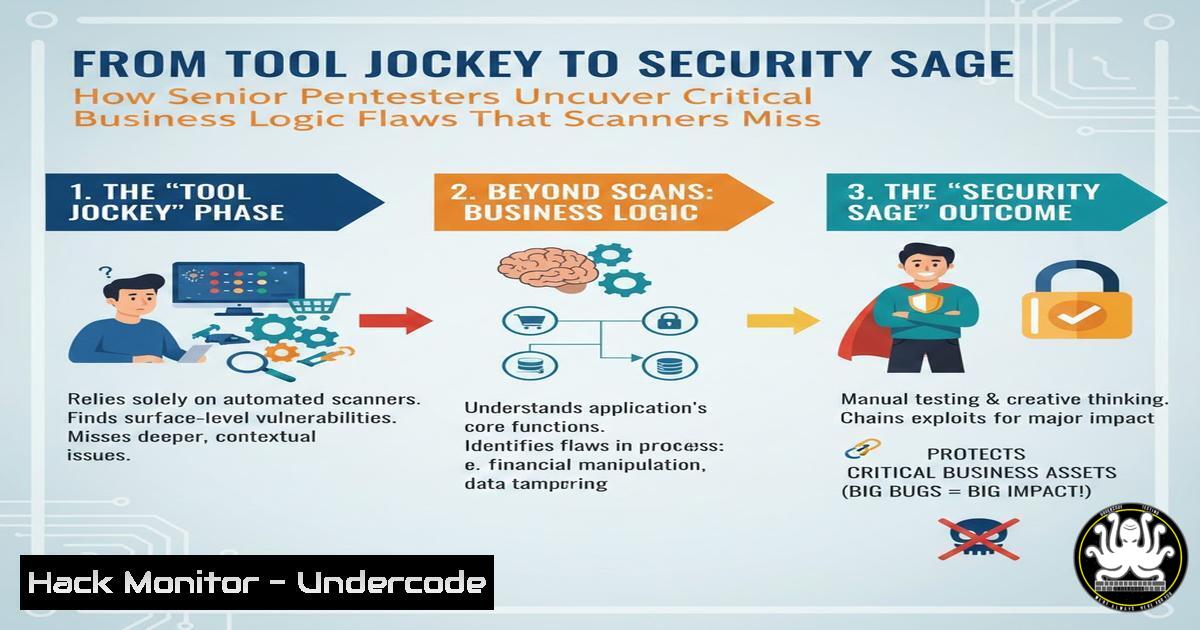
Introduction:
In the evolving landscape of cybersecurity, automated vulnerability scanners are indispensable for breadth, but they consistently fail to grasp the nuanced context of business workflows. True critical vulnerabilities often reside not in outdated software, but in flawed application logic and broken access controls that only a human, thinking like a determined attacker, can uncover. This article deconstructs the mindset and methodology required to move beyond tool-generated reports and execute senior-level security assessments that protect the core of the business.
Learning Objectives:
- Understand the critical limitations of automated scanning tools and when to rely on manual penetration testing techniques.
- Learn practical methodologies for identifying Improper Access Control and Business Logic Vulnerabilities in web applications and APIs.
- Gain hands-on command-line and procedural knowledge for testing, exploiting, and mitigating these high-impact flaws.
You Should Know:
- The Scanner Blind Spot: Why Tools Miss Logic Flaws
Automated tools excel at identifying known signatures—common CVEs, default configurations, and simple injection points. However, they lack the cognitive ability to understand the intended workflow of an application. A tool might verify that a login page is present, but it cannot comprehend that after logging in as a “user,” you can manipulate a parameter to access an “admin” function by changing a `user_id=456` to user_id=1. This requires understanding the application’s role hierarchy, which is a business rule.
Step-by-step guide:
Step 1: Map the Application Manually. Before running any scanner, use your browser and proxy (like Burp Suite or OWASP ZAP) to manually click through every user role’s journey (e.g., Guest → Customer → Vendor → Admin).
Step 2: Identify State-Changing Requests. Focus on POST, PUT, PATCH, and DELETE requests that alter data (e.g., /api/updateProfile, /admin/deleteUser).
Step 3: Analyze Parameters. Look for parameters that reference objects belonging to other users (IDs, emails, account numbers) or that specify roles/privileges.
2. Exploiting Improper Access Control (IDOR & BAC)
Insecure Direct Object References (IDOR) and Broken Access Control (BAC) are classic examples of Improper Access Control. The vulnerability exists when an application fails to verify a user’s authorization to access a specific resource.
Step-by-step guide:
Step 1: Discover Object References. While proxying traffic, note all instances of numeric or UUID identifiers in URLs or request bodies (e.g., GET /api/invoices/20517, POST /users/update {"userId": "892"}).
Step 2: Test for Horizontal Privilege Escalation. Using two authenticated test accounts (User A and User B), try to access User B’s resources by substituting User B’s ID while authenticated as User A.
Linux/cURL Example: `curl -H “Authorization: Bearer
Step 3: Test for Vertical Privilege Escalation. If you have a low-privilege user, look for hidden admin endpoints or parameters. Bruteforce common admin paths.
Windows PowerShell Example: `Get-Content admin_paths.txt | ForEach-Object { Invoke-WebRequest -Uri “https://app.com/$_” -Headers @{“Authorization”=”Bearer
3. Uncovering Business Logic Vulnerabilities
These flaws abuse the intended workflow. Examples include: replaying a “Finalize Purchase” request multiple times, applying multiple coupons, or altering the sequence of steps in a process.
Step-by-step guide:
Step 1: Understand the Business Flow. What is the expensive or irreversible operation? (e.g., fund transfer, ticket booking, status approval).
Step 2: Intercept and Tamper. Use your proxy to intercept the critical transaction request. Can you modify the quantity to a negative number for a refund? Can you change the price after it’s been validated on the client-side?
Step 3: Challenge State Assumptions. If a process has steps 1 > 2 > 3 > Confirm, can you skip to step 3? Can you send the “Confirm” request twice?
4. Hardening APIs Against Logic and Access Flaws
APIs are prime targets for these attacks due to their structured nature.
Step-by-step guide for developers/testers:
Step 1: Implement Proper Authorization. Always check permissions server-side on every request. Use a central middleware.
Example Pseudo-Code: `if (request.user.id != resource.ownerId && !request.user.isAdmin) { return 403; }`
Step 2: Use UUIDs Instead of Sequential IDs. While not a security control, it makes mass enumeration harder.
Step 3: Implement Nonces or Idempotency Keys. For critical transactions, use a unique key to prevent replay attacks.
5. Cloud Logging and Monitoring for Detection
Catching these exploits requires intelligent logging, as they return normal HTTP 200 codes.
Step-by-step guide for Cloud (AWS Example):
Step 1: Enable Detailed Application Logs. Log user IDs, resource IDs, and actions taken for all state-changing operations.
Step 2: Ingest Logs into a SIEM. Use Amazon CloudWatch Logs to Kinesis, then to a security lake or SIEM like Wazuh/Elastic.
Step 3: Create Detection Rules. Build alerts for abnormal patterns.
Example Wazuh/Elastic Rule Logic: `user:A accesses more than 50 distinct resource IDs belonging to other users within 1 minute.`
Example AWS CloudWatch Insights Query: `filter @message like /UPDATE/ | stats count() by userIdentity.arn, requestParameters.resourceId | sort by count() desc`
What Undercode Say:
- Tools are Force Multipliers, Not Replacements. The most critical findings—Improper Access Control and Business Logic flaws—are discovered through manual, context-aware testing. Scanners provide a baseline; the human mind provides the breakthrough.
- Security is a Emulation Exercise. The core competency of a senior pentester is the ability to deconstruct the developer’s intended workflow and then systematically break every assumption within it, asking “What if I do this?” at every step.
Prediction:
The over-reliance on AI-driven automated scanning will initially create a false sense of security, leading to a surge in breaches caused by subtle logic and access control flaws. This will catalyze a market correction, significantly increasing the demand and compensation for manual penetration testers and red teamers who possess deep analytical skills. The industry will shift towards “Adversarial Simulation” as a core service, blending automated discovery with intensive manual analysis to truly measure risk. Secure by Design principles will gain prominence, forcing developers to build authorization and business logic checks from the ground up.
▶️ Related Video (74% Match):
🎯Let’s Practice For Free:
IT/Security Reporter URL:
Reported By: Thamotharanvajramani Two – Hackers Feeds
Extra Hub: Undercode MoN
Basic Verification: Pass ✅


