Listen to this Post
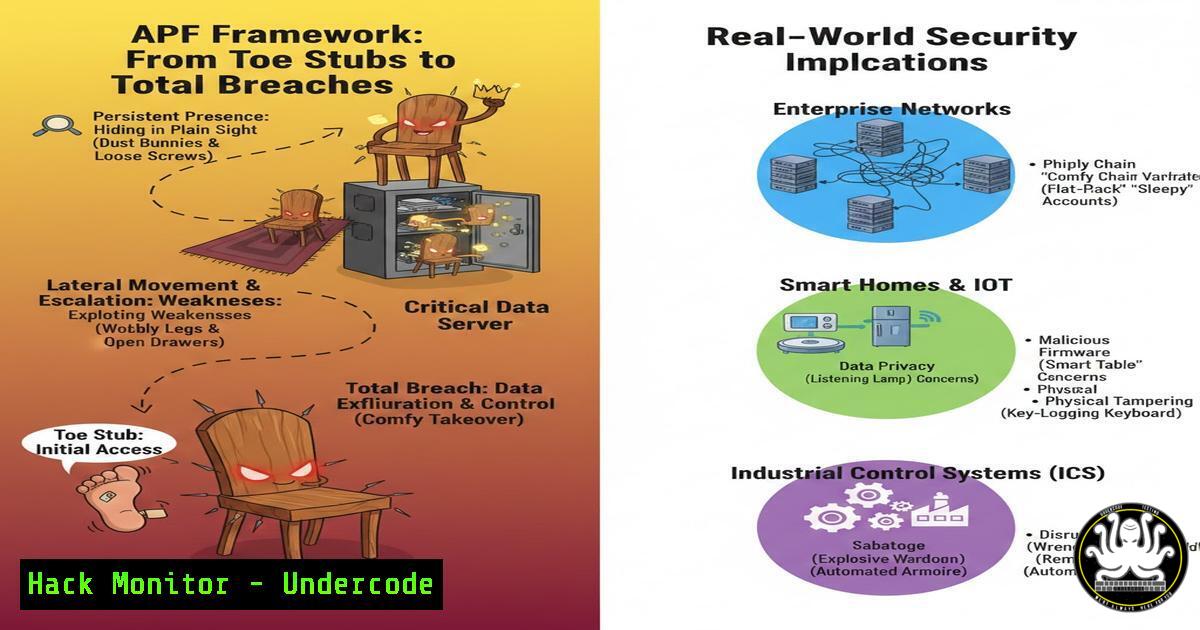
Introduction:
A satirical LinkedIn post comparing a stubbed toe to an advanced persistent threat (APT) attack cycle has gone viral, using humor to underscore fundamental cybersecurity principles. While framed as comedy, the analogy accurately maps the stages of a kinetic incident to a digital cyber kill chain, highlighting universal flaws in security postures, from individual complacency to organizational failure in critical infrastructure. This article extracts the core technical lessons, translating the “Advanced Persistent Furniture” framework into actionable IT and operational technology (OT) security guidance.
Learning Objectives:
- Understand how the cyber kill chain model applies to both physical and digital intrusion attempts.
- Identify and mitigate common reconnaissance and initial access vectors in IT/OT environments.
- Implement practical defense-in-depth and zero-trust controls to disrupt lateral movement and data exfiltration.
You Should Know:
- Phase 1: Reconnaissance – The Art of Studying Your “Dresser”
The post highlights that the dresser had been in place for months, “studying” patterns. In cybersecurity, reconnaissance is the critical first phase where attackers gather intelligence on their target.
Step‑by‑step guide explaining what this does and how to use it:
Reconnaissance can be passive (using publicly available info) or active (probing the target). Adversaries map network ranges, identify software versions, and harvest employee data from social media (like LinkedIn).
Open-Source Intelligence (OSINT) Self-Audit (Linux):
 Use theHarvester to find emails, subdomains, and hosts associated with your domain
theharvester -d yourcompany.com -b all -l 500 -f report.html
 Use nmap for a basic, non-intrusive scan of your own external IP range to see what's visible
nmap -sS -Pn --open -T4 -v your_public_ip_range/24 -oG external_scan.gnmap
Mitigation: Regularly conduct these scans on your own assets to see what an attacker sees. Limit publicly available information through strict social media policies and ensure network perimeter devices do not leak internal information in banners.
- Phase 2: Initial Compromise – The “Barefoot” Attack Surface
The “barefoot = Windows XP with no patches” analogy perfectly describes an unhardened, vulnerable endpoint. Initial compromise exploits this weak security posture.
Step‑by‑step guide explaining what this does and how to use it:
Attackers use phishing, exploit public-facing applications, or leverage stolen credentials to gain a foothold.
Windows Command to Check for Critical Patches:
 PowerShell command to list all installed HotFixes (patches)
Get-HotFix | Sort-Object -Property InstalledOn -Descending | Select-Object -First 20
Mitigation: Implement a rigorous patch management policy. Use Endpoint Detection and Response (EDR) tools. Harden systems by disabling unnecessary services and enforcing the principle of least privilege. In OT/SCADA, this may involve air-gapping critical systems or using unidirectional gateways.
- Phase 3: Lateral Movement – Pivoting Through the “Nervous System”
Pain traveling up the leg mirrors an attacker moving from a compromised workstation to servers and domain controllers within a network.
Step‑by‑step guide explaining what this does and how to use it:
Attackers use tools like Mimikatz to harvest credentials and techniques like Pass-the-Hash to authenticate to other systems.
Detecting Lateral Movement with Network Monitoring (Linux):
 Use tcpdump to look for SMB or RDP traffic between internal hosts (indicative of lateral movement)
sudo tcpdump -i eth0 'port 445 or port 3389' -n -c 100 -w lateral_movement.pcap
Mitigation: Implement network segmentation (micro-segmentation for critical assets). Use strong, unique passwords and multi-factor authentication (MFA) to make credential theft less useful. Monitor for anomalous internal traffic patterns.
- Phase 4: Data Exfiltration – The “Screaming” SIEM Alert
The involuntary scream represents data leaking into an uncontrolled environment, akin to unmonitored data transfers to an external IP.
Step‑by‑step guide explaining what this does and how to use it:
Exfiltration often occurs over encrypted channels (HTTPS, DNS tunneling) or via cloud storage APIs to bypass traditional security.
Detecting Data Exfiltration with Data Loss Prevention (DLP) Logic:
 Example Suricata/Snort rule to alert on large outbound HTTP POST requests
alert tcp $INTERNAL_NET any -> $EXTERNAL_NET $HTTP_PORTS (msg:"LARGE POST Potential Exfil"; flow:established,to_server; content:"POST"; http_method; classtype:policy-violation; threshold:type threshold, track by_src, count 5, seconds 60; sid:1000008; rev:1;)
Mitigation: Deploy a DLP solution. Monitor outbound network traffic volume and destination. Encrypt sensitive data at rest and in transit, and use data classification to tag and protect critical assets.
- Implementing “Multiple Footwear Authentication” – A Zero-Trust Model
The joke about MFA (Multiple Footwear Authentication) points to the core of Zero Trust: never trust, always verify, regardless of location within the network.
Step‑by‑step guide explaining what this does and how to use it:
Zero Trust Architecture (ZTA) requires strict identity verification for every person and device trying to access resources.
Implementing Conditional Access (Conceptual):
- Identify: Integrate all users and devices into a central directory (e.g., Azure AD, Okta).
2. Verify: Enforce MFA for all access attempts.
- Authorize: Use policies that grant least-privilege access based on user, device health, location, and application sensitivity. (e.g., “Block access from non-compliant devices”).
- Assume Breach: Log and inspect all traffic, including east-west (internal) traffic, for anomalies.
What Undercode Say:
- The Analogy is the Assessment: The humorous post is essentially a threat model for a human body. Applying the same rigorous, phase-by-phase analysis to your IT/OT systems is the foundation of effective cybersecurity.
- Complacency is the Universal Vulnerability: Whether it’s forgetting to turn on a nightlight or delaying a critical patch, the root cause of most breaches is a failure to maintain basic security hygiene and a proactive mindset.
The post’s brilliance lies in using absurdity to expose the routine failures that lead to catastrophic breaches. While we are not defending against sentient furniture, we are defending against automated bots and skilled attackers who exploit the exact same gaps in reconnaissance, vulnerability management, and internal trust. The transition from a purely perimeter-based defense (“the bedroom door is locked”) to a zero-trust, defense-in-depth model (“require verification to approach the dresser, even in the dark”) is the non-negotiable evolution for modern security.
Prediction:
The “APF” meme will catalyze a wave of security awareness training that uses relatable, physical-world analogies to explain complex cyber threats, making them more accessible to non-technical stakeholders and board members. This approach will drive increased investment in foundational cyber hygiene—patch management, MFA, and segmentation—as organizations realize that preventing the “stubbed toe” equivalent in their networks is far more cost-effective than responding to a full-scale “kinetic” breach. The future of security advocacy lies in bridging the gap between technical abstraction and human experience.
🎯Let’s Practice For Free:
IT/Security Reporter URL:
Reported By: Larisa M – Hackers Feeds
Extra Hub: Undercode MoN
Basic Verification: Pass ✅


