Listen to this Post
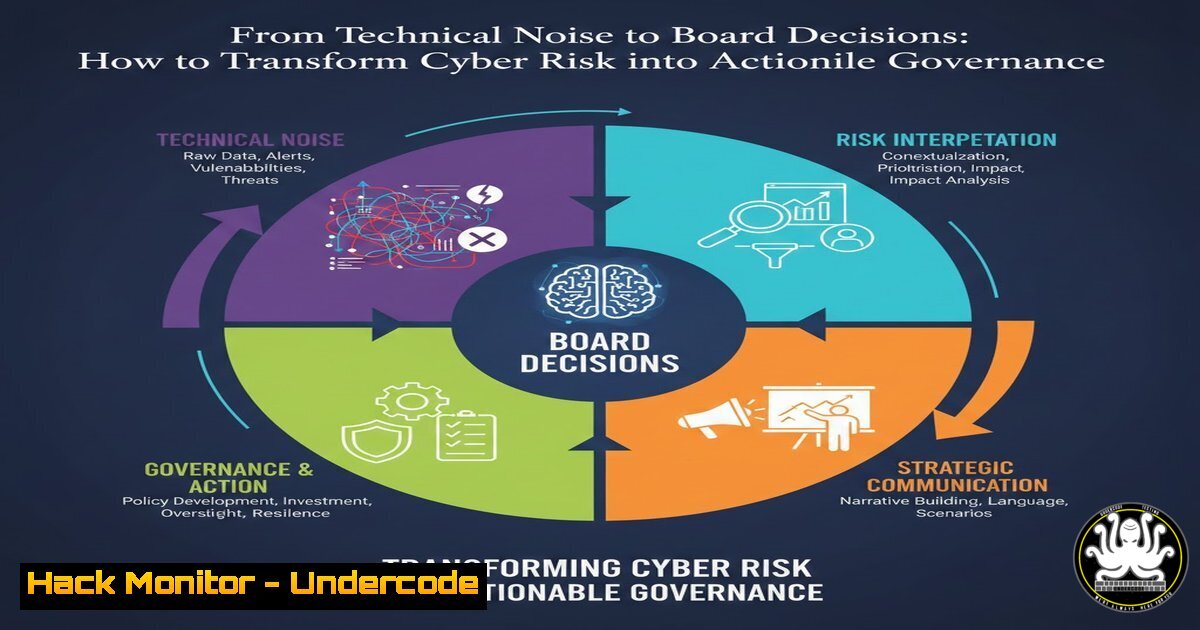
Introduction:
The pervasive disconnect between cybersecurity teams and corporate boards stems from a critical misalignment: technical jargon versus strategic decision-making. Frameworks like ISO 27001 and regulations like NIS2 are not merely checklists but blueprints for bridging this gap, forcing organizations to translate vulnerabilities and threats into clear business risks, defined ownership, and deliberate executive choices. This shift is essential for moving from reactive technical fixes to proactive business resilience.
Learning Objectives:
- Understand how to reframe cyber risk reports from technical updates into decision-ready options for leadership.
- Learn to establish clear risk ownership and escalation thresholds aligned with frameworks like ISO 27001.
- Develop the tools to create a governance model where the board actively manages cyber risk trade-offs.
You Should Know:
- From Threat Briefings to Decision Briefings: Reframing the Conversation
The core failure is presenting “cyber” as a separate, technical domain. Boards are adept at weighing risks, costs, and opportunities—but only when presented in that language. A report detailing ten critical vulnerabilities is noise; a briefing presenting two mitigation strategies with associated costs, residual risk levels, and recommended ownership is a decision.
Step‑by‑step guide explaining what this does and how to use it.
Step 1: Identify a Top Risk. Instead of a list of vulnerabilities, start with a business impact scenario (e.g., “Ransomware-induced operational shutdown of our primary manufacturing line”).
Step 2: Define Choices. Present 2-3 strategic options. Option A: Invest $200K in enhanced segmentation & immutable backups (residual risk: LOW). Option B: Accept current controls (residual risk: HIGH, with estimated potential loss of $2M per day of downtime).
Step 3: Assign Ownership. Clearly state: “This is a decision for the Board/CEO/COO because it involves capital expenditure and strategic risk tolerance.” Use a RACI chart (Responsible, Accountable, Consulted, Informed) to formalize this.
Step 4: Document the Decision. The outcome—whether to invest or accept—must be minuted in the board meeting notes, creating an auditable trail of risk acceptance.
- Operationalizing Risk Ownership with ISO 27001 Annex A
ISO 27001’s Annex A controls provide the perfect mechanism to assign clear accountability beyond the IT department. The standard mandates that for every control, roles and responsibilities are defined and assigned.
Step‑by‑step guide explaining what this does and how to use it.
Step 1: Map Controls to Business Owners. Don’t assign all controls to the CISO. A.9.1.2 (Access to networks and services) involves IT, but A.7.1.1 (Screening of personnel) is owned by HR. A.13.2.1 (Information transfer policies) may be owned by Legal or Compliance.
Step 2: Create Control Ownership Matrices. Develop a simple spreadsheet or use GRC tooling:
Control ID: A.8.1.1 (Inventory of Assets)
Owner: Head of Department (e.g., Head of Marketing for marketing assets)
Responsible Party: IT Asset Manager
Accountable Executive: CFO
Step 3: Integrate into Performance Reviews. Include the fulfillment of these information security responsibilities in the annual goals and performance evaluations of the identified business owners.
3. Building Technical Escalation Thresholds into Governance
NIS2 explicitly requires incident reporting within strict timelines. Boards must define what constitutes a “reportable event” not just legally, but for their governance. This requires translating technical indicators into business-impact thresholds.
Step‑by‑step guide explaining what this does and how to use it.
Step 1: Define Technical Triggers. Work with technical teams to define metrics that signal a potential governance-level incident. Examples:
Detection of a ransomware strain on more than 5% of workstations.
Unauthorized access attempt to a crown jewel server holding customer PII.
A cloud misconfiguration exposing a database to the public internet.
Step 2: Map to Business Impact. For each trigger, pre-define the potential business impact (Financial, Operational, Reputational, Legal).
Step 3: Create an Escalation Workflow. Implement automated alerts that notify not just the SOC, but also the CISO and legal counsel when a threshold is breached. Use tools like SIEMs (Security Information and Event Management) to automate this.
Example SIEM Rule Logic (Pseudocode): `IF (Malware.Detection AND Asset.Tag == “Critical”) > 5 THEN Alert.Severity = “Critical” AND Auto-Assign-To = “CISO_On-Call” AND Send-Email-To = “Legal_Team_Distribution_List”`
Windows Command for Critical Asset Monitoring (PowerShell): `Get-WinEvent -LogName Security -FilterXPath “[System[EventID=4625]]” -MaxEvents 10 | Where-Object {$_.Properties[bash].Value -eq “Administrator”} | Select-Object TimeCreated, Message` This checks for failed logon attempts to the Administrator account.
4. Implementing Continuous Control Monitoring for Board Assurance
Boards need assurance that the governance framework is functioning. Continuous control monitoring (CCM) provides real-time or near-real-time insight, moving from annual audits to ongoing assurance.
Step‑by‑step guide explaining what this does and how to use it.
Step 1: Select Key Control Indicators (KCIs). Choose a subset of critical controls from your ISMS (e.g., A.12.4.1 – Event Logging). Define a measurable KCI: “98% of critical systems have logging enabled and forwarding to the central SIEM.”
Step 2: Automate KCI Collection. Use configuration management and auditing tools to collect data.
Linux Command to Verify Auditd is Running: `sudo systemctl status auditd` and to check rules: `sudo auditctl -l`
Windows Command via PowerShell to Check Log Settings: `Get-ItemProperty -Path “HKLM:\SOFTWARE\Policies\Microsoft\Windows\EventLog\Security” -Name “Retention” | Select-Object Retention`
Step 3: Create a Board Dashboard. Feed KCI data into a simplified executive dashboard (using tools like Power BI, Tableau, or a GRC platform). The board should see a red/amber/green status for core governance controls, not server uptime.
5. Conducting a Tabletop Exercise Focused on Decision-Making
Move beyond technical disaster recovery drills. Conduct a board-level tabletop exercise that simulates a major incident and forces strategic choices under pressure.
Step‑by‑step guide explaining what this does and how to use it.
Step 1: Craft a Business-Focused Scenario. Example: “A data extortion group has leaked 10% of our customer database and threatens to release the rest in 48 hours unless a $500K cryptocurrency payment is made. They claim to have also encrypted our backups.”
Step 2: Pose Strategic Questions to the Board. Stop the technical response narrative. Ask the board: “Do we engage with the threat actor? What is our communication strategy with customers and regulators? Do we have pre-authorized crisis spending, and from which budget? Who is the final decision-maker for paying a ransom if we choose to?”
Step 3: Review and Gap Analysis. Post-exercise, document the decision-making process, identify gaps in authority or policy, and update the incident response plan with clear delegation of strategic (not tactical) decision authority.
What Undercode Say:
- Governance Precedes Technology. The most advanced security tools fail without a governance framework that dictates their purpose, ownership, and the business decisions they inform. Compliance mandates are forcing this alignment.
- Clarity is the CISO’s Primary Weapon. A CISO’s value is not in knowing the latest exploit, but in clarifying which risks the business consciously accepts and ensuring the board understands the consequences of that choice.
Prediction:
The convergence of stringent regulations (NIS2, DORA, SEC rules) and escalating breach costs will catalyze a fundamental shift. Cybersecurity expertise will become a non-negotiable prerequisite for board membership, particularly for audit and risk committees. We will see the rise of the “Board-Level Security Orchestration” role, tasked solely with translating technical risk landscapes into continuous streams of executable choices for the C-suite. Organizations that master this translation will not just be more secure; they will wield cyber risk governance as a competitive advantage, building unparalleled trust with clients and investors. The era of technical cybersecurity is giving way to the era of cyber business governance.
▶️ Related Video (80% Match):
🎯Let’s Practice For Free:
IT/Security Reporter URL:
Reported By: Darius Jasiulionis – Hackers Feeds
Extra Hub: Undercode MoN
Basic Verification: Pass ✅


