Listen to this Post
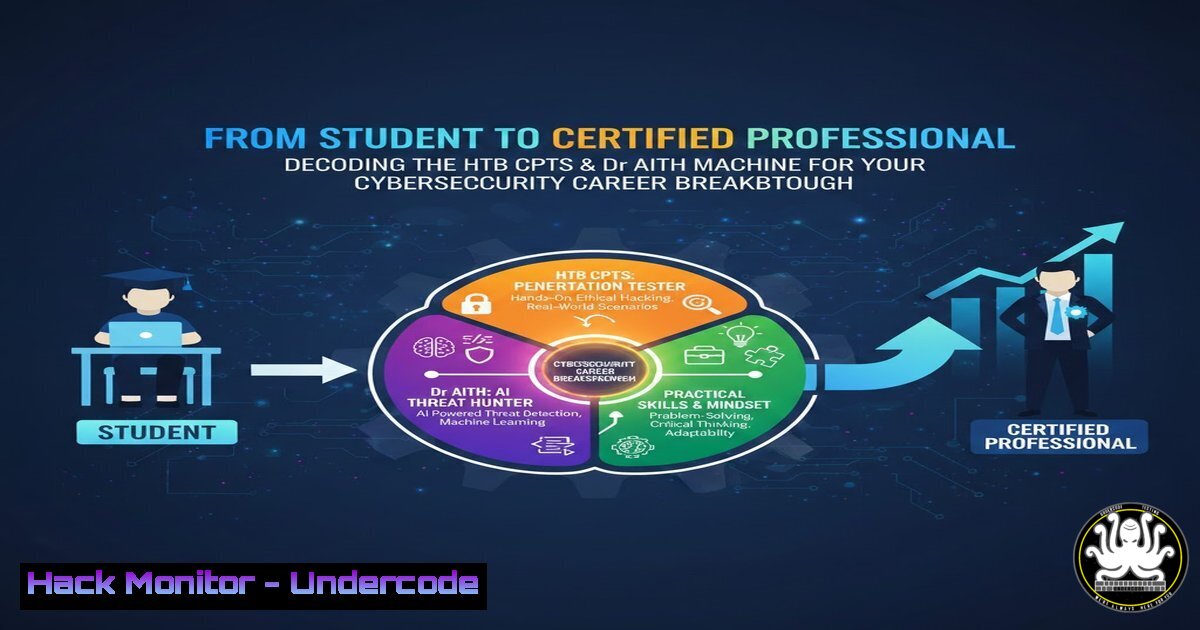
Introduction:
The journey from cybersecurity student to certified professional is a demanding path that requires practical, hands-on experience with real-world offensive security techniques. Platforms like HackTheBox (HTB) and certifications like the Certified Penetration Testing Specialist (CPTS) have become industry benchmarks, offering structured, scenario-based training. The recent completion of the “Dr. AITH” machine, as highlighted by a Duoc UC student, underscores the critical blend of theoretical knowledge and applied skill-building needed to succeed in modern penetration testing roles, where AI and complex systems are common targets.
Learning Objectives:
- Understand the core competencies tested by the HTB CPTS certification path and machines like “Dr. AITH.”
- Learn key offensive security methodologies for network reconnaissance, vulnerability exploitation, and post-exploitation.
- Acquire practical command-line skills for both Linux and Windows environments relevant to advanced penetration testing scenarios.
You Should Know:
- The HTB CPTS Blueprint: Beyond Basic Penetration Testing
The HTB CPTS certification validates a professional-level, comprehensive penetration testing skill set. It moves far beyond automated tool runs, emphasizing manual exploitation, thorough reconnaissance, and nuanced attack chains. The “Dr. AITH” machine is a quintessential example, likely involving a multi-stage attack path that tests a candidate’s ability to chain vulnerabilities.
Step‑by‑step guide explaining what this does and how to use it.
A methodological approach is non-negotiable. Before touching an exploit, information gathering is paramount.
1. Reconnaissance & Enumeration: Use `nmap` for port discovery and service enumeration. Advanced scripts can reveal subtle details.
 Comprehensive TCP SYN scan with service/version detection
sudo nmap -sS -sV -sC -O -p- <TARGET_IP> -oA initial_scan
 UDP scan for critical services like SNMP
sudo nmap -sU --top-ports=50 <TARGET_IP> -oA udp_scan
2. Web Application Analysis: For HTTP/HTTPS services, manual inspection coupled with directory brute-forcing is key.
 Directory/file enumeration with Gobuster
gobuster dir -u http://<TARGET_IP> -w /usr/share/wordlists/dirbuster/directory-list-2.3-medium.txt
 Subdomain enumeration for virtual hosts
gobuster vhost -u https://<TARGET_DOMAIN> -w /usr/share/wordlists/seclists/Discovery/DNS/subdomains-top1million-5000.txt
- Exploiting Modern Application Stacks: AI Services & APIs
Machines like “Dr. AITH” often involve exploiting modern components, such as poorly secured AI model endpoints, REST APIs, or containerized services. API security testing is a core CPTS skill, focusing on authentication flaws, insecure direct object references (IDOR), and excessive data exposure.
Step‑by‑step guide explaining what this does and how to use it.
1. API Endpoint Discovery: Use tools like `katana` or `feroxbuster` to crawl applications and identify API routes (/api/v1/, /graphql, etc.).
2. Analyze & Attack: Intercept requests with `Burp Suite` or OWASP ZAP. Test for common vulnerabilities:
Broken Object Level Authorization (BOLA): Manipulate object IDs in requests.
 Change the 'id' parameter to access another user's data
GET /api/v1/user/orders?id=123 HTTP/1.1
Host: target.com
Authorization: Bearer <your_token>
Server-Side Request Forgery (SSRF): If the API fetches external resources, test for SSRF to access internal networks.
POST /api/v1/fetch_url HTTP/1.1
Host: target.com
Content-Type: application/json

{"url": "http://169.254.169.254/latest/meta-data/"}
3. Privilege Escalation: The Linux to Windows Pivot
Initial access is only the beginning. The CPTS exam rigorously tests privilege escalation on both Linux and Windows. You must be fluent in enumerating misconfigurations and exploiting them.
Step‑by‑step guide explaining what this does and how to use it.
Linux Privilege Escalation:
- Automated Enumeration: Run scripts like `linpeas.sh` to identify potential vectors.
2. Manual Checks: Always verify:
 SUID binaries
find / -perm -4000 -type f 2>/dev/null
 Sudo rights for current user
sudo -l
 Cron jobs
crontab -l; ls -la /etc/cron
 Writable system files or directories
find / -writable 2>/dev/null | grep -v "/proc"
Windows Privilege Escalation:
- Initial Enumeration: Use `winpeas.exe` or manual commands in PowerShell.
System information
systeminfo
Network information
ipconfig /all
Current user privileges
whoami /priv
Installed applications and patches
wmic product get name,version
Get-Hotfix
- Exploitation: Common vectors include unquoted service paths, vulnerable drivers, or misconfigured permissions (e.g.,
SeImpersonatePrivilege) exploitable with tools like `PrintSpoofer` orJuicyPotatoNG.
4. Active Directory Compromise & Lateral Movement
For Windows-centric machines, attacking Active Directory (AD) is a critical skill. This involves understanding protocols like Kerberos, LDAP, and SMB for lateral movement and domain dominance.
Step‑by‑step guide explaining what this does and how to use it.
1. Enumeration from a Compromised Host: Use `PowerView` or the newer `ActiveDirectory` PowerShell module.
 Discover domain information
Get-ADDomain
 Find all domain users
Get-ADUser -Filter
 Find potentially sensitive groups
Get-ADGroupMember "Domain Admins"
2. Credential Theft & Attacks: Dump hashes from memory using `Mimikatz` or `Rubeus` and perform attacks like AS-REP Roasting or Kerberoasting.
 Using Rubeus for Kerberoasting (from a Windows host)
Rubeus.exe kerberoast /outfile:hashes.txt
 Crack the captured hash with Hashcat
hashcat -m 13100 hashes.txt /usr/share/wordlists/rockyou.txt
5. Cloud & Container Security Post-Exploitation
Modern environments often include cloud or container components. Post-initial access, you must check for cloud metadata services, IAM roles, or misconfigured Kubernetes pods.
Step‑by‑step guide explaining what this does and how to use it.
1. Cloud Instance Metadata Query: A common pivot to cloud compromise.
 Attempt to access AWS, Azure, or GCP metadata
curl http://169.254.169.254/latest/meta-data/
curl -H "Metadata: true" "http://169.254.169.254/metadata/instance?api-version=2021-02-01"
2. Container Escape Checks: If on a container, attempt to break out.
 Check for privileged mode or Docker socket
cat /proc/self/cgroup | grep -i docker
ls -la /var/run/docker.sock
 Check kernel version for exploits
uname -a
What Undercode Say:
- Certifications Are Proven Pathways: Successfully tackling HTB machines like “Dr. AITH” is a strong, verifiable indicator of practical skill, often valued more than theoretical exams by hiring managers in offensive security.
- The Methodology is the Master Key: The specific exploit is transient, but the underlying methodology—recon, enumeration, exploitation, pivoting, and persistence—is permanent. Mastering this process is the true goal of certifications like the CPTS.
The post reflects a significant trend: the professionalization of cybersecurity through performance-based credentials. It’s not just about solving a puzzle; it’s about demonstrating a replicable, disciplined attack process that mirrors real-world engagements. This shift forces educational institutions and training programs to heavily integrate practical, lab-driven curricula, closing the gap between academic knowledge and the technical demands of the job market.
Prediction:
The convergence of AI, cloud, and complex hybrid networks will make integrated attack chains, like those simulated in advanced HTB machines, the standard for red team operations. Future certifications and training will increasingly focus on attacking AI pipelines (data poisoning, model theft), automating exploit chains with scripting, and navigating multi-cloud environments. The “professional hacker” will evolve into a specialist who can not only exploit software vulnerabilities but also manipulate complex, interconnected systems and the business logic that governs them, making continuous, hands-on practice on platforms like HTB non-optional for career advancement.
▶️ Related Video (72% Match):
🎯Let’s Practice For Free:
IT/Security Reporter URL:
Reported By: Cybrod Htb – Hackers Feeds
Extra Hub: Undercode MoN
Basic Verification: Pass ✅


