Listen to this Post
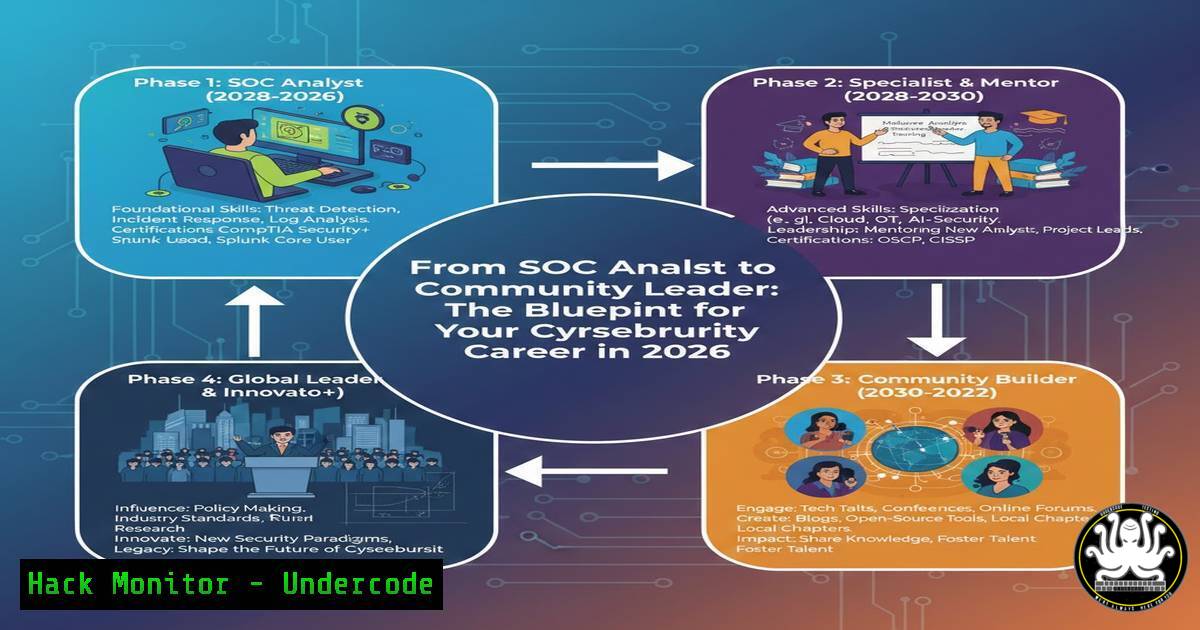
Introduction:
The cybersecurity landscape is no longer just about technical prowess; it’s a multidimensional field where community building, continuous education, and strategic career management are critical for success. As exemplified by a SOC analyst’s journey of balancing a full-time role, education, and founding a thriving community, the modern security professional must architect a holistic growth plan. This article deconstructs that blueprint, providing actionable steps for technical skill acquisition, community engagement, and personal branding to future-proof your career.
Learning Objectives:
- Develop a structured learning path incorporating key certifications and hands-on lab environments.
- Implement strategies for building and contributing to cybersecurity communities to enhance knowledge and network.
- Master the operational commands and tooling essential for a SOC analyst’s daily workflow.
You Should Know:
- Building Your Foundational Skill Set: Certifications and Home Labs
The journey begins with a solid technical foundation. A blend of vendor-neutral and role-specific certifications, coupled with a personal home lab, is non-negotiable. Certifications like CompTIA Security+, Blue Team Level 1 (BTL1), and EC-Council’s ECIH provide structured learning and validate your knowledge to employers. However, theory must be paired with practice.
Step‑by‑step guide:
A. Certification Path: Start with Security+ for core concepts. Progress to hands-on, practical certifications like BTL1, which focuses on defensive security operations and includes real-world labs.
B. Home Lab Setup: Create a controlled environment to practice.
1. Virtualization: Install VMware Workstation or VirtualBox.
- Security Distro: Deploy a Security Onion virtual machine for network security monitoring (NSM).
- Target VMs: Set up vulnerable machines from platforms like VulnHub or the “Metasploitable” Linux/Windows images.
- Practice: Use your lab to simulate attacks and practice detection. For example, generate suspicious traffic with a simple Python script and observe alerts in Security Onion’s Squert or Kibana interface.
2. The SOC Analyst’s Command-Line Arsenal
Efficiency in a Security Operations Center hinges on command-line fluency for log analysis, process inspection, and initial triage.
Step‑by‑step guide:
A. Linux (for SIEM & Log Analysis):
grep -i "failed password" /var/log/auth.log: Search for failed SSH attempts.journalctl -u ssh --since "today" --no-pager: View SSH service logs for the current day.tail -f /var/log/suricata/fast.log: Follow Suricata IDS alerts in real-time.tcpdump -i eth0 -nn 'port 53' -w dns_capture.pcap: Capture DNS traffic for analysis.
B. Windows (for Endpoint Investigation):
Get-WinEvent -FilterHashtable @{LogName='Security'; ID=4625} -MaxEvents 10 | Format-List: Pull recent failed logon events.netstat -ano | findstr :443: List processes using HTTPS/443.tasklist /SVC: List all running processes with their associated services.wmic process get caption,commandline,processid: List processes with full command-line arguments for deep inspection.
- Contributing to and Building Your Community (SOC4M Model)
Community engagement accelerates learning through knowledge sharing and provides networking opportunities. The SOC4M model shows this can be done alongside a full-time role.
Step‑by‑step guide:
A. Consume & Engage: Join existing communities on LinkedIn, Discord (e.g., The DFIR Report, Blue Team Village), and local meetups. Participate in CTF competitions and share your write-ups.
B. Create & Share: Start small. Document a technical problem you solved in a blog post. Create a short tutorial video on a tool like Wireshark or Sigma rules.
C. Scale & Structure: As your audience grows, formalize your community. Use a free Discord server to host channels for news, help, and resources. Organize monthly “study jam” sessions or invite guest speakers for AMAs (Ask Me Anything).
4. Automating SOC Workflows with Scripting
Automate repetitive tasks to increase investigative efficiency. Start with simple bash and PowerShell scripts.
Step‑by‑step guide:
A. Bash Script for Log Summarization: Create a script (log_summary.sh) to parse auth logs.
!/bin/bash
LOG_FILE="/var/log/auth.log"
echo "=== Failed Login Attempts (Today) ==="
grep "Failed password" $LOG_FILE | wc -l
echo "=== Unique IPs Attempting Logins ==="
grep "Failed password" $LOG_FILE | grep -oE "[0-9]+.[0-9]+.[0-9]+.[0-9]+" | sort -u
Run with: `chmod +x log_summary.sh && ./log_summary.sh`
B. Powerhell for Windows Event Query: Create a script (get_failed_logons.ps1) to export failed logons.
$Events = Get-WinEvent -FilterHashtable @{LogName='Security'; ID=4625} -MaxEvents 50
$Events | Select-Object TimeCreated, @{n='TargetUser';e={$<em>.Properties[bash].Value}}, @{n='SourceIP';e={$</em>.Properties[bash].Value}} | Export-Csv -Path "C:\temp\failed_logons.csv" -NoTypeInformation
Write-Host "Failed logons exported to CSV." -ForegroundColor Green
- Developing a Personal GRC (Governance, Risk, Compliance) Mindset
Understanding GRC frameworks makes you a more well-rounded analyst, helping you comprehend the “why” behind security controls.
Step‑by‑step guide:
A. Familiarize with Standards: Study the core objectives of frameworks like ISO 27001 and the NIST Cybersecurity Framework (CSF). Focus on the “Identify” and “Respond” functions of NIST CSF.
B. Map Alerts to Controls: When analyzing an alert, practice mapping it to a compliance requirement. For example, a brute-force attack alert directly ties to NIST CSF PR.AC-7 (Remote access is managed) and ISO 27001 A.9.4.2 (Secure log-on procedures).
- Leveraging Open Source Intelligence (OSINT) for Threat Context
Enrich security incidents with external threat intelligence to determine severity and scope.
Step‑by‑step guide:
A. IP & Domain Investigation: Use command-line tools and online platforms.
– nslookup suspicious-domain.com: Perform DNS lookup.
– `whois 192.168.1.100` (or use `whois` on a domain): Get registration details.
– Utilize online platforms like AbuseIPDB (curl -s https://api.abuseipdb.com/api/v2/check?ipAddress=<IP>) via API to check IP reputation.
B. Integrate into Triage: Before escalating an alert for an external IP, quickly check its reputation to prioritize. A high-abuse-score IP makes the alert a higher priority.
What Undercode Say:
- The Hybrid Professional is the New Standard: Success in 2026 cybersecurity demands a hybrid model: deep technical skills must be complemented by soft skills in communication, community leadership, and strategic career planning. The individual contributor who also builds collective knowledge becomes indispensable.
- Community is a Force Multiplier: A personal learning community like SOC4M is not just a network; it’s a real-time sensor for industry trends, a support system for problem-solving, and a platform for personal branding that attracts opportunities organically.
Analysis: The post highlights a critical evolution in cybersecurity careers. It’s no longer sufficient to be a passive consumer of training. The most resilient and impactful professionals are those who create ecosystems around their knowledge. This approach turns a career into a portfolio of demonstrable skills (via labs/certs), a visible reputation (via community), and practical experience (via the day job). This triad creates a virtuous cycle where each element feeds the others, making the professional adaptable to the rapid changes in the threat landscape and job market. The underlying message is one of agency: you must architect your own career path.
Prediction:
The trend of community-centric career development will intensify, with platforms emerging to formally credential community contributions and mentorship. Employers will increasingly value demonstrable community engagement and content creation as proxies for leadership, communication skills, and proactive learning. We will see the rise of the “Security Influencer-Analyst,” where threat intelligence sharing and detection engineering insights are disseminated through personal and community brands, potentially rivaling traditional vendor research blogs in speed and relevance. This will also pressure organizations to better support employees’ external professional development activities as a source of innovation and recruitment.
▶️ Related Video (78% Match):
🎯Let’s Practice For Free:
IT/Security Reporter URL:
Reported By: Mohamed Amineel – Hackers Feeds
Extra Hub: Undercode MoN
Basic Verification: Pass ✅


