Listen to this Post
Introduction:
The proliferation of AI-driven autonomous drones across military, commercial, and critical infrastructure domains has created an urgent cybersecurity imperative. As unmanned aerial vehicles (UAVs) evolve from remotely piloted aircraft to intelligent edge-computing platforms, they inherit a sprawling attack surface spanning GPS spoofing, MAVLink command injection, hardware trojans, and AI model manipulation. Cyber2Labs’ AI Drone Hacking & Defense – Train-the-Trainer program addresses this critical skills gap by equipping experienced professionals with the实战 knowledge to secure next-generation aerial systems.
Learning Objectives:
- Master UAV Attack Vector Identification — Understand the complete threat landscape, from RF jamming and deauthentication attacks to AI-specific vulnerabilities like FlyTrap visual adversarial patterns and MAVLink protocol exploits.
-
Execute Hands-On Penetration Testing — Apply industry-standard tools (Aircrack-1g, MAVProxy, pymavlink, HackRF One) in Software-in-the-Loop (SITL) simulated environments to intercept telemetry, inject malicious commands, and compromise drone control links.
-
Design and Implement Defense-in-Depth Countermeasures — Develop layered security architectures incorporating MAVLink 2.0 cryptographic signing, AI-enabled detection systems, and zero-trust authentication frameworks for ground control stations and drone swarms.
You Should Know:
- The Expanding Threat Surface: From Hardware Trojans to AI Adversarial Attacks
Modern drones are complex cyber-physical systems integrating flight controllers, sensors, communication radios, and AI-powered autonomy stacks. Each layer presents unique vulnerabilities. Hardware-level threats like DroneTROJAN demonstrate how malicious modifications to PWM generator modules and gyroscope sensor IP can cause crashes or parametric deviations that degrade drone lifespan. At the software level, the MAVLink telemetry protocol—widely used in ArduPilot and PX4 autopilots—lacks cryptographic authentication by default. CVE-2026-1579 (CVSS 9.8 Critical) allows unauthenticated attackers with network access to send SERIAL_CONTROL messages and obtain interactive shell access, achieving full remote takeover.
Perhaps most concerning are AI-specific physical-world attacks. UC Irvine researchers recently demonstrated FlyTrap, a novel framework exploiting autonomous target-tracking deficiencies. By deploying an ordinary umbrella covered with a specifically designed visual pattern, attackers can deceive neural network tracking systems—the drone interprets the pattern as a person moving farther away and steadily approaches until it can be captured with a net or crashed. This attack successfully compromised three commercial drones (DJI Mini 4 Pro, DJI Neo, and HoverAir X1) without requiring any wireless connectivity.
Practical Exercise: MAVLink Command Injection Simulation
Using the Damn Vulnerable Drone (DVD) platform—a Docker-based SITL simulator replicating ArduPilot/MAVLink architectures—security professionals can safely practice exploitation techniques:
 Launch the DVD environment
docker run -p 5760:5760 -p 14550:14550 -it nicholasaleks/damn-vulnerable-drone

Connect MAVProxy to the simulated drone
mavproxy.py --master tcp:127.0.0.1:5760 --sitl 127.0.0.1:5501

Intercept unencrypted telemetry (MAVLink v1 vulnerability)
 Monitor MAVLink messages in real-time
 Inject a malicious command (example: change flight mode)
--msg "COMMAND_LONG" --param1 4 --command 176  MAV_CMD_DO_SET_MODE
- Wireless Exploitation: Deauthentication, GPS Spoofing, and RF Attacks
Wi-Fi-connected consumer drones remain highly susceptible to deauthentication attacks using the Aircrack-1g suite. Attackers can force disconnection by sending deauth packets, capture the WPA handshake during reconnection, and subsequently compromise the control link. This attack chain requires no specialized hardware beyond a USB Wi-Fi adapter with packet injection capabilities.
GPS spoofing represents another critical vulnerability. Using a HackRF One software-defined radio (SDR) and GPS-SDR-SIM, attackers can generate counterfeit GPS L1 signals (1.57542 GHz) to redirect drone navigation. The attack is executed as follows:
 Generate spoofed GPS signal with custom coordinates
gps-sdr-sim -e brdc3540.14n -l 37.7749,-122.4194,100 -b 8 -o gpssim.bin

Transmit via HackRF One
hackrf_transfer -t gpssim.bin -f 1575420000 -s 2600000 -a 1 -x 0
Recent research on chained attacks against drone-based federated learning systems reveals how adversaries can combine 802.11 deauthentication with credential-based impersonation—forcing legitimate drones offline and seamlessly replacing them with malicious nodes. This has profound implications for mission-critical drone swarms operating in contested environments.
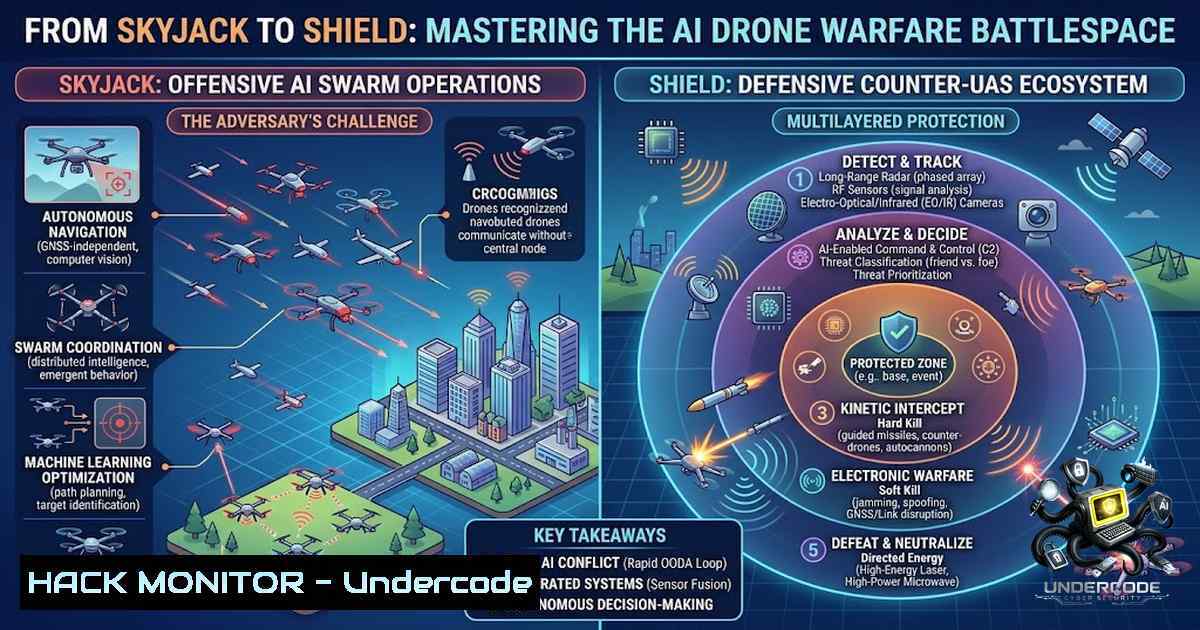
3. Counter-UAS Defense: AI-Enabled Detection and Multi-Layered Protection
The defensive landscape is evolving rapidly with AI-enabled counter-UAS systems. Lockheed Martin’s NetSense™ system leverages existing 5G infrastructure (in partnership with Verizon, NVIDIA, and Keysight) to detect, track, and predict drone flight paths using AI algorithms that interpret RF measurements. This approach requires no new hardware deployment and scales across stadiums, power plants, airports, and other critical infrastructure.
Robel Innovation’s Black Raven system exemplifies frontline-driven counter-UAS design. Developed from operational experience against Hezbollah’s fiber-optic drones, it employs a three-stage process: long-range detection, precision tracking via electro-optical and multi-sensor data fusion, and targeted interception through a modular weapons station. The system’s dual-mode operation (autonomous or manual) provides tactical flexibility essential for rapidly shifting battlefield conditions.
For enterprise and critical infrastructure protection, a defense-in-depth framework combining RF detection, AI behavioral analysis, and kinetic/non-kinetic interdiction options is essential. The FAA’s proposed Unmanned Aircraft Flight Restrictions (UAFRs) over critical infrastructure sites add a regulatory layer, though technical controls remain paramount.
4. Hands-On Training: The Damn Vulnerable Drone Ecosystem
The Damn Vulnerable Drone (DVD) platform provides an invaluable, zero-cost training environment for offensive security professionals. Built on ArduPilot’s Software-in-the-Loop (SITL) with Gazebo 3D physics simulation, DVD replicates authentic drone behaviors and responses without requiring physical hardware. Key attack scenarios include:
- MAVLink telemetry interception and command injection
- GPS spoofing simulation
- Deauthentication and Evil Twin attacks
- Firmware extraction and reverse engineering
- CAN bus injection and fuzzing
The platform is dockerized for rapid deployment and includes comprehensive documentation for each attack vector.
5. Certification Pathways and Professional Development
The Cyber2Labs AI Drone Hacking & Defense – Train-the-Trainer program represents a strategic investment in workforce development. Complementing this, the CISA-recognized Certified Unmanned Aerial Vehicle and Urban Air Mobility Security Specialist (CUASS) credential examines low-altitude operations, Command and Control (C2) links, and security architecture. Academic programs such as Georgia Tech’s cyber-physical systems security course and Green River College’s UAV Cybersecurity Certificate (aligned with CompTIA Security+) provide additional pathways.
What Undercode Say:
- The AI attack surface is expanding faster than defensive capabilities — Physical-world adversarial attacks like FlyTrap demonstrate that cybersecurity can no longer be confined to the digital realm; security professionals must understand computer vision, sensor fusion, and control theory.
-
Protocol-level vulnerabilities remain the low-hanging fruit — CVE-2026-1579 (CVSS 9.8) highlights that fundamental design choices (like default-unauthenticated telemetry) continue to plague even widely deployed systems. Enabling MAVLink 2.0 message signing must become mandatory, not optional.
-
Simulation-based training is non-1egotiable — The cost and regulatory barriers to physical drone hacking make platforms like Damn Vulnerable Drone essential for skill development. Organizations should integrate DVD-based labs into their security training pipelines.
-
Counter-UAS is a multi-domain challenge — Effective defense requires integration of RF sensing, AI analytics, kinetic interceptors, and regulatory frameworks. No single technology solves the problem; layered defense is the only viable approach.
-
The instructor gap threatens scalability — Programs like Cyber2Labs’ Train-the-Trainer model are critical for building the instructional capacity needed to meet surging demand for drone security expertise. Certification alone is insufficient; practical teaching skills matter equally.
Prediction:
+1 The drone security training market will experience compound annual growth exceeding 25% through 2028, driven by regulatory mandates (FAA UAFRs, NATO STANAG standards) and accelerating military adoption of autonomous systems.
+1 AI-enabled counter-UAS systems leveraging 5G/6G ISAC (Integrated Sensing and Communications) will become standard infrastructure at all critical facilities, creating a new category of security-as-a-service offerings.
-1 The proliferation of affordable SDR hardware (HackRF, BladeRF) and open-source exploitation tools will democratize drone hacking capabilities, increasing the frequency of low-sophistication attacks against consumer and commercial drones.
-1 Without widespread adoption of cryptographic authentication (MAVLink 2.0 signing, PKI-based C2 links), critical vulnerabilities like CVE-2026-1579 will continue to be discovered and exploited in production systems, potentially enabling catastrophic failures in safety-critical applications.
+1 The convergence of drone security with automotive cybersecurity (CAN bus, ECU firmware, ISO/SAE 21434) will create cross-domain expertise opportunities, with practitioners able to transfer skills between aerial and ground vehicle platforms.
▶️ Related Video (88% Match):
🎯Let’s Practice For Free:
🎓 Live Courses & Certifications:
Join Undercode Academy for Verified Certifications
🚀 Request a Custom Project:
Secure, high-velocity infrastructure and disruptive technological engineering. Contact our engineering team for high-tier development and proprietary systems:
[email protected]
💎 Smart Architecture | 🛡️ Secure by Design | ⭐ Trusted by Thousands
IT/Security Reporter URL:
Reported By: https://lnkd.in/p/eK45v6M8 – Hackers Feeds
Extra Hub: Undercode MoN
Basic Verification: Pass ✅


