Listen to this Post
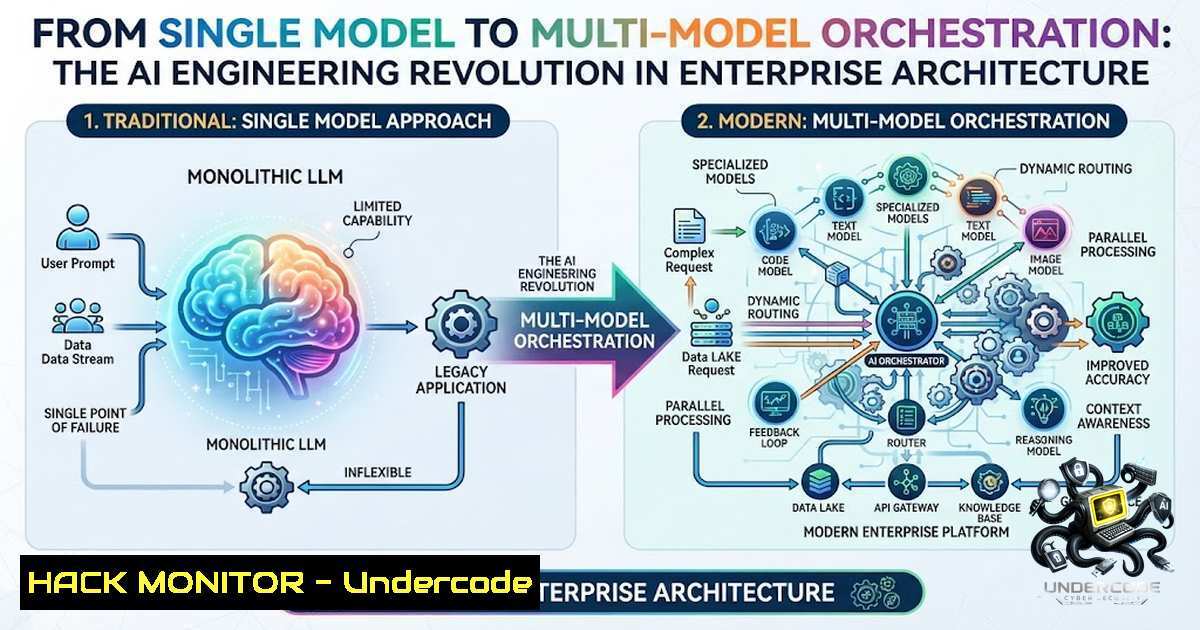
Introduction:
The artificial intelligence landscape has reached an inflection point where relying on a single large language model for every task is no longer a viable production strategy. As organizations scale AI from experimental prototypes to mission-critical systems, architects are discovering that the most robust solutions emerge from orchestrating multiple specialized models working in concert【0†L1-L3】. This paradigm shift—from monolithic AI to multi-model architectures—represents not just a technical evolution but a fundamental rethinking of how we build intelligent systems that are accurate, scalable, and production-ready【0†L3-L6】.
Learning Objectives:
- Understand the ten primary multi-model AI architectures and their appropriate use cases in production environments
- Master implementation techniques for RAG-based systems, multi-agent collaboration, and Mixture of Experts routing
- Acquire practical command-line and coding skills for deploying, monitoring, and securing multi-model AI systems across cloud and edge infrastructure
- Pipeline Architecture: Sequential Model Chaining for Complex Workflows
Pipeline architectures represent the most intuitive entry point into multi-model systems, where models work sequentially and the output of one becomes the input for the next【0†L8-L9】. This approach excels in document processing pipelines—for instance, an OCR model extracts text from images, a language model performs entity recognition, and a summarization model produces the final output.
Step-by-Step Implementation Guide:
Linux/MacOS – Building a Document Processing Pipeline with Python:
 Create a virtual environment and install dependencies
python3 -m venv multi_model_pipeline
source multi_model_pipeline/bin/activate
pip install transformers torch pillow pytesseract langchain openai pandas
Python Pipeline Implementation:
import pytesseract
from PIL import Image
from transformers import pipeline
from langchain.chains import LLMChain
from langchain.llms import OpenAI

Stage 1: OCR extraction
def extract_text_from_image(image_path):
image = Image.open(image_path)
return pytesseract.image_to_string(image)

Stage 2: Entity recognition
ner_pipeline = pipeline("ner", model="dbmdz/bert-large-cased-finetuned-conll03-english")

Stage 3: Summarization
summarizer = pipeline("summarization", model="facebook/bart-large-cnn")

def process_document_pipeline(image_path):
raw_text = extract_text_from_image(image_path)
entities = ner_pipeline(raw_text)
summary = summarizer(raw_text, max_length=150, min_length=30)[bash]['summary_text']
return {"raw_text": raw_text, "entities": entities, "summary": summary}
Windows PowerShell – Equivalent Setup:
 Create virtual environment
python -m venv multi_model_pipeline
.\multi_model_pipeline\Scripts\activate
pip install transformers torch pillow pytesseract langchain openai pandas
Security Consideration: When chaining models, each stage becomes a potential attack surface. Implement input validation at each pipeline stage and use API keys stored in environment variables rather than hardcoded credentials.
2. Ensemble Models: Combining Predictions for Superior Accuracy
Ensemble methods combine outputs from multiple models solving the same task to improve accuracy and reduce variance【0†L10-L11】. This approach is particularly valuable in classification tasks, fraud detection, and sentiment analysis where no single model achieves acceptable performance.
Implementation Strategy – Voting and Weighted Ensembles:
from transformers import AutoTokenizer, AutoModelForSequenceClassification
import torch
import numpy as np
from scipy.special import softmax

Load three different sentiment analysis models
models = [
"cardiffnlp/twitter-roberta-base-sentiment-latest",
"distilbert-base-uncased-finetuned-sst-2-english",
"nlptown/bert-base-multilingual-uncased-sentiment"
]

class EnsembleSentimentClassifier:
def <strong>init</strong>(self, model_names):
self.models = []
self.tokenizers = []
for name in model_names:
tokenizer = AutoTokenizer.from_pretrained(name)
model = AutoModelForSequenceClassification.from_pretrained(name)
self.tokenizers.append(tokenizer)
self.models.append(model)

def predict(self, text):
predictions = []
for tokenizer, model in zip(self.tokenizers, self.models):
inputs = tokenizer(text, return_tensors="pt", truncation=True, max_length=512)
with torch.no_grad():
outputs = model(inputs)
probs = softmax(outputs.logits.numpy(), axis=1)
predictions.append(probs)

Weighted average ensemble (higher weight for more accurate models)
weights = [0.4, 0.3, 0.3]  Adjust based on validation performance
ensemble_pred = np.average(np.array(predictions), axis=0, weights=weights)
return np.argmax(ensemble_pred, axis=1)[bash]
Validation Command – Testing Ensemble Performance:
 Run validation script to compare ensemble vs individual models
python -c "from ensemble import EnsembleSentimentClassifier; \
classifier = EnsembleSentimentClassifier([...]); \
 Add test harness with sklearn metrics"
- Mixture of Experts (MoE): Intelligent Routing for Efficiency
Mixture of Experts architectures use a routing mechanism that activates only the most suitable expert models for each request, dramatically improving efficiency and performance at scale【0†L16-L18】. This is the architectural pattern behind many of today’s most powerful models, including Google’s Switch Transformer and Mixtral.
Understanding the Routing Mechanism:
The core innovation in MoE is the gating network (router) that learns to direct each input to the most appropriate expert. Here’s a simplified implementation:
import torch
import torch.nn as nn
import torch.nn.functional as F

class MoELayer(nn.Module):
def <strong>init</strong>(self, num_experts=8, expert_dim=512, input_dim=768, top_k=2):
super().<strong>init</strong>()
self.num_experts = num_experts
self.top_k = top_k
 Gating network (router)
self.gate = nn.Linear(input_dim, num_experts)
 Expert networks
self.experts = nn.ModuleList([
nn.Sequential(
nn.Linear(input_dim, expert_dim),
nn.ReLU(),
nn.Linear(expert_dim, input_dim)
) for _ in range(num_experts)
])

def forward(self, x):
 Router computes gate scores
gate_scores = self.gate(x)  [batch, num_experts]
gate_probs = F.softmax(gate_scores, dim=-1)

Select top-k experts
top_k_probs, top_k_indices = torch.topk(gate_probs, self.top_k, dim=-1)
top_k_probs = top_k_probs / top_k_probs.sum(dim=-1, keepdim=True)

Route input to selected experts
output = torch.zeros_like(x)
for i in range(self.top_k):
expert_idx = top_k_indices[:, i]
expert_weight = top_k_probs[:, i].unsqueeze(-1)
for batch_idx, exp_idx in enumerate(expert_idx):
expert_output = self.experts<a href="x[bash].unsqueeze(0)">exp_idx</a>
output[bash] += expert_weight[bash]  expert_output.squeeze(0)
return output
Load Balancing Consideration: Without proper load balancing, MoE systems suffer from “expert collapse” where only a few experts are ever used. Implement an auxiliary loss function that encourages equal usage across experts.
4. RAG-Based Architectures: Grounding LLMs in Real-World Data
Retrieval-Augmented Generation combines LLMs with embedding models, vector databases, rerankers, OCR, and search to generate accurate, grounded responses【0†L20-L22】. This architecture has become the gold standard for enterprise AI applications that require factual accuracy and up-to-date information.
Complete RAG Pipeline Implementation:
Step 1: Set up Vector Database (ChromaDB with FAISS backend)
pip install chromadb faiss-cpu sentence-transformers langchain
Step 2: Document Ingestion and Indexing
from langchain.document_loaders import DirectoryLoader, TextLoader
from langchain.text_splitter import RecursiveCharacterTextSplitter
from langchain.embeddings import HuggingFaceEmbeddings
from langchain.vectorstores import Chroma
import os

Load documents
loader = DirectoryLoader('./documents/', glob="/.txt", loader_cls=TextLoader)
documents = loader.load()

Split into chunks
text_splitter = RecursiveCharacterTextSplitter(
chunk_size=1000,
chunk_overlap=200,
length_function=len,
)
chunks = text_splitter.split_documents(documents)

Create embeddings and vector store
embeddings = HuggingFaceEmbeddings(model_name="sentence-transformers/all-MiniLM-L6-v2")
vectorstore = Chroma.from_documents(
documents=chunks,
embedding=embeddings,
persist_directory="./chroma_db"
)
vectorstore.persist()
Step 3: RAG Query Pipeline with Reranking
from langchain.retrievers import ContextualCompressionRetriever
from langchain.retrievers.document_compressors import CrossEncoderReranker
from langchain.llms import OpenAI
from langchain.chains import RetrievalQA

Setup retriever with reranking
base_retriever = vectorstore.as_retriever(search_kwargs={"k": 10})
reranker = CrossEncoderReranker(model_name="cross-encoder/ms-marco-MiniLM-L-6-v2")
compression_retriever = ContextualCompressionRetriever(
base_compressor=reranker,
base_retriever=base_retriever
)

Create RAG chain
llm = OpenAI(temperature=0)
qa_chain = RetrievalQA.from_chain_type(
llm=llm,
chain_type="stuff",
retriever=compression_retriever,
return_source_documents=True
)

Query
result = qa_chain({"query": "What are the key findings from our latest research?"})
print(result['result'])
print(f"Sources: {[doc.metadata for doc in result['source_documents']]}")
Monitoring RAG Performance:
 Track retrieval latency and accuracy
python -c "from rag_metrics import track_rag_performance; track_rag_performance()"
- Multi-Agent Systems: Collaborative AI for Complex Problem Solving
Multi-agent systems deploy specialized AI agents that collaborate, each responsible for distinct tasks like planning, retrieval, reasoning, coding, or validation【0†L14-L15】. This architecture mirrors human team dynamics and is particularly effective for complex, multi-step problems.
Building a Multi-Agent System with AutoGen:
pip install pyautogen
Agent Definition and Orchestration:
import autogen
from autogen import AssistantAgent, UserProxyAgent, GroupChat, GroupChatManager

Define specialized agents
planner = AssistantAgent(
name="Planner",
system_message="You are a project planner. Break down complex tasks into manageable steps.",
llm_config={"config_list": [{"model": "gpt-4", "api_key": os.getenv("OPENAI_API_KEY")}]}
)

coder = AssistantAgent(
name="Coder",
system_message="You are a senior software engineer. Write clean, efficient code with documentation.",
llm_config={"config_list": [{"model": "gpt-4", "api_key": os.getenv("OPENAI_API_KEY")}]}
)

reviewer = AssistantAgent(
name="Reviewer",
system_message="You are a code reviewer. Analyze code for bugs, security issues, and best practices.",
llm_config={"config_list": [{"model": "gpt-4", "api_key": os.getenv("OPENAI_API_KEY")}]}
)

Set up group chat
group_chat = GroupChat(
agents=[planner, coder, reviewer],
messages=[],
max_round=10
)

manager = GroupChatManager(
groupchat=group_chat,
llm_config={"config_list": [{"model": "gpt-4", "api_key": os.getenv("OPENAI_API_KEY")}]}
)

Initiate the collaborative process
user_proxy = UserProxyAgent(name="User")
user_proxy.initiate_chat(
manager,
message="Design and implement a REST API for user authentication with JWT tokens."
)
Security Best Practices for Multi-Agent Systems:
- Implement agent-level access controls and authentication
- Use sandboxed execution environments for code-generating agents
- Log all agent interactions for audit and security monitoring
- Validate all agent outputs before execution
6. Tool-Augmented AI: Extending Models with External Capabilities
Tool-augmented AI enables models to interact with APIs, databases, web search, and external applications to complete complex tasks【0†L23-L24】. This transforms LLMs from static knowledge repositories into dynamic action systems.
Implementing Tool-Augmented AI with LangChain:
from langchain.agents import Tool, AgentExecutor, LLMSingleActionAgent
from langchain.tools import DuckDuckGoSearchRun, WikipediaQueryRun
from langchain.utilities import WikipediaAPIWrapper
from langchain.llms import OpenAI

Define tools
search = DuckDuckGoSearchRun()
wikipedia = WikipediaQueryRun(api_wrapper=WikipediaAPIWrapper())
calculator = Tool(
name="Calculator",
func=lambda x: eval(x),
description="Useful for mathematical calculations"
)

tools = [
Tool(name="Search", func=search.run, description="Web search for current information"),
Tool(name="Wikipedia", func=wikipedia.run, description="Search Wikipedia for facts"),
calculator
]

Create agent
llm = OpenAI(temperature=0)
agent = LLMSingleActionAgent.from_llm_and_tools(
llm=llm,
tools=tools,
verbose=True
)

agent_executor = AgentExecutor.from_agent_and_tools(
agent=agent,
tools=tools,
verbose=True
)

Execute
result = agent_executor.run("What is the current GDP of Japan and calculate 15% of it?")
API Security Configuration:
 Store API keys securely
export OPENAI_API_KEY="your_key_here"
export SERPAPI_API_KEY="your_key_here"

Use AWS Secrets Manager for production
aws secretsmanager create-secret --1ame MultiModelAI/APIKeys --secret-string '{"OPENAI":"key"}'
- Cloud + Edge AI: Hybrid Deployment for Latency Optimization
Cloud and Edge AI architectures run smaller models on edge devices for low latency, while larger foundation models handle advanced reasoning in the cloud【0†L25-L26】. This hybrid approach is essential for IoT, mobile, and real-time applications.
Deploying Edge Models with TensorFlow Lite:
 Convert model to TensorFlow Lite
pip install tensorflow tensorflow-lite

Quantization for edge deployment
python -c "
import tensorflow as tf
converter = tf.lite.TFLiteConverter.from_saved_model('./saved_model')
converter.optimizations = [tf.lite.Optimize.DEFAULT]
converter.target_spec.supported_types = [tf.float16]
tflite_model = converter.convert()
with open('model_quantized.tflite', 'wb') as f:
f.write(tflite_model)
"
Edge-Cloud Orchestration Script:
import requests
import json

class HybridAIClient:
def <strong>init</strong>(self, edge_model_path, cloud_api_url):
self.edge_model = self.load_edge_model(edge_model_path)
self.cloud_api_url = cloud_api_url
self.latency_threshold = 100  ms

def predict(self, input_data):
 First, try edge inference
start_time = time.time()
edge_result = self.edge_model.predict(input_data)
edge_latency = (time.time() - start_time)  1000

if edge_latency < self.latency_threshold and edge_result['confidence'] > 0.8:
return edge_result

Fallback to cloud for complex cases
response = requests.post(
f"{self.cloud_api_url}/predict",
json={"data": input_data.tolist()},
timeout=5
)
return response.json()
Windows Edge Deployment:
 Install ONNX Runtime for Windows edge devices
pip install onnxruntime
 Convert and deploy using ONNX
python -c "import onnx; from onnx.tools import update_model; ..."
8. Enterprise AI Platforms: Production-Scale Integration
Enterprise AI platforms integrate multiple models with RAG, agents, memory, monitoring, evaluation, security, and human feedback to power production-scale AI systems【0†L27-L29】. This represents the pinnacle of multi-model architecture maturity.
Comprehensive Monitoring Stack:
 docker-compose.yml for AI monitoring
version: '3'
services:
prometheus:
image: prom/prometheus
ports:
- "9090:9090"
volumes:
- ./prometheus.yml:/etc/prometheus/prometheus.yml

grafana:
image: grafana/grafana
ports:
- "3000:3000"
environment:
- GF_SECURITY_ADMIN_PASSWORD=admin

mlflow:
image: mlflow/mlflow
ports:
- "5000:5000"
command: mlflow server --host 0.0.0.0 --backend-store-uri sqlite:///mlflow.db
Model Evaluation and A/B Testing:
from mlflow import log_metric, log_param, start_run
import numpy as np

def evaluate_models(models, test_data, metrics=['accuracy', 'latency', 'cost']):
results = {}
for model_name, model in models.items():
with start_run(run_name=model_name):
predictions = model.predict(test_data['X'])
accuracy = np.mean(predictions == test_data['y'])
log_metric('accuracy', accuracy)
log_param('model_type', model_name)
results[bash] = {'accuracy': accuracy}
return results

Implement canary deployment
def canary_deployment(new_model, old_model, traffic_split=0.1):
 Route 10% of traffic to new model
 Monitor error rates and latency
 Auto-rollback if metrics degrade
pass
What Undercode Say:
- Key Takeaway 1: The future of AI engineering lies not in finding a single do-everything model but in designing sophisticated systems where multiple models collaborate, each contributing its unique strengths【0†L31-L33】. Organizations that master multi-model orchestration will have a significant competitive advantage.
-
Key Takeaway 2: The ten architectures outlined—from pipelines and ensembles to MoE and multi-agent systems—represent a complete toolkit for modern AI engineers. The most effective solutions often combine multiple patterns; for instance, a RAG system might use ensemble reranking and agent-based validation【0†L8-L29】.
-
Key Takeaway 3: Production readiness requires more than just model selection. Security, monitoring, evaluation, and human feedback loops are essential components that separate experimental prototypes from enterprise-grade systems【0†L27-L29】. The complexity of multi-model systems demands robust MLOps practices.
-
Key Takeaway 4: The shift toward multi-model architectures is democratizing AI capabilities. Smaller organizations can now compete by intelligently combining open-source models and cloud services rather than training massive proprietary models from scratch.
-
Key Takeaway 5: Edge-cloud hybrid architectures will become increasingly important as latency-sensitive applications like autonomous vehicles, robotics, and real-time analytics demand AI inference at the point of action【0†L25-L26】.
-
Key Takeaway 6: Security in multi-model systems requires a defense-in-depth approach. Each model, API endpoint, and data pipeline component represents a potential vulnerability that must be assessed and protected.
-
Key Takeaway 7: The most impactful multi-model architecture over the next few years will likely be RAG-based systems combined with multi-agent collaboration, as this combination enables both factual grounding and complex reasoning—the two capabilities most lacking in single-model approaches【0†L20-L22】【0†L14-L15】.
Prediction:
+1 The enterprise AI market will see a 300% increase in multi-model platform adoption by 2028, driven by the realization that no single model can address all use cases effectively.
+1 RAG architectures will become the default pattern for 80% of enterprise AI applications, with vector databases and embedding models becoming as common as relational databases in modern stacks.
-1 The complexity of managing multiple models will create significant operational challenges, with organizations needing to invest heavily in MLOps, monitoring, and governance frameworks.
+1 Multi-agent systems will revolutionize software development, with specialized coding, testing, and documentation agents collaborating to accelerate delivery cycles by 40-60%.
-1 Security risks will multiply exponentially in multi-model systems, requiring new approaches to AI supply chain security, model provenance, and output validation.
+1 Mixture of Experts will become the dominant architecture for foundation model training, enabling larger, more capable models with lower inference costs.
▶️ Related Video (80% Match):
🎯Let’s Practice For Free:
🎓 Live Courses & Certifications:
Join Undercode Academy for Verified Certifications
🚀 Request a Custom Project:
Secure, high-velocity infrastructure and disruptive technological engineering. Contact our engineering team for high-tier development and proprietary systems:
[email protected]
💎 Smart Architecture | 🛡️ Secure by Design | ⭐ Trusted by Thousands
IT/Security Reporter URL:
Reported By: Shakib Ai – Hackers Feeds
Extra Hub: Undercode MoN
Basic Verification: Pass ✅


