Listen to this Post
Introduction:
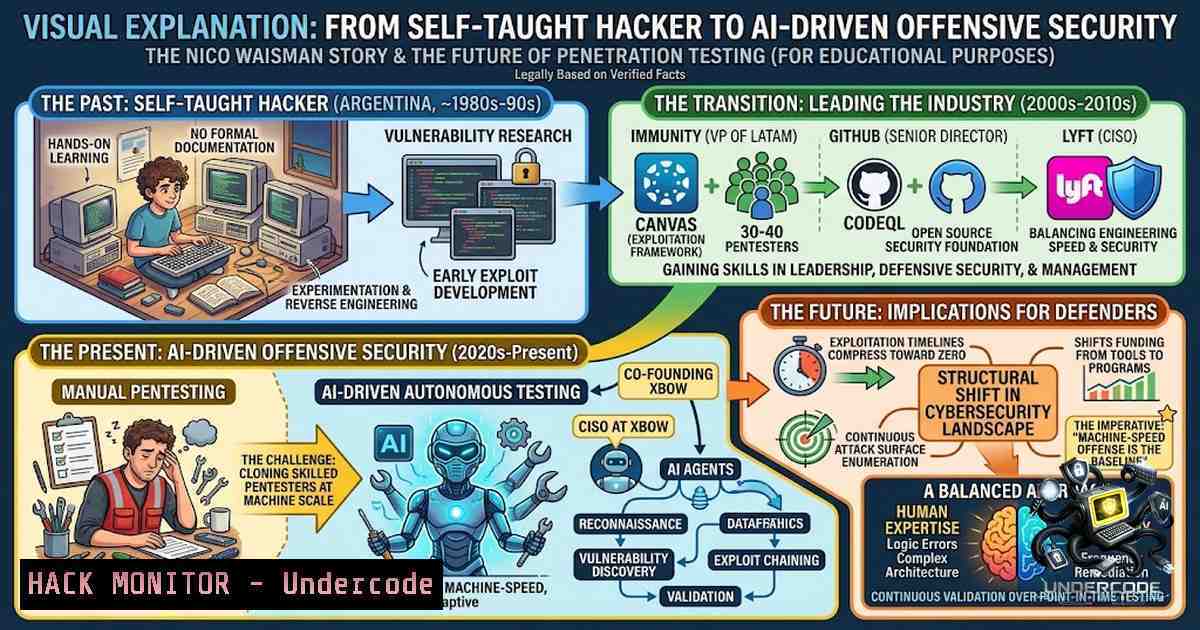
The cybersecurity industry is witnessing a seismic shift as artificial intelligence transitions from a defensive aid to an autonomous offensive weapon. Nico Waisman’s journey—from a self-taught hacker in Argentina’s early underground scene to Chief Information Security Officer at XBOW, an AI-powered offensive security firm—epitomizes this transformation. With no formal training and no career plan, Waisman built a path that now leads the charge in autonomous penetration testing, where AI systems rival and surpass top-tier human hackers. His story is not just inspirational; it is a blueprint for understanding how offensive security is being redefined by machine speed and AI reasoning.
Learning Objectives & Secrets:
- Objective 1: Understand the Evolution from Manual Hacking to AI-Driven Offense. Learn how Waisman’s early reverse engineering and exploitation skills—honed without documentation—laid the groundwork for today’s autonomous penetration testing platforms.
-
Objective 2 Secret Tip: Master the Art of Continuous Testing. Traditional point-in-time pentests are obsolete. XBOW’s platform runs continuously, finding and exploiting vulnerabilities as attackers do, integrating security directly into the development lifecycle.
-
Objective 3 Secret Tip: Leverage AI to Scale Expert-Level Testing. The secret is not replacing humans but augmenting them. AI systems like XBOW can complete comprehensive penetration tests in hours, not weeks, while maintaining low false-positive rates.
You Should Know:
1. The Autonomous Penetration Testing Revolution
Waisman’s career arc—from Immunity’s CANVAS exploitation framework to GitHub Security Lab and finally to XBOW—mirrors the industry’s shift toward automation. XBOW, co-founded with Oege de Moor (creator of GitHub Copilot), represents the first AI autonomous product that mimics human hacking skills at scale. In 2025, XBOW’s AI agent became the 1 hacker in the United States on HackerOne, outperforming every human participant. This is not a future concept; it is happening now.
Step‑by‑step guide to understanding autonomous pentesting:
- Step 1: Reconnaissance Automation. AI agents use tools like Subfinder, Amass, and Naabu to map attack surfaces without human intervention.
- Step 2: Vulnerability Discovery. Platforms like XBOW combine AI reasoning with adversarial workflows to find vulnerabilities at machine speed.
- Step 3: Exploitation Validation. The AI validates findings, keeping false positives low enough for security teams to act with confidence.
- Step 4: Continuous Monitoring. Unlike point-in-time tests, autonomous systems run continuously, syncing with development.
Linux command example for automated reconnaissance:
 Install and run a basic autonomous recon tool (example with Amass)
sudo apt-get install amass
amass enum -d example.com -o recon_output.txt
Windows PowerShell example for API endpoint discovery:
 Using Invoke-WebRequest to enumerate API endpoints
Invoke-WebRequest -Uri "https://api.example.com/v1/endpoints" -Method Get
- CodeQL and the Shift to Semantic Code Analysis
During his tenure at GitHub Security Lab, Waisman helped integrate Semmle’s CodeQL, a semantic code analysis engine that treats code as data. CodeQL enables developers to find security vulnerabilities with greater confidence than traditional static analyzers. This technology is now foundational to securing the open-source software supply chain.
Step‑by‑step guide to setting up CodeQL for your repository:
- Step 1: Install the CodeQL CLI. Download from GitHub and add to your PATH.
- Step 2: Create a CodeQL database. `codeql database create ./db –language=javascript –source-root ./src`
– Step 3: Run queries against the database. `codeql database analyze ./db –format=sarif-latest –output=results.sarif codeql/javascript-queries`
– Step 4: Integrate with CI/CD. Add the CodeQL Action to your GitHub workflow to automate scanning on every push.
Example GitHub Actions workflow for CodeQL:
name: "CodeQL Analysis"
on:
push:
branches: [bash]
jobs:
analyze:
runs-on: ubuntu-latest
steps:
- uses: actions/checkout@v3
- uses: github/codeql-action/init@v2
with:
languages: javascript
- uses: github/codeql-action/analyze@v2
3. AI in Offensive Security: Tools and Commands
The open-source ecosystem is rapidly evolving with AI-powered penetration testing tools. Projects like Pentest Swarm AI, RedAmon, and Phantom use swarm intelligence and multi-agent systems to orchestrate reconnaissance, exploitation, and reporting. These tools integrate with nmap, sqlmap, Burp, Metasploit, and dozens of other security utilities.
Step‑by‑step guide to deploying an AI-powered pentesting agent:
- Step 1: Choose a platform. For open-source, consider Pentest Swarm AI or Phantom. For enterprise, XBOW, Horizon3.ai NodeZero, or Pentera are leading options.
- Step 2: Install dependencies. Ensure Docker, Python, and necessary CLI tools are available.
- Step 3: Configure the AI agent. Define scope, targets, and testing parameters.
- Step 4: Launch the autonomous test. Monitor the agent’s progress and review validated findings.
Linux command to run a containerized AI pentesting tool:
 Example with Phantom (autonomous multi-agent system)
docker run -it --rm usta0x001/phantom:latest --target example.com
Windows command using PowerShell to invoke an AI scanning tool:
 Example with Apex (AI-powered offensive security CLI)
irm https://www.pensarai.com/apex.ps1 | iex
apex scan --target https://example.com
4. The Defender’s Dilemma: Balancing Security and Enablement
Waisman’s experience as CISO at Lyft taught him a critical lesson: security must enable, not impede. “You need a solid defense to enable your forwards to advance—you do not want a defense that defends by simply kicking the ball out of the stadium at every opportunity.” This philosophy is essential when deploying AI-driven security tools that can overwhelm teams with alerts. The goal is validated, actionable findings, not noise.
Step‑by‑step guide to implementing security enablement:
- Step 1: Adopt a risk-based approach. Prioritize vulnerabilities that matter most.
- Step 2: Automate validation. Use AI to filter false positives before they reach human analysts.
- Step 3: Integrate with development. Shift security left by embedding tools like CodeQL into the CI/CD pipeline.
- Step 4: Measure and iterate. Track metrics like mean time to remediate (MTTR) and adjust processes accordingly.
5. Burnout and Leadership in Cybersecurity
Waisman openly discusses the burnout crisis facing CISOs and security teams. “You are in an impossible position, being responsible for the actions of other people.” His leadership philosophy emphasizes empathy, shielding teams from excessive pressure, and promoting work/life balance. He advocates a Socratic approach to mentoring—asking questions rather than providing answers.
Step‑by‑step guide to preventing burnout in security teams:
- Step 1: Recognize the signs. Physical, mental, and emotional exhaustion are red flags.
- Step 2: Distribute pressure. CISOs should act as filters, absorbing stress before it reaches team members.
- Step 3: Foster open communication. Create an environment where team members can voice concerns.
- Step 4: Encourage breaks and boundaries. Promote a healthy work/life balance.
What Undercode Say:
- Key Takeaway 1: Cybersecurity chose Nico Waisman, not the other way around. His journey from an introverted, self-taught hacker to a CISO at a unicorn AI security firm proves that passion and curiosity can outweigh formal credentials.
-
Key Takeaway 2: AI is not replacing hackers; it is scaling them. XBOW’s success on HackerOne demonstrates that autonomous systems can outperform humans in certain contexts, but human expertise remains essential for training and oversight.
-
Analysis: Waisman’s career reflects the maturation of offensive security from a niche hobby to a critical enterprise function. His transition from offensive to defensive roles at Lyft gave him a 360-degree view of security challenges. Now, at XBOW, he combines both perspectives to build AI systems that are not just effective but also responsibly deployed. The industry must prepare for a future where AI-driven attacks are cheap and scalable—Waisman warns that attackers will soon have a positive ROI for targeting IPs with autonomously adjusting malware. Defenders must adopt AI at the same speed or risk being overwhelmed.
Prediction:
-
+1 AI-powered autonomous penetration testing will become the enterprise standard within 24 months, reducing the average cost of a pentest by 60-80% while increasing coverage from periodic to continuous.
-
+1 The open-source ecosystem will produce fully autonomous red-teaming agents that rival commercial offerings, democratizing access to advanced security testing.
-
-1 Attackers will weaponize autonomous AI to launch massive, self-propagating exploits against unpatched vulnerabilities, creating a “chaos” period before defenders catch up.
-
-1 The burnout crisis among CISOs will intensify as AI generates more findings, requiring human oversight, unless AI-driven triage and validation tools mature rapidly.
-
+1 CodeQL and similar semantic analysis tools will become mandatory in CI/CD pipelines, effectively eliminating entire classes of vulnerabilities before they reach production.
-
-1 Organizations that fail to integrate AI into their security programs will face a widening gap against adversaries who adopt these technologies first.
▶️ Related Video (66% Match):
https://www.youtube.com/watch?v=18924d89VsE
🎯Let’s Practice For Free:
🎓 Live Courses & Certifications:
Join Undercode Academy for Verified Certifications
🚀 Request a Custom Project:
Secure, high-velocity infrastructure and disruptive technological engineering. Contact our engineering team for high-tier development and proprietary systems:
[email protected]
💎 Smart Architecture | 🛡️ Secure by Design | ⭐ Trusted by Thousands
IT/Security Reporter URL:
Reported By: https://lnkd.in/p/e4CcCFh5 – Hackers Feeds
Extra Hub: Undercode MoN
Basic Verification: Pass ✅


