
Listen to this Post
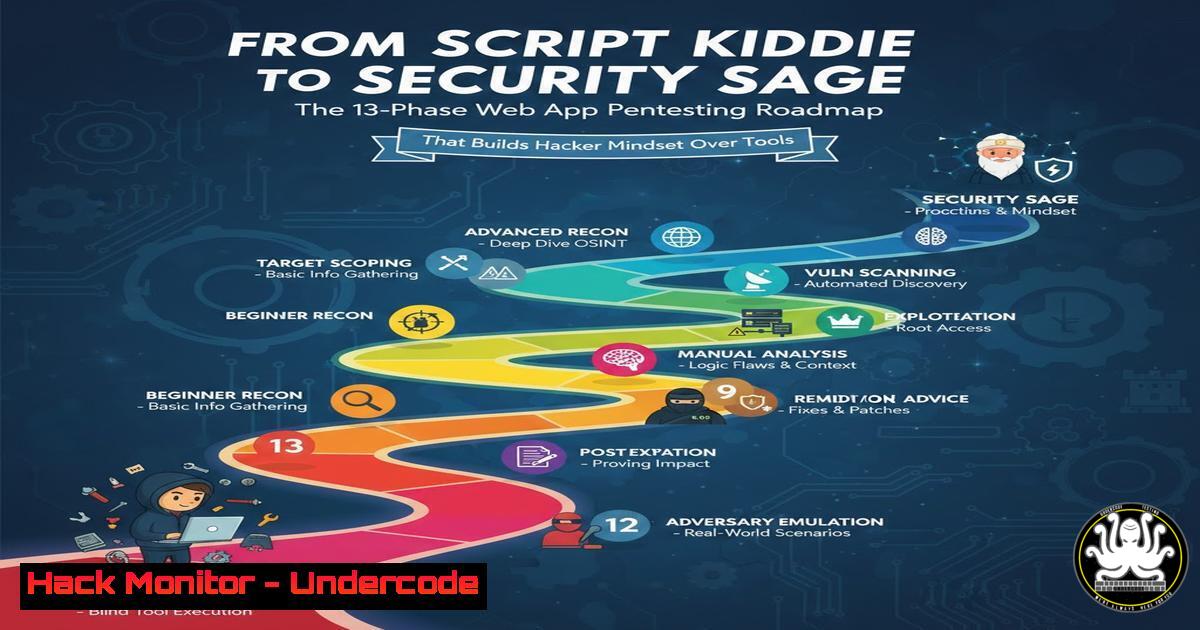
Introduction:
In an era where automated vulnerability scanners dominate, true penetration testing demands a deep understanding of web application architecture, attacker logic, and systematic exploitation methodology. This roadmap transitions practitioners from tool-dependent beginners to experts who can uncover complex business logic flaws and evolving attack vectors that machines miss.
Learning Objectives:
- Master the foundational technology stack of modern web applications and how communication flows between client, server, and database.
- Develop a methodological approach to mapping attack surfaces and testing for the OWASP Top 10 and beyond.
- Learn to identify, exploit, and articulate sophisticated vulnerabilities like insecure direct object references (IDOR), weak cryptography, and business logic flaws.
You Should Know:
1. Building Your Cyber Dojo: Legal Lab Setup
A controlled, legal environment is non-negotiable. Using intentionally vulnerable applications allows for safe, repeatable practice without risking real systems.
Step‑by‑step guide explaining what this does and how to use it.
Step 1: Choose Your Virtualization Platform. Install VirtualBox or VMware Workstation Player. Isolating your lab within a virtual machine (VM) contains your testing activities.
Step 2: Deploy a Vulnerable App. Download and install bWAPP (Buggy Web Application) or OWASP Juice Shop. These are designed with flaws for educational purposes.
For bWAPP: Use the pre-configured VM from SourceForge or deploy via Docker: docker run -d -p 80:80 raesene/bwapp.
Step 3: Configure Your Proxy. Install Burp Suite Community or Professional. Configure your browser to use Burp as a local proxy (typically 127.0.0.1:8080). Install Burp’s CA certificate to intercept HTTPS traffic.
Step 4: Network Configuration. Ensure your vulnerable app VM and attacker machine (host) are on a host-only or NAT network where they can communicate.
2. Mapping the Battlefield: Application Reconnaissance
Before attacking, you must discover everything the application exposes: endpoints, parameters, technologies, and hidden content.
Step‑by‑step guide explaining what this does and how to use it.
Step 1: Passive Reconnaissance. Use Burp’s built-in browser to manually explore the application. Let Burp Suite’s Proxy history and Target site map build automatically.
Step 2: Active Discovery. Use command-line tools to find hidden directories and files.
Linux (using ffuf): `ffuf -w /usr/share/wordlists/dirb/common.txt -u http://target/FUZZ -fc 403`
Windows (PowerShell alternative): Use `Invoke-WebRequest` in a loop against a wordlist.
Step 3: Technology Fingerprinting. Identify the tech stack using Wappalyzer browser extension or by analyzing HTTP headers and file extensions.
Step 4: Parameter Discovery. Use Burp Suite’s “Engagement tools” > “Discover content” or tools like `arjun` (`python3 arjun.py -u https://target.com/endpoint`).
- The Classic Arsenal: Exploiting OWASP Top 10 Vulnerabilities
Understanding the root cause of common vulnerabilities allows you to craft precise exploits, not just run generic payloads.
Step‑by‑step guide explaining what this does and how to use it.
SQL Injection (A03:2021-Injection):
Detection: Submit a single quote (') in input fields. Look for SQL errors.
Exploitation (Union-based): `’ UNION SELECT username, password FROM users–`
Automated Tool (SQLmap): `sqlmap -u “http://target.com/page?id=1” –batch –dbs`
Cross-Site Scripting (A03:2021-Injection):
Test Payload: ``
Blind XSS Probe: Use a payload that calls back to your server: ``
Broken Access Control (A01:2021): Manually change parameter values (e.g., `user_id=100` to user_id=101) to test for Insecure Direct Object References (IDOR).
4. Cracking the Session: Authentication & Authorization Flaws
Testing how an application manages identity is crucial for vertical and horizontal privilege escalation.
Step‑by‑step guide explaining what this does and how to use it.
Step 1: Analyze Session Tokens. Examine cookies and JWT tokens in Burp’s Proxy. Look for predictability, lack of signing, or sensitive data stored in the token.
Step 2: Test for Weak Lockout Mechanisms. Use Burp Intruder to send rapid login attempts with a list of common passwords to see if account lockout is enforced.
Step 3: Test for Horizontal Privilege Escalation. Log in as userA. Access a resource for `userB` by changing an ID parameter (IDOR).
Step 4: Test for Vertical Privilege Escalation. Log in as a low-privilege user. Try to access admin endpoints (/admin, /api/admin/users) or functions.
5. Beyond the Scanner: Uncovering Business Logic Vulnerabilities
These flaws are unique to the application’s purpose and require human reasoning to find and exploit.
Step‑by‑step guide explaining what this does and how to use it.
Scenario 1: E-commerce Price Manipulation.
- Intercept the `POST` request when adding an item to the cart.
- Change the `price` or `total` parameter to a negative value or
0.01. - Forward the request and observe if the order total changes incorrectly.
Scenario 2: Workflow Bypass.
- An application flow is: Step A -> Step B -> Step C -> Payment.
- After completing Step B, intercept the request to go to Step C.
- Attempt to directly access the Payment endpoint (
GET /payment) or skip steps by modifying a `step` parameter.
Scenario 3: Excessive Data Leakage in APIs. For an API endpoint/api/users/search?q=a, iterate through all possible single characters, then analyze responses for unique data not intended for your user context. -
The Silent Informant: Leveraging Error Handling & Information Leakage
Verbose errors can reveal stack traces, database structure, API keys, and internal system paths.
Step‑by‑step guide explaining what this does and how to use it.
Step 1: Induce Errors. Fuzz parameters with unexpected data types: very long strings, special characters, or data types (submit a string where a number is expected).
Step 2: Analyze Stack Traces. A Java stack trace might reveal library versions (e.g., Spring Framework 5.3.15), which can be cross-referenced with known vulnerabilities.
Step 3: Check Default Files. Request common files that may leak data: /robots.txt, /.git/HEAD, /.env, /phpinfo.php.
Step 4: Use `curl` with Verbose Output: `curl -v http://target.com/debug.php` to inspect all HTTP headers and response bodies for leaks.
7. Cryptographic Misconfigurations: Spotting the Weak Links
The goal is not to break cryptography but to identify its weak implementation, such as weak algorithms, hard-coded keys, or improper randomness.
Step‑by‑step guide explaining what this does and how to use it.
Step 1: Inspect TLS/SSL Configuration. Use `testssl.sh` or `nmap` scripts: nmap --script ssl-enum-ciphers -p 443 target.com. Look for support of weak ciphers like SSLv3 or TLS 1.0.
Step 2: Analyze Custom Tokens. Decode JSON Web Tokens (JWTs) using the `jwt.io` debugger. Check if the algorithm is set to `none` (none algorithm attack) or if the token is signed with a weak secret.
Step 3: Check for Sensitive Data in Client-Side Code. Use browser developer tools (Sources tab) to search for keywords like API_KEY, secret, password, `encrypt` in JavaScript files.
Step 4: Test Password Reset Tokens. Request a password reset and analyze the token sent via email or URL. Is it predictable? Can you generate tokens for other users?
What Undercode Say:
- Tools Are a Means, Not the Master. True expertise is measured by the ability to find what automated tools cannot—logic flaws, novel abuse cases, and chained vulnerabilities that require deep understanding.
- The Attacker’s Mindset is Built on Fundamentals. A rock-solid grasp of HTTP, sessions, and application architecture is what allows a tester to pivot and innovate when standard attacks fail.
The roadmap’s greatest strength is its philosophical core: logic mistakes repeat. While frameworks and libraries evolve, flawed human assumptions about trust, workflow, and data validation persist. This guide systematically deconstructs those assumptions, forging testers who think like architects and attackers simultaneously. In a landscape increasingly reliant on AI and automation, this human-centric, foundational skillset becomes more valuable, not less.
Prediction:
The future of penetration testing will bifurcate. On one path, AI-driven tools will commoditize the discovery of common, pattern-based vulnerabilities at immense scale. On the other, the value of the human expert who can perform deep system analysis, reason through complex business logic, and creatively chain subtle flaws will skyrocket. This roadmap directly prepares practitioners for the latter, high-value trajectory. Furthermore, as applications become more interconnected via APIs and move towards serverless architectures, the fundamentals of communication, authentication, and input validation emphasized here will become even more critical, making this foundational mindset future-proof.
▶️ Related Video (72% Match):
🎯Let’s Practice For Free:
IT/Security Reporter URL:
Reported By: Muneer Jamali – Hackers Feeds
Extra Hub: Undercode MoN
Basic Verification: Pass ✅


