
Listen to this Post
Introduction:
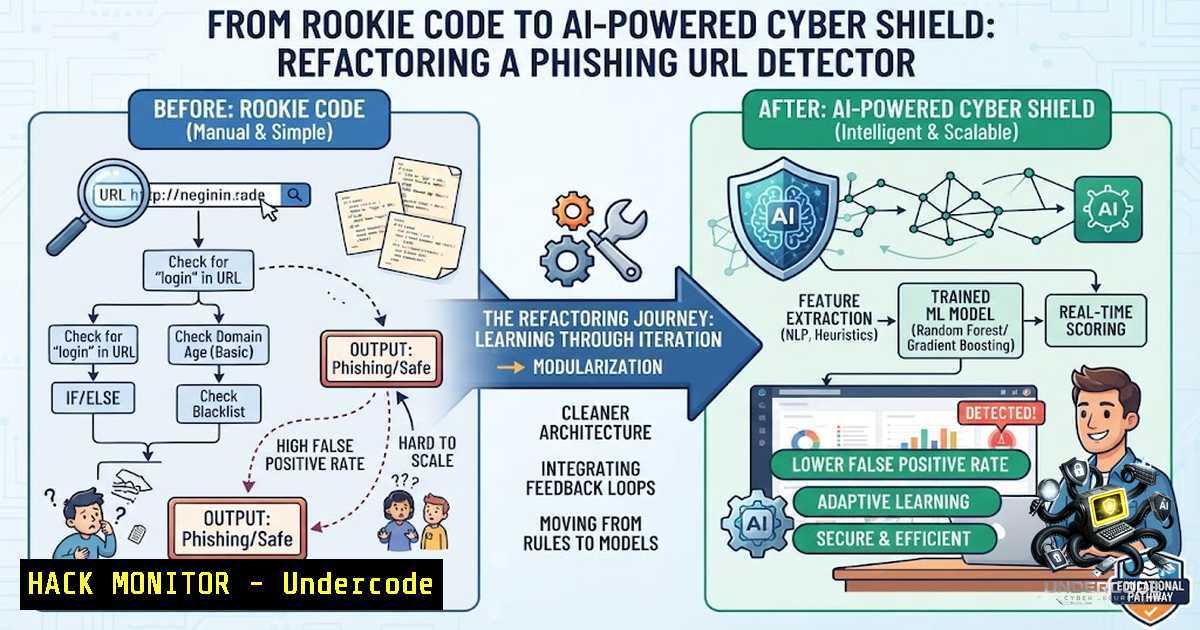
In the ever-evolving landscape of cybersecurity, the ability to distinguish between a legitimate link and a malicious phishing trap has become a critical line of defense. Machine learning offers a powerful approach to this challenge, enabling systems to analyze URL patterns and predict threats with remarkable accuracy. However, building a functional prototype is only the first step; the true test of a developer’s growth lies in revisiting past work, refactoring code for maintainability, and hardening it against real-world adversarial inputs. This article chronicles the journey of transforming a simple AI-powered phishing URL detector into a production-ready security tool, offering a step-by-step guide on how you can apply similar principles to your own cybersecurity projects.
Learning Objectives:
- Understand the architecture and key features of a machine learning-based phishing URL detection system.
- Learn how to refactor Python code for improved readability, maintainability, and performance.
- Gain practical skills in updating dependencies, enhancing UI/UX, and structuring cybersecurity projects.
You Should Know:
- Understanding the Core: How ML Detects Phishing URLs
The foundation of any AI-powered phishing detector is its ability to extract and analyze features from a URL that indicate malicious intent. Unlike simple blacklists, machine learning models can identify never-before-seen phishing sites by recognizing patterns in the URL’s structure. Key features often include the URL length, the number of special characters (like ‘@’ or ‘-‘), the presence of suspicious keywords (e.g., “secure”, “login”, “banking”), and the use of URL shorteners. These features are fed into a classification algorithm—such as a Random Forest, Gradient Boosting, or ExtraTreesClassifier—which has been trained on a large dataset of both legitimate and phishing URLs. The model learns to associate certain feature combinations with phishing attempts, allowing it to predict the safety of a new, unseen URL in real-time.
2. The Refactoring Mindset: Why Revisiting Code Matters
The decision to revisit an old project is often more valuable than starting a new one. As developers gain experience in areas like AI, cloud computing, and full-stack development, their understanding of software architecture deepens. Refactoring is not just about fixing bugs; it’s about applying that accumulated knowledge to create a more robust, scalable, and secure application. For a cybersecurity tool, this is paramount. A poorly structured codebase can introduce vulnerabilities, make it difficult to update the model, or hinder the integration of new threat intelligence feeds. By focusing on better readability, updating outdated dependencies, and cleaning up the project structure, you are not just improving code—you are strengthening the security posture of the application itself.
3. Step-by-Step Guide: Refactoring Your Phishing Detector
Step 1: Audit Your Codebase and Dependencies
Before writing any new code, conduct a thorough audit. Identify all external libraries and frameworks used. Check for known vulnerabilities in outdated packages using tools like `pip-audit` or safety. For instance, if your project uses an older version of Flask or scikit-learn, update them to the latest stable releases to patch security holes and leverage performance improvements.
 Linux/macOS: Audit Python dependencies for vulnerabilities
pip install pip-audit
pip-audit

Windows: Using Safety CLI
pip install safety
safety check
Step 2: Restructure for Maintainability
Organize your project into a clear, modular structure. A common pattern is to separate data processing, model training, prediction logic, and the user interface. This makes the code easier to test, debug, and extend.
phishing-detector/
├── app/
│ ├── <strong>init</strong>.py
│ ├── routes.py  Flask route handlers
│ ├── models.py  ML model loading and prediction logic
│ └── utils.py  Helper functions (feature extraction)
├── data/
│ └── processed/  Datasets for training
├── models/
│ └── phishing_model.pkl  Trained model file
├── notebooks/  Jupyter notebooks for experimentation
├── requirements.txt
└── run.py  Application entry point
Step 3: Enhance Feature Extraction Logic
The accuracy of your model depends on the quality of the features you extract. Review and improve your feature engineering code. For example, you might add functions to check if a URL uses an IP address instead of a domain name, or to calculate the entropy of the URL string, which can indicate obfuscation.
import re
from urllib.parse import urlparse

def extract_features(url):
features = {}
parsed_url = urlparse(url)
 Feature 1: URL Length
features['length'] = len(url)
 Feature 2: Number of special characters
features['special_chars'] = len(re.findall(r'[^a-zA-Z0-9]', url))
 Feature 3: Presence of '@' symbol (often used in phishing)
features['has_at'] = 1 if '@' in url else 0
 Feature 4: Use of IP address instead of domain
features['is_ip'] = 1 if re.match(r'^\d+.\d+.\d+.\d+$', parsed_url.netloc) else 0
 Feature 5: Count of subdomains
features['subdomain_count'] = parsed_url.netloc.count('.')
return features
Step 4: Re-train and Validate the Model
With your improved feature set, it’s time to re-train your model. Use a robust dataset, such as the ones available on Kaggle or the UCI Machine Learning Repository. Split your data into training and testing sets, and use cross-validation to ensure your model generalizes well to new data. Compare different algorithms (e.g., Random Forest, XGBoost, or a neural network) to find the best performer.
from sklearn.ensemble import RandomForestClassifier
from sklearn.model_selection import train_test_split
from sklearn.metrics import accuracy_score, classification_report

Assume X contains your feature vectors and y contains labels (0=legitimate, 1=phishing)
X_train, X_test, y_train, y_test = train_test_split(X, y, test_size=0.2, random_state=42)
model = RandomForestClassifier(n_estimators=100, random_state=42)
model.fit(X_train, y_train)
y_pred = model.predict(X_test)
print(f"Accuracy: {accuracy_score(y_test, y_pred)}")
print(classification_report(y_test, y_pred))
Step 5: Harden the Web Interface
If your detector has a web interface (e.g., built with Flask or Django), implement security best practices. Sanitize all user inputs to prevent injection attacks. Implement rate limiting to prevent abuse of your API. Use HTTPS to encrypt data in transit. Add a Content Security Policy (CSP) header to mitigate XSS risks.
from flask import Flask, request, jsonify
from flask_limiter import Limiter
from flask_limiter.util import get_remote_address

app = Flask(<strong>name</strong>)
limiter = Limiter(app, key_func=get_remote_address)

@app.route('/predict', methods=['POST'])
@limiter.limit("10 per minute")  Rate limit to prevent abuse
def predict():
data = request.get_json()
url = data.get('url')
if not url:
return jsonify({'error': 'URL is required'}), 400
 Sanitize input (basic example)
url = url.strip()
 ... feature extraction and prediction logic ...
return jsonify({'prediction': 'phishing' if prediction == 1 else 'legitimate'})
Step 6: Polish and Deploy
Finally, improve the user experience. Provide clear, actionable feedback. Instead of just a “phishing” or “legitimate” label, consider showing a confidence score or highlighting the suspicious features that led to the prediction. Deploy your application using a platform like Heroku, AWS, or a simple VPS. Use environment variables for sensitive configuration (like API keys) and set up logging to monitor for errors and potential attacks.
4. Beyond the Basics: Integrating Threat Intelligence
To elevate your detector from a simple classifier to a powerful security tool, consider integrating threat intelligence feeds. Services like VirusTotal, AlienVault OTX, or the IBM X-Force Exchange provide real-time data on known malicious domains and IPs. By cross-referencing a URL against these feeds before running the ML model, you can achieve near-instant detection of well-known threats, reducing false positives and improving overall efficiency.
5. The Windows and Linux Perspective: Cross-Platform Deployment
While Python is cross-platform, deployment and automation scripts often differ. For a Linux server, you might use `systemd` to run your Flask app as a service. For Windows, you could use Task Scheduler or run it as a Windows Service using pywin32. Here’s a basic `systemd` service file for Linux:
[bash]
Description=Phishing URL Detector
After=network.target

[bash]
User=www-data
Group=www-data
WorkingDirectory=/path/to/your/app
Environment="PATH=/path/to/your/venv/bin"
ExecStart=/path/to/your/venv/bin/python run.py
Restart=always

[bash]
WantedBy=multi-user.target
6. Continuous Improvement: The Key to AI Security
The cybersecurity landscape is dynamic; attackers constantly evolve their tactics. Therefore, your ML model must also evolve. Implement a feedback loop where users can report false positives or negatives. This data can be used to periodically retrain your model, ensuring it remains effective against new phishing techniques. Consider using techniques like online learning or federated learning to update your model without compromising user privacy.
What Undercode Say:
- Key Takeaway 1: The true measure of a developer’s growth is not in the number of new projects started, but in the quality of improvements made to existing work. Refactoring a cybersecurity tool is an act of continuous defense.
- Key Takeaway 2: A production-ready AI security solution requires more than just a good model. It demands a well-structured codebase, secure APIs, up-to-date dependencies, and a commitment to continuous learning and adaptation.
- Analysis: The journey from a simple proof-of-concept to a robust, refactored application mirrors the evolution of the cybersecurity industry itself. We move from reactive, signature-based defenses to proactive, AI-driven threat intelligence. This project exemplifies that shift, highlighting the importance of applying software engineering best practices to the field of AI security. It serves as a powerful reminder that in the fight against cybercrime, our tools must be as dynamic and resilient as the threats they aim to neutralize.
Prediction:
- +1 The democratization of AI-powered security tools, as demonstrated by open-source projects like this phishing detector, will empower smaller organizations and individual developers to implement enterprise-grade threat detection without massive budgets.
- +1 As machine learning models become more sophisticated and integrated into the software development lifecycle (DevSecOps), we will see a significant reduction in the success rate of zero-day phishing attacks that bypass traditional filters.
- +1 The practice of regularly refactoring and updating AI models will become a standard security mandate, leading to a new breed of “adaptive” security systems that learn and evolve in real-time alongside the threat landscape.
- -1 The increasing reliance on AI for cybersecurity will also lead to more sophisticated adversarial attacks, where bad actors use AI to craft URLs and content specifically designed to evade detection models, creating an ongoing “AI arms race.”
▶️ Related Video (66% Match):
🎯Let’s Practice For Free:
🎓 Live Courses & Certifications:
Join Undercode Academy for Verified Certifications
🚀 Request a Custom Project:
Secure, high-velocity infrastructure and disruptive technological engineering. Contact our engineering team for high-tier development and proprietary systems:
[email protected]
💎 Smart Architecture | 🛡️ Secure by Design | ⭐ Trusted by Thousands
IT/Security Reporter URL:
Reported By: Gaur4avkumar Python – Hackers Feeds
Extra Hub: Undercode MoN
Basic Verification: Pass ✅


