Listen to this Post
Introduction
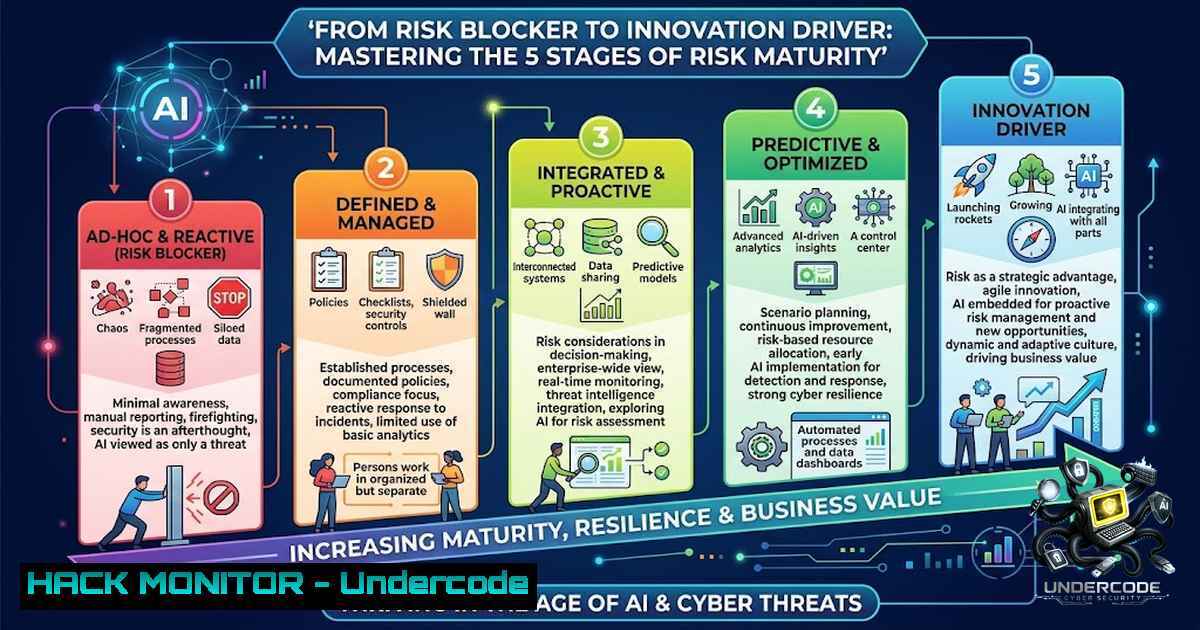
For decades, enterprise risk management has been viewed as a necessary obstacle—a bureaucratic hurdle that slows down innovation, complicates digital transformation, and frustrates business leaders eager to move fast. But this perspective is fundamentally flawed. Risk doesn’t slow innovation; unmanaged risk does. As organizations navigate the convergence of AI adoption, escalating cyber threats, mounting regulatory demands, and relentless market disruption, the ability to understand, measure, and mature risk management capabilities has become a strategic imperative rather than a compliance checkbox. This article explores the five stages of risk maturity, provides actionable frameworks for progression, and delivers hands-on technical guidance for security professionals, IT leaders, and risk practitioners seeking to transform risk from a barrier into a competitive advantage.
Learning Objectives
- Understand the five-stage risk maturity model and accurately assess your organization’s current position across the maturity spectrum
- Master practical implementation techniques including Linux/Windows security commands, cloud hardening procedures, and API security configurations
- Develop a strategic roadmap to advance from reactive risk management to proactive, intelligence-driven resilience
You Should Know
- The Five Stages of Risk Maturity: From Ad Hoc to Optimized
The risk maturity journey follows a predictable progression that has been codified across multiple frameworks, including the ERMA ISO 31000 RM³ model, the NIST Cybersecurity Framework implementation tiers, and the OneTrust integrated risk management (IRM) methodology. Understanding where your organization sits on this spectrum is the first step toward meaningful improvement.
Stage 1: Initial (Ad Hoc) – Risk management is informal, reactive, and relies on individual initiative. There is no standardized approach; risk data is scattered across spreadsheets, and each department defines risk differently. Security teams operate blindly without comprehensive asset visibility.
Stage 2: Repeatable – Basic processes begin to emerge. Risk management starts to be implemented systematically, though inconsistently across the organization. Organizations begin consolidating risk data and establishing foundational taxonomies.
Stage 3: Defined – Risk management is implemented systematically and consistently practiced according to established frameworks such as ISO 31000. Controls are documented, roles are assigned, and processes are standardized across the enterprise.
Stage 4: Managed – Risk management becomes integrated with organizational governance. Organizations leverage dashboards and analytics to surface cross-functional insights, linking IT, compliance, audit, privacy, and third-party risk in a connected ecosystem.
Stage 5: Optimized – Risk management is an integral part of organizational governance, systematically and continuously improved. Organizations employ predictive and prescriptive analytics, continuous monitoring across global operations, and embed risk intelligence into strategic decision-making on capital allocation and transformation initiatives.
- Assessing Your Current Maturity Level: Practical Benchmarking Techniques
Before you can advance, you must accurately assess where you stand. This requires a systematic approach combining framework-based evaluation with technical validation.
Step 1: Framework Selection and Mapping – Choose a maturity framework appropriate for your organization. The NIST CSF 2.0 has emerged as the baseline framework for enterprise cybersecurity maturity assessments, blending technical depth, operational realism, and governance clarity. Alternatively, the ISO 31000-based ERMA RM³ model provides five progressive stages—Initial, Repeatable, Defined, Managed, and Optimized.
Step 2: Technical Asset Discovery – Maturity assessment begins with knowing what you have. Run comprehensive asset discovery across your environment:
Linux:
 Discover all listening services and open ports
sudo ss -tulpn | grep LISTEN

Inventory installed packages and their versions
rpm -qa --last | head -50  RHEL/CentOS
dpkg -l | grep -E '^(ii|hi)' | wc -l  Debian/Ubuntu

Identify all users and their shell access
cat /etc/passwd | grep -E '/(bin|sbin)/.sh' | cut -d: -f1

Check for world-writable files and directories
find / -type f -perm -002 -exec ls -la {} \; 2>/dev/null | head -20
Windows (PowerShell):
 Get all installed software and versions
Get-WmiObject -Class Win32_Product | Select-Object Name, Version, Vendor

List all open ports and associated processes
netstat -ano | Select-String "LISTENING"

Enumerate all local user accounts
Get-LocalUser | Where-Object {$_.Enabled -eq $true}

Check Windows Update status and last scan
Get-WindowsUpdateLog
Step 3: Control Mapping and Gap Analysis – Map your existing controls against framework requirements. The NIST CSF 2.0 provides a structured way to assess control maturity across access controls, detection mechanisms, and supply chain risk. Document gaps and prioritize remediation based on business impact.
3. Building Visibility and Consistency: The Crawl Phase
The starting point of maturity progression is often chaotic. Risk data is scattered, reporting is backward-looking, and teams operate in silos. Success in this phase comes from consolidation and standardization.
Step 1: Centralize Risk Data – Establish a single, governed source of truth for risk and compliance data. This may involve implementing a GRC platform like OneTrust GRC, which enables risk, compliance, and audit professionals to identify, measure, and remediate risk across the business.
Step 2: Standardize Risk Taxonomies – Refine foundational data taxonomies and risk classifications to enable consistency and scalability. Create a crosswalk of controls, frameworks, and scoring methodologies.
Step 3: Automate Evidence Collection – Implement automated, repeatable processes for evidence collection and reporting to free up resources for higher-value activities. This is where technical automation becomes critical:
Linux Automation (cron + scripts):
 Schedule automated vulnerability scans with OpenVAS
sudo crontab -e
 Add: 0 2    /usr/bin/openvas-cli --scan-target 192.168.1.0/24 --report-format html > /var/reports/vuln_$(date +\%Y\%m\%d).html

Automate log collection and analysis
sudo journalctl --since "1 hour ago" | grep -i "error|fail|denied" | mail -s "Hourly Security Alert" [email protected]
Windows Automation (Task Scheduler + PowerShell):
 Create a scheduled task for security log analysis
$Action = New-ScheduledTaskAction -Execute "PowerShell.exe" -Argument "-File C:\Scripts\SecurityLogAnalysis.ps1"
$Trigger = New-ScheduledTaskTrigger -Daily -At 2am
Register-ScheduledTask -TaskName "SecurityLogAnalysis" -Action $Action -Trigger $Trigger -User "SYSTEM"

Sample PowerShell log analysis
Get-WinEvent -FilterHashtable @{LogName='Security'; ID=4624,4625; StartTime=(Get-Date).AddHours(-24)} |
Group-Object -Property @{E='Message'; A='substring'} |
Sort-Object Count -Descending |
Select-Object -First 10
- Connecting Risk Across the Enterprise: The Walk Phase
Once the foundation is in place, organizations focus on integrating risk management across domains and connecting previously siloed functions.
Step 1: Integrate Security Tooling – Embed security scanning directly into developer workflows. This includes SAST (Static Application Security Testing), SCA (Software Composition Analysis), IaC (Infrastructure as Code) scanning, and secrets detection. The goal is to turn security gates into guardrails that enable development teams to move at full speed.
Step 2: Implement Continuous Threat Exposure Management (CTEM) – Traditional vulnerability management falls short in today’s hybrid, high-speed environment. The CTEM lifecycle includes five phases: Scoping (understand business context and threat landscape), Discovery (identify assets and exposures), Prioritization (map exposures to business impact), Validation (test controls and simulate attacks), and Mobilization (business-aligned responses).
Step 3: Deploy Real-time Vendor Risk Monitoring – Third-party risk is a critical component of modern risk management. Implement continuous monitoring of vendor risks and map controls across multiple frameworks.
API Security Configuration (REST API hardening):
 Implement rate limiting with iptables to prevent API abuse
sudo iptables -A INPUT -p tcp --dport 443 -m connlimit --connlimit-above 100 -j REJECT

Configure API gateway authentication (example with Kong)
curl -X POST http://localhost:8001/plugins \
--data "name=key-auth" \
--data "config.key_names=apikey"

Validate JWT tokens in API middleware (Node.js example)
 const jwt = require('jsonwebtoken');
 function authenticateToken(req, res, next) {
 const authHeader = req.headers['authorization'];
 const token = authHeader && authHeader.split(' ')[bash];
 if (!token) return res.sendStatus(401);
 jwt.verify(token, process.env.ACCESS_TOKEN_SECRET, (err, user) => {
 if (err) return res.sendStatus(403);
 req.user = user;
 next();
 });
 }
- Embedding Resilience as a Strategic Asset: The Run Phase
At the highest maturity level, risk management becomes a proactive enabler of strategy. Organizations anticipate risk, model scenarios, and embed resilience into growth plans.
Step 1: Implement Predictive Analytics – Deploy advanced analytics to generate predictive and prescriptive insights. This requires integrating threat intelligence feeds with internal risk data:
 Fetch and integrate threat intelligence feeds
curl -s https://feeds.alienvault.com/feeds/ipv4 | grep -v '^' | head -100 > /tmp/threat_ips.txt

Block known malicious IPs with iptables
while read ip; do
sudo iptables -A INPUT -s $ip -j DROP
done < /tmp/threat_ips.txt

Monitor for indicators of compromise (IoC) in logs
sudo grep -f /path/to/ioc_patterns.txt /var/log/auth.log | mail -s "IoC Detected" [email protected]
Step 2: Continuous Monitoring at Scale – Deploy continuous monitoring across global operations, third parties, and digital assets. This includes Cloud Security Posture Management (CSPM) tools that continuously scan cloud environments for misconfigurations.
Cloud Security Hardening (AWS CLI examples):
 Enforce MFA for all IAM users
aws iam list-users --query 'Users[].UserName' --output text | xargs -I {} aws iam list-mfa-devices --user-1ame {}

Enable S3 bucket encryption and block public access
aws s3api put-bucket-encryption --bucket my-bucket --server-side-encryption-configuration '{"Rules":[{"ApplyServerSideEncryptionByDefault":{"SSEAlgorithm":"AES256"}}]}'
aws s3api put-public-access-block --bucket my-bucket --public-access-block-configuration "BlockPublicAcls=true,IgnorePublicAcls=true,BlockPublicPolicy=true,RestrictPublicBuckets=true"

Audit security group rules for overly permissive access
aws ec2 describe-security-groups --query 'SecurityGroups[].IpPermissions[?IpProtocol==<code>-1</code>]' --output table
Step 3: Operationalize Resilience – Top-performing organizations don’t just monitor threats; they operationalize resilience. This means integrating risk into decision-making on strategy, capital allocation, and transformation initiatives.
- Cloud and API Security: Hardening Modern Attack Surfaces
As organizations mature their risk management capabilities, securing cloud infrastructure and APIs becomes paramount. Misconfigured cloud settings account for 23% of all cloud security incidents, with 82% of those misconfigurations stemming from human error.
Step 1: Implement Zero Trust Architecture – Adopt decentralized, prevention-first cloud security strategies with adaptive access controls. Enforce least-privilege access across every identity, human and machine.
Step 2: Eliminate Secrets from Code – Remove hardcoded credentials from code and CI/CD pipelines. Use secrets management tools:
 Scan for secrets in your codebase (using truffleHog)
trufflehog filesystem --directory=/path/to/repo --json | jq '.[] | select(.Verified==true)'

Rotate secrets regularly using AWS Secrets Manager
aws secretsmanager rotate-secret --secret-id my-secret --rotation-rules "AutomaticallyAfterDays=30"

Git hook to prevent committing secrets
!/bin/sh
 .git/hooks/pre-commit
if git diff --cached | grep -E '(password|secret|key|token).='; then
echo "❌ Commit blocked: Secrets detected in staged changes!"
exit 1
fi
Step 3: API Security Hardening – Implement comprehensive API security controls including authentication, authorization, rate limiting, and input validation:
 Python Flask API with JWT authentication and rate limiting
from flask import Flask, request, jsonify
from flask_jwt_extended import JWTManager, create_access_token, jwt_required
from flask_limiter import Limiter
from flask_limiter.util import get_remote_address

app = Flask(<strong>name</strong>)
app.config['JWT_SECRET_KEY'] = 'your-secret-key'  Use environment variable in production
jwt = JWTManager(app)
limiter = Limiter(app, key_func=get_remote_address, default_limits=["100 per minute"])

@app.route('/api/risk-data', methods=['GET'])
@jwt_required()
@limiter.limit("50 per minute")
def get_risk_data():
 Validate input parameters
param = request.args.get('param')
if param and not param.isalnum():
return jsonify({"error": "Invalid parameter"}), 400
 Process request...
return jsonify({"data": "Risk intelligence data"})
What Undercode Say
- Risk maturity is not optional – Organizations that fail to progress beyond the initial stages will find themselves overwhelmed by the compounding effects of AI-driven threats, regulatory complexity, and cloud-scale attack surfaces. The gap between maturity levels is not incremental; it’s exponential in terms of risk exposure.
-
Technical controls enable strategic outcomes – The commands, scripts, and configurations provided in this article are not just operational tactics; they are the building blocks of a mature risk management program. Automation of evidence collection, continuous monitoring, and secrets management directly enables the transition from reactive to proactive risk management.
-
Integration is the differentiator – The most significant leap in maturity occurs when organizations move from siloed risk functions to an integrated ecosystem connecting IT, compliance, audit, privacy, and third-party risk. This integration transforms risk management from overhead into business intelligence that informs strategic decision-making.
-
AI introduces new risk vectors – As AI adoption accelerates, organizations must extend their risk maturity frameworks to address AI-specific governance, security, and compliance challenges. The NIST AI Risk Management Framework provides a structured approach, but maturity in this domain requires continuous adaptation.
-
Resilience by design, not by reaction – The highest maturity level is characterized by resilience embedded into the fabric of the organization. This means anticipating threats, modeling scenarios, and building risk intelligence into every major business decision. Organizations that achieve this level don’t just survive disruptions; they thrive through them.
Prediction
-
+1 Organizations that achieve Stage 5 (Optimized) risk maturity by 2028 will demonstrate 40-60% faster recovery from security incidents and significantly lower breach costs compared to Stage 1-2 organizations. The economic advantage of maturity will become increasingly quantifiable and will influence cyber insurance premiums and investor confidence.
-
+1 The convergence of AI governance and integrated risk management will create new C-suite roles—Chief Risk & AI Officers—by 2027, as organizations recognize that AI risk cannot be managed in isolation from broader enterprise risk. This will drive demand for professionals with cross-domain expertise in security, privacy, compliance, and AI ethics.
-
-1 Organizations that remain at Stage 1-2 (Initial/Repeatable) will face existential threats as regulatory frameworks (GDPR, DORA, EU AI Act) impose stricter accountability requirements. The compliance burden alone will overwhelm immature programs, leading to significant fines, reputational damage, and potential business failure.
-
-1 The rapid adoption of agentic AI systems will introduce novel risk vectors that traditional maturity models do not adequately address. Organizations will struggle to adapt their risk frameworks quickly enough, creating a “maturity gap” that attackers will exploit through AI-powered attack techniques.
-
+1 Cloud-1ative security tools (CSPM, CWPP, CNAPP) will become integrated components of IRM platforms, enabling real-time risk scoring that combines cloud misconfigurations, vulnerability data, and threat intelligence into a unified risk posture. This integration will accelerate maturity progression for cloud-first organizations.
▶️ Related Video (66% Match):
https://www.youtube.com/watch?v=-E-jfcoR2W0
🎯Let’s Practice For Free:
🎓 Live Courses & Certifications:
Join Undercode Academy for Verified Certifications
🚀 Request a Custom Project:
Secure, high-velocity infrastructure and disruptive technological engineering. Contact our engineering team for high-tier development and proprietary systems:
[email protected]
💎 Smart Architecture | 🛡️ Secure by Design | ⭐ Trusted by Thousands
IT/Security Reporter URL:
Reported By: Harryclements Understand – Hackers Feeds
Extra Hub: Undercode MoN
Basic Verification: Pass ✅


