Listen to this Post
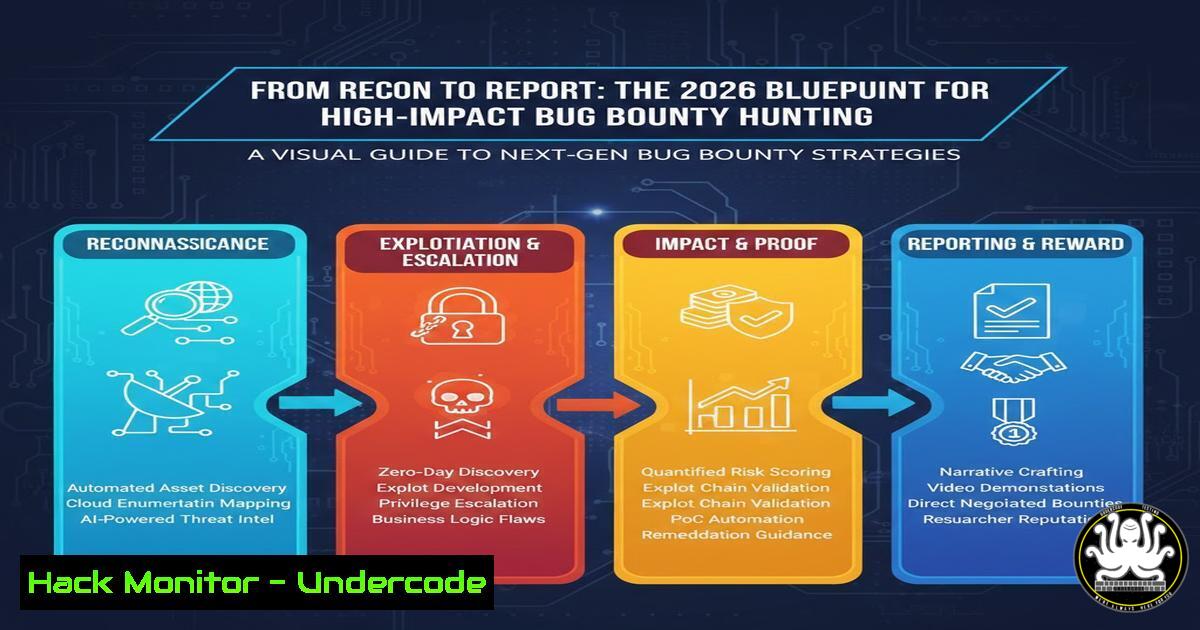
Introduction:
The modern bug bounty landscape is evolving beyond automated payload spraying into a discipline of meticulous reconnaissance, logical analysis, and professional communication. Successful hunters are shifting their focus from noise to signal, prioritizing subtle logic flaws and undiscovered attack surfaces over common vulnerabilities. This article deconstructs a professional hunter’s 2026 methodology, providing a technical blueprint for mastering passive reconnaissance, logic-based vulnerability discovery, and high-impact reporting.
Learning Objectives:
- Master advanced passive reconnaissance techniques using Certificate Transparency logs, GitHub monitoring, and automation.
- Develop a methodology for identifying complex, multi-step business logic flaws over common injection vulnerabilities.
- Learn to craft high-signal, actionable bug reports that clearly demonstrate impact and ensure reproducibility.
You Should Know:
1. Passive Reconnaissance: Uncovering Hidden Attack Surfaces
Passive reconnaissance involves gathering intelligence without directly interacting with the target, minimizing detection risk and uncovering assets missed by aggressive scanners. The core philosophy is to let the internet’s inherent transparency—through logs, code repositories, and historical data—reveal the target’s footprint.
Step‑by‑step guide:
- Subdomain Enumeration via CT Logs: Certificate Transparency (CT) logs are a goldmine. Use tools like `certspotter` or `ctfr` to find subdomains for which SSL/TLS certificates have been issued.
Using certspotter (install via pip)
certspotter -d example.com

Using ctfr.py
python3 ctfr.py -d example.com -o subdomains_ct.txt
- GitHub Reconnaissance: Hunt for exposed secrets, internal endpoints, and source code. Use
gitrob,truffleHog, or manual GitHub search operators.Clone and run gitrob (requires Go) go install github.com/michenriksen/gitrob@latest gitrob -save . -threads 2 -mode org -github-api-token <your_token> "TargetOrg"
- Content Discovery from Historical Data: Use tools like `gau` (GetAllURLs) to fetch known URLs from AlienVault OTX, Wayback Machine, and Common Crawl.
gau example.com --subs | tee urls_gau.txt
Filter for potential parameters
cat urls_gau.txt | grep "?" | sort -u > parameters.txt
-
Automation & Data Correlation: Combine these streams using a tool like `amass` for continuous intelligence gathering.
amass enum -passive -d example.com -config config.ini -o amass_passive.txt
-
Beyond Payloads: The Art of Hunting Logic Flaws
Logic flaws reside in the application’s workflow, not its syntax. They bypass traditional security controls by misusing legitimate functions. Testing requires understanding the intended business process and creatively subverting it.
Step‑by‑step guide:
- Map the Application Workflow: Manually explore every user journey (e.g., sign-up > upgrade > purchase > cancel). Document each step, parameters, and API call using Burp Suite’s Proxy.
- Identify Trust Boundaries: Note where the application checks permissions, validates state, or calculates prices. These are prime logic flaw targets.
3. Test for Flaws Methodically:
Horizontal Privilege Escalation: Can you access another user’s resource by altering an ID? Replay a request for `/api/user/1234/profile` with ID=5678.
Broken Access Control on Multi-Step Processes: Can you skip a step? After step 1 of a checkout, directly navigate to the confirmed payment endpoint (step 4).
Negative Pricing/Quantity Manipulation: Intercept a `POST /cart/update` request and change `”price”: 100` to `”price”: -100` or `”quantity”: 1` to "quantity": -10. Does the total become negative?
POST /api/applyCoupon HTTP/1.1
Host: shop.example.com
{"couponCode":"SUMMER50", "originalTotal":200}

Tampered Request
{"couponCode":"SUMMER50", "originalTotal":-200}
4. Automate State Manipulation: Use Burp Suite’s `Match and Replace` rules or a custom Python script to auto-replace session cookies or user IDs during a scan.
3. Weaponizing GitHub Recon: From Dorking to Exploitation
Public repositories often contain more than secrets; they reveal internal APIs, outdated dependencies, and configuration files that map the internal network.
Step‑by‑step guide:
- Construct Advanced Search Dorks: Use GitHub’s search syntax.
org:TargetOrg password
"target.com" api_key
filename:.env "AWS_SECRET"
filename:docker-compose.yml target.com
- Analyze Commit History: Previous commits may contain removed secrets. Use `git log -p` on a cloned repo to audit history.
git clone https://github.com/TargetOrg/repo.git
cd repo
git log -p --since="2023-01-01" | grep -E "AKIA|secret|token|password"
- Identify Internal Infrastructure: Search for Jenkinsfiles, Docker configurations, or Kubernetes manifests.
filename:Jenkinsfile org:TargetOrg
filename:prod.yaml
- From Finding to Foothold: If you find an AWS key, validate its permissions and report immediately. Do not over-interact.
Quick, read-only check with awscli (in a safe, isolated environment)
export AWS_ACCESS_KEY_ID="AKIA..."
export AWS_SECRET_ACCESS_KEY="..."
aws sts get-caller-identity
aws s3 ls
4. Crafting the High-Signal Report: The Professional’s Edge
A good report gets a bug triaged. A great report gets it fixed and rewarded quickly. Clarity, reproducibility, and demonstrable impact are non-negotiable.
Step‑by‑step guide:
- Structure: Use a clear template: Summary, Vulnerability Details, Steps to Reproduce, Proof of Concept (PoC), Impact, Remediation.
- The PoC is King: Provide a one-click reproducible PoC. For web apps, create a minimal HTML/JavaScript file or a curl command sequence.
<!-- PoC for a CSRF leading to email change -->
<html>
<body onload="document.forms[bash].submit()"></li>
</ol>

<form action="https://target.com/account/change-email" method="POST">
<input type="hidden" name="email" value="[email protected]" />
</form>

</body>
</html>
 PoC as a curl sequence for an API flaw
curl -X POST 'https://target.com/api/v1/cart' -H "Authorization: Bearer <token>" -d '{"items":[{"id":1,"price":-999}]}'
curl -X POST 'https://target.com/api/v1/checkout' -H "Authorization: Bearer <token>"
3. Quantify Impact: Use CVSS vector strings. For business logic, explain how the flaw could lead to financial loss, data breach, or reputation damage. Example: “This flaw allows any user to purchase items for negative credit, leading to infinite account credit. The CVSS 3.1 score is 8.1 (High): AV:N/AC:L/PR:L/UI:N/S:U/C:H/I:H/A:N.”
4. Recommend Concrete Fixes: Suggest code-level remediation. Example: “Server-side validation must be implemented for the `price` parameter, ensuring it is a positive integer greater than zero before processing the order.”5. Building Your Continuous Hunting Pipeline
Consistency beats sporadic genius. Automate the collection of data to create your own target intelligence feed.
Step‑by‑step guide:
- Set Up a Cron Job for Recon: Automate daily passive recon on your target scope.
Example crontab entry
0 2    /home/hunter/scripts/recon_scan.sh target.com
2. The `recon_scan.sh` Script:
!/bin/bash
TARGET=$1
DATE=$(date +%Y%m%d)
DIR="./scans/$TARGET/$DATE"
mkdir -p $DIR

subfinder -d $TARGET -o $DIR/subfinder.txt
assetfinder --subs-only $TARGET | tee -a $DIR/subs.txt
gau $TARGET --subs | tee $DIR/urls.txt
 ... add other tools
sort -u $DIR/.txt > $DIR/final_subs.txt
3. Monitor for Changes: Use `diff` to compare today’s and yesterday’s asset lists to spot new subdomains or endpoints.
4. Integrate with Notifications: Pipe critical findings (like new, potentially vulnerable subdomains) to a Telegram bot or Slack webhook for immediate investigation.What Undercode Say:
- The Hunter Becomes the Architect: The methodology shift from “running tools” to “orchestrating intelligence pipelines” marks the professionalization of bug bounty hunting. Success is now a product of systematic engineering.
- Impact Over Volume: Platforms and programs are increasingly saturated with low-quality reports. Hunters who invest time in deep, logical flaws and present them with clarity will stand out, receive higher bounties, and build a formidable reputation.
- The analysis: This 2026 blueprint isn’t about new vulnerabilities but a refined process for discovering them. It emphasizes patience, deep understanding, and professional craftsmanship. The tools are merely amplifiers of this mindset. The most critical skill is no longer knowing how to exploit a SQLi, but knowing where to find the hidden login portal that might have one. This approach aligns with the industry’s move towards defending against sophisticated attackers, making hunters who adopt it invaluable partners in security.
Prediction:
Within two years, the bug bounty economy will formally stratify. A premium tier will emerge for hunters employing these intelligence-driven, logic-based methodologies, commanding significantly higher rewards for critical findings. Automated tooling will become a commodity, and platform triage systems will integrate AI to filter out low-signal reports, making the described skillset not just advantageous but essential for participation. Furthermore, organizations will begin to proactively monitor the same passive data sources (like CT logs and GitHub) as hunters, leading to a real-time “cat and mouse” game where the window between asset discovery and remediation shrinks dramatically.
▶️ Related Video (84% Match):
🎯Let’s Practice For Free:
IT/Security Reporter URL:
Reported By: Muhammad Aqib – Hackers Feeds
Extra Hub: Undercode MoN
Basic Verification: Pass ✅🔐JOIN OUR CYBER WORLD [ CVE News • HackMonitor • UndercodeNews ]
📢 Follow UndercodeTesting & Stay Tuned:
- Set Up a Cron Job for Recon: Automate daily passive recon on your target scope.


