Listen to this Post
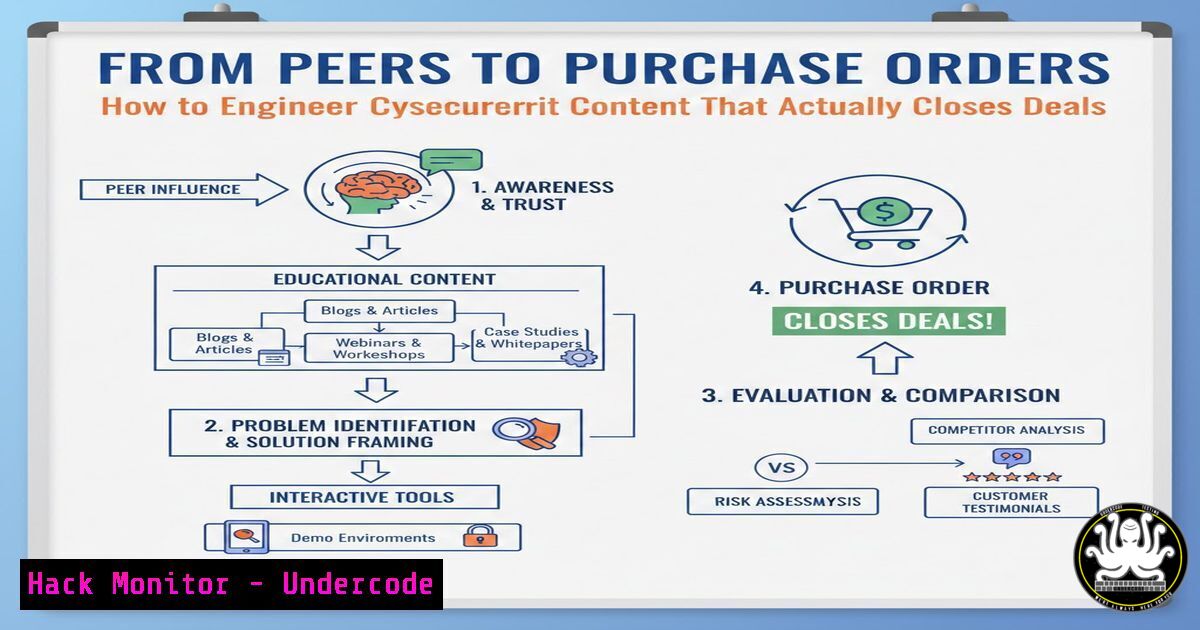
Introduction:
In the crowded arena of cybersecurity marketing, technical prowess alone is no longer a differentiator. True influence is measured not by peer admiration but by the ability to navigate the complex, risk-averse dynamics of enterprise buying committees. This article deconstructs why most thought leadership fails to drive revenue and provides a tactical blueprint for creating content that empowers every stakeholder in the security procurement process, ultimately making your solution the safe and defensible choice.
Learning Objectives:
- Understand the multifaceted concerns of each member in a cybersecurity buying committee (CISO, IT, Legal, Procurement, Finance).
- Learn to create technical content that translates into internal justification language for buyers.
- Implement practical tools and frameworks to audit and reshape existing content for direct commercial impact.
You Should Know:
- Mapping the Buying Committee: The Five-Way Pressure Cooker
The first step is to move beyond addressing a monolithic “buyer.” A cybersecurity purchase is a negotiated settlement between departments with conflicting priorities. Your content must speak to all of them simultaneously.
Step‑by‑step guide:
- Stakeholder Analysis: For every piece of content, create a simple matrix. Label columns: CISO, IT Ops, Legal/Compliance, Procurement, Finance. Label rows: Primary Fear, Success Metric, Internal Language.
- Content Audit: Take a recent whitepaper or blog post. Use the `grep` command on Linux or `Select-String` in PowerShell on Windows to search for jargon-heavy, technically isolated phrases.
Linux Command Example: `grep -n “advanced heuristic” your_whitepaper.md`
Windows PowerShell Example: `Select-String -Path .\your_whitepaper.md -Pattern “zero-day”`
Count how many terms serve only technical credibility versus those that address operational, legal, or financial risk.
3. Rewrite for Translation: For each technical claim (e.g., “Uses ML-driven behavioral analysis”), write a one-line translation for each stakeholder. For Finance: “Reduces manual investigation costs by X%.” For Legal: “Creates an audit trail for compliance with GDPR 32.”
- Building the “Internal Justification Kit”: Beyond the Datasheet
Your content must become ammunition for your champion. This means providing ready-to-use assets that fit into internal presentation templates and risk registers.
Step‑by‑step guide:
- Create a “Battle Card” Against Inaction: Develop a single-page document formatted for internal use. Structure it around the primary risks of not acting. Use headers like “Calculated Risk vs. Unmanaged Exposure.”
- Develop Pre-Built Risk Assessment Scripts: Provide simple, secure scripts buyers can run to demonstrate a vulnerability your product addresses. This turns your claim into their evidence.
Example Python Script Snippet (for illustrative purposes):
 Vulnerability Demo Script - Checks for weak TLS configurations
import ssl
import socket
def check_tls(hostname):
context = ssl.create_default_context()
with socket.create_connection((hostname, 443)) as sock:
with context.wrap_socket(sock, server_hostname=hostname) as ssock:
cert = ssock.getpeercert()
print(f"Cipher: {ssock.cipher()}")
 Add logic to evaluate certificate strength
3. Supply Slide Templates: Offer a downloadable PowerPoint slide deck section with editable slides titled “Addressing [Legal/IT/Finance] Concerns: Our Vendor’s Approach.”
3. Translating Technical Features into Political Cover
The CISO’s primary need is often “cover” — the ability to justify a decision to the board. Your content must explicitly provide that cover by aligning with frameworks and speaking the language of governance.
Step‑by‑step guide:
- Map to Frameworks: Create a public spreadsheet or interactive tool mapping your product’s capabilities directly to specific controls in NIST CSF, ISO 27001, MITRE ATT&CK, or CIS Benchmarks. Don’t just list them; explain the mapping.
- Draft an “Executive Briefing” Email: Provide a template email a CISO can forward to their CEO/Board. It should start with business risk, not technology. Template Start: “To address the board-identified priority of reducing operational downtime from security incidents, our recommended solution directly mitigates the top cause, which is…”
- Quantify “Blame Reduction”: Use case studies to statistically show how your solution reduces the frequency and severity of incidents that trigger post-mortem reviews and blame assignments.
4. Operationalizing Content for IT & DevOps
IT teams care about integration overhead, performance impact, and support burden. Technical deep-dives are good, but they must culminate in clear, operational commands and compatibility statements.
Step‑by‑step guide:
- Provide Verifiable Integration Commands: Give IT teams exact commands to test compatibility in their staging environment.
Kubernetes Integration Example:
 Add our security scanner Helm repo and do a dry-run install
helm repo add yourcompany-sec https://charts.yourcompany.com
helm install yourcompany-scanner yourcompany-sec/scanner --dry-run --debug --namespace security
2. Publish Detailed Performance Benchmarks: Show the exact CPU/Memory overhead of your agent in a CI/CD pipeline using tools like `perf` or time.
Linux Performance Test Command Example: `time docker run –rm -v /path/to/code:/src yourcompany/scanner:latest`
3. Create Troubleshooting Wikis: Publicly host a knowledge base that addresses common integration pitfalls, demonstrating you understand and ease their operational burden.
5. Arming Procurement with Vendor Comparison Matrices
Procurement uses RFPs and scoring matrices to level the playing field and gain negotiation leverage. By providing your own, you shape the criteria in your favor.
Step‑by‑step guide:
- Publish a “Total Cost of Ownership (TCO) Calculator”: Build an interactive web tool where buyers can input their scale, existing tools, and team size to generate a realistic 3-year TCO comparison vs. building in-house or using competitors.
- Pre-Fill the RFP: Offer a complete, well-formatted response to a standard security questionnaire (e.g., SIG, CAIQ). Make it downloadable in Word and Excel formats for easy copy-pasting.
- Create a “Competitive Differentiation” Guide: This internal document for your sales team should be adapted into a public-facing blog series titled “What to Look for in a [Your Category] Solution,” subtly establishing your features as the evaluation criteria.
What Undercode Say:
- Key Takeaway 1: The most powerful cybersecurity content is not an exhibit of knowledge, but a tool for de-risking a purchase decision. It must provide direct utility to the buyer in their internal political and procedural landscape.
- Key Takeaway 2: Influence is engineered through translation. The core technical work is table stakes; the real work is systematically translating features into financial justification, legal defensibility, operational simplicity, and personal cover for every stakeholder involved.
Analysis:
The post hits on a fundamental shift in B2B cybersecurity: the market has moved from being sold to to being sold through. Vendors are no longer the primary educators on risk; buyers are already informed but paralyzed by internal complexity. Therefore, the winning strategy is “enablement marketing.” This involves a deep systems-thinking approach to the client’s internal governance, not just their technical stack. The future of cybersecurity content lies in AI-driven tools that can dynamically customize justification kits based on a prospect’s industry, mentioned compliance frameworks, and even the inferred structure of their buying committee from LinkedIn data, making every piece of content feel personally engineered for their internal battle.
Prediction:
By 2026, AI will automate much of this translation layer. We’ll see the rise of “Contextual Content Engines” integrated into CRM platforms. These tools will auto-generate stakeholder-specific briefs, compliance mapping documents, and customized TCO models in real-time during sales cycles. The differentiator won’t be the static content a company produces, but the dynamic, adaptive, and audit-ready content it can generate for a specific deal at the push of a button. Cybersecurity marketing will become less about broad thought leadership and more about personalized decision-support systems, fundamentally merging sales engineering and content marketing functions.
▶️ Related Video (80% Match):
🎯Let’s Practice For Free:
IT/Security Reporter URL:
Reported By: Bhuvaneshkr Cybersecuritythoughtleadership – Hackers Feeds
Extra Hub: Undercode MoN
Basic Verification: Pass ✅


