Listen to this Post
Introduction:
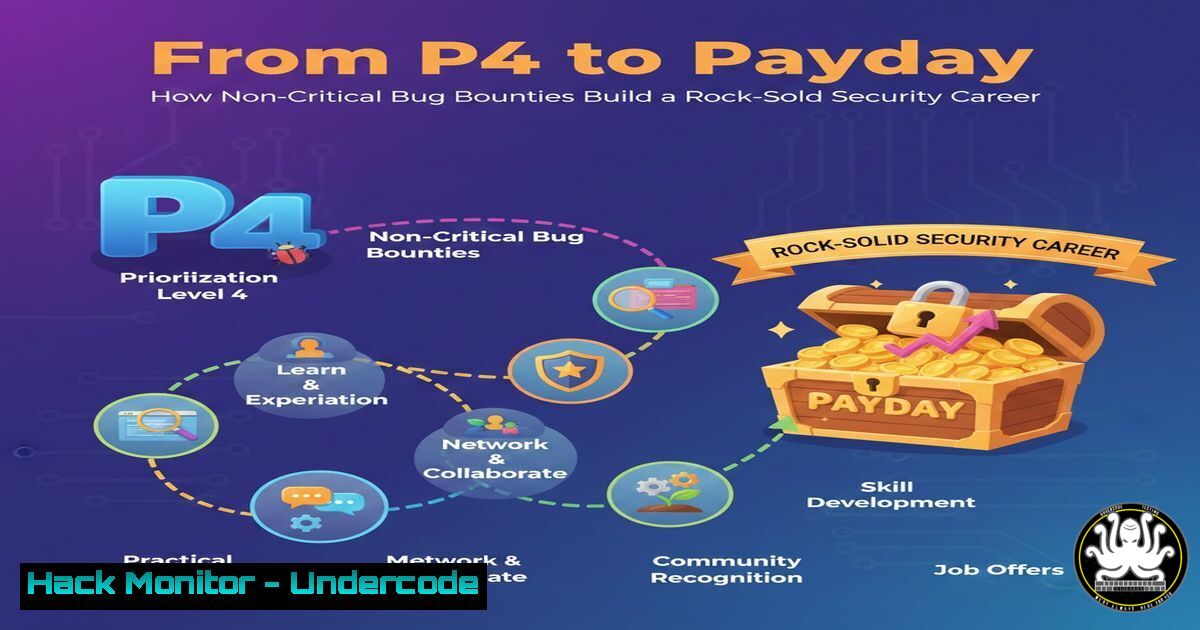
In the high-stakes world of bug bounty hunting, the spotlight often shines on critical remote code execution or SQL injection flaws. However, a sustainable and impactful career is built on mastering the fundamentals: consistent, high-quality reporting of lower-severity findings. This article deconstructs the journey from a validated P4 (low severity) report to a rewarded disclosure, outlining the technical processes and strategic mindset required to thrive in collaborative security research.
Learning Objectives:
- Understand the role and importance of P3/P4 severity findings in a comprehensive security posture.
- Learn the technical workflow for identifying, validating, and reporting lower-impact vulnerabilities.
- Develop the skills for crafting high-quality reports that demonstrate clear impact and reproducibility.
You Should Know:
1. The Strategic Mindset: Why P4 Findings Matter
Bug bounty platforms and VDPs categorize vulnerabilities using severity scales (e.g., Critical, High, Medium, Low/P4). A P4 issue might be an informational leak, a low-impact cross-site scripting (XSS), or a missing security header. While not immediately dangerous, they represent security gaps that can be chained with other flaws or indicate poor security hygiene. Hunting for these requires consistency and a deep understanding of “impact.” It trains you to think like an architect, not just a breaker, seeing how small weaknesses fit into a larger system.
2. Phase 1: Intelligent Reconnaissance & Target Selection
Before any testing, effective recon is key. This involves mapping an application’s attack surface to find less-obvious endpoints where lower-severity issues often hide.
Step‑by‑step guide:
- Subdomain Enumeration: Use tools like
sublist3r,amass, orsubfinder.sublist3r -d target.com -o subdomains.txt
- Content Discovery: Use `gobuster` or `ffuf` to find hidden directories, APIs, and configuration files.
gobuster dir -u https://api.target.com -w /usr/share/wordlists/dirb/common.txt -t 50
- Technology Fingerprinting: Use `Wappalyzer` (browser extension) or `whatweb` to identify frameworks, JavaScript libraries, and server headers that may have known low-severity misconfigurations.
whatweb https://target.com --color=never
3. Phase 2: Methodology for Finding P3/P4 Vulnerabilities
Focus on common low-severity flaw categories with a systematic approach.
Step‑by‑step guide (Example: Missing Security Headers):
- Manually inspect HTTP responses in browser developer tools (Network tab) or use a command-line tool like
curl.curl -I https://target.com
2. Look for missing headers such as:
– `Content-Security-Policy` (mitigates XSS)
– `X-Frame-Options` (prevents clickjacking)
– `Referrer-Policy` (controls referrer information)
– `Strict-Transport-Security` (enforces HTTPS)
3. Use automated scanners like `nikto` or `nuclei` (with community templates) to scan for these and other common misconfigurations.
nuclei -u https://target.com -t /path/to/misconfigurations-templates/
4. Phase 3: Validation and Proof-of-Concept (PoC) Creation
A report must prove the flaw exists and demonstrate its realistic, if limited, impact.
Step‑by‑step guide (Example: Reflected XSS on a non-sensitive page):
1. Locate Input: Find a parameter that reflects user input in the response (e.g., ?search=term).
2. Test Payload: Inject a basic payload like <svg onload=alert(1)>.
3. Validate & Document: If the payload executes, create a clean PoC. Write an HTML file or use a tool like `Burp Suite Collaborator` to prove interaction.
4. Assess Impact: Explain the context. E.g., “This XSS on the help page requires user interaction and does not access sensitive sessions, but it can be used in phishing campaigns to damage trust.”
- Phase 4: The Art of the High-Quality Report
This is where researchers are distinguished. A good report gets you accepted; a great one gets you rewarded.
Step‑by‑step guide:
- Clear and specific. “Missing Content-Security-Policy Header on https://app.target.com”
2. Summary: One-line overview of the vulnerability.
- Technical Details: Include the vulnerable URL, parameters, request/response snippets (with credentials redacted), and the exact steps to reproduce.
- Impact Analysis: Contextualize the business/security risk, even for P4. “While this information disclosure alone does not expose user data, it reveals server versions that can streamline attacks against known vulnerabilities.”
- Remediation Proposal: Provide actionable fixes. For a missing header, suggest the exact policy line: e.g., `Content-Security-Policy: default-src ‘self’;`
6. Essential Toolstack for the Modern Bug Hunter
Step‑by‑step guide to setting up a core environment:
- Proxy & Scanner: Configure `Burp Suite` or `OWASP ZAP` as your man-in-the-middle proxy for traffic inspection and automated scanning.
- Recon Automation: Set up a basic workflow using `bash` scripting to chain tools.
Simple recon script
echo "Running recon on $1"
subfinder -d $1 -o subs.txt
cat subs.txt | httpx -silent | tee live_urls.txt
nuclei -l live_urls.txt -t /nuclei-templates/http/exposures/ -o findings.txt
- Vulnerability Verification: Use
curl,wget, or custom Python scripts to reliably verify findings outside of GUI tools.
7. Navigating Program Rules and Building Reputation
Step‑by‑step guide:
- Read the Scope/Rules: Before testing, meticulously review the program’s policy. What assets are in/out-of-scope? What testing is forbidden?
- Practice Responsible Disclosure: Never exfiltrate data, always use test accounts, avoid automated scanning on production unless allowed.
- Communicate Professionally: Post-report, be polite and helpful in follow-up communications. This builds relationships for future collaborations.
What Undercode Say:
- Consistency Over Criticals: A stream of well-documented, valid P3/P4 reports demonstrates reliability and deep observational skills, making you a valued researcher more than a single critical find.
- Impact is Contextual: The ability to articulate how a minor flaw contributes to an attack chain or erodes security posture is a senior-level skill that transforms a simple finding into a valuable report.
Analysis: Sai Jayanth’s post underscores a maturity often missed in bug bounty discourse. The 45-day remediation timeline and reward eligibility for a P4 issue highlight that serious programs value comprehensive risk reduction, not just headline-grabbing exploits. This model benefits both parties: companies incrementally harden their assets, and researchers build a track record of professional, ethical work. It shifts the paradigm from a lottery-like hunt for criticals to a structured, skill-based profession focused on continuous improvement and collaboration.
Prediction:
The future of bug bounties and VDPs will increasingly formalize and reward this granular, consistent approach. We will see more programs implementing tiered rewards for all validated severity levels and offering “continuous engagement” roles for top researchers. AI will augment reconnaissance and initial analysis, but the human researcher’s skill in impact assessment, creative testing, and clear communication will become even more premium. This professionalization will further bridge the gap between external security researchers and internal AppSec teams, leading to more proactive and resilient software development lifecycles.
▶️ Related Video (82% Match):
🎯Let’s Practice For Free:
IT/Security Reporter URL:
Reported By: Sai Jayanth – Hackers Feeds
Extra Hub: Undercode MoN
Basic Verification: Pass ✅


