Listen to this Post
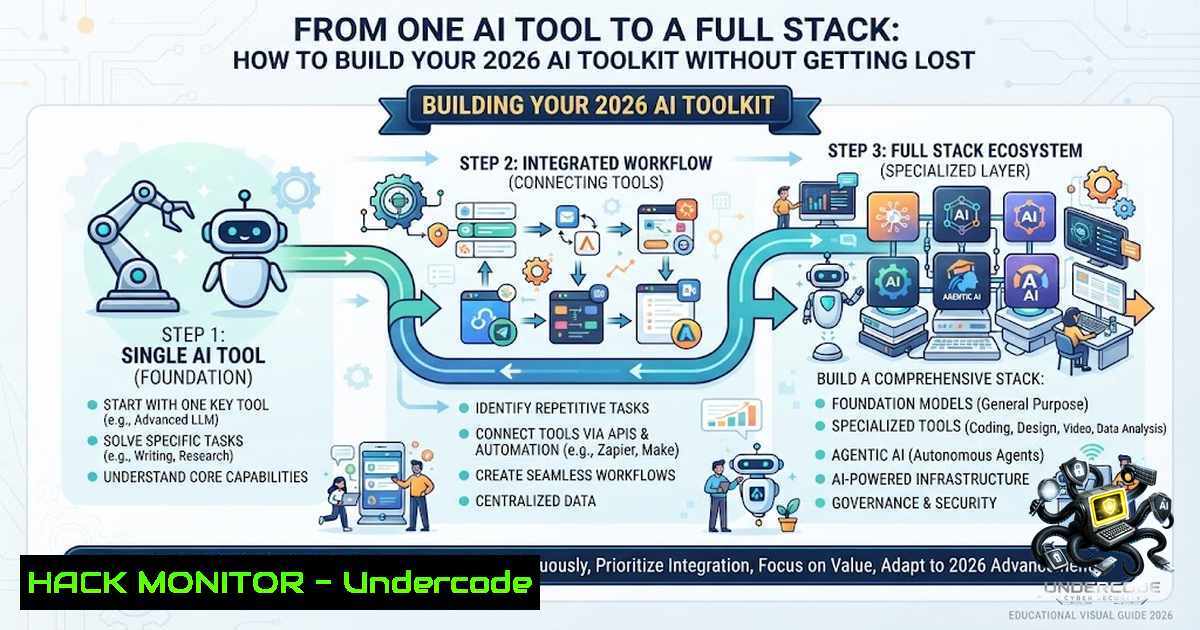
Introduction:
The artificial intelligence landscape has evolved far beyond the novelty of a single chatbot. In 2026, marketing professionals and IT leaders are realizing that AI is not a monolith but a diverse ecosystem of specialized tools, each designed for distinct functions. Just as a developer wouldn’t use a single programming language for every task, a modern marketer or security professional cannot rely on one AI model for research, content creation, automation, and analysis. The key to leveraging AI effectively lies in understanding the specific “job” each tool performs and integrating them into a cohesive, secure workflow that enhances productivity without introducing unnecessary risk or redundancy.
Learning Objectives:
- Understand the distinct roles of various AI tools across research, writing, design, video, and automation categories.
- Learn how to build a secure and efficient AI stack by selecting the right tool for each specific job.
- Gain practical knowledge on integrating these tools using APIs, automation platforms, and scripting to create a seamless workflow.
- Identify key cybersecurity and data privacy considerations when deploying third-party AI services in a professional environment.
You Should Know:
- The AI Stack Breakdown: Categorizing Tools for Maximum Impact
The foundation of an effective AI strategy is categorization. Rather than viewing AI as a single entity, successful teams break it down into functional layers. According to industry expert Jonathan Parsons, who has observed marketing teams split into two groups—the cautious single-tool users and the high-performance full-stack adopters—the gap between them is growing rapidly【0†L1-L8】. The “full stack” approach covers research, writing, design, video, audio, and automation, ensuring that every aspect of the content lifecycle is augmented by specialized AI【0†L9-L12】.
Research and Discovery: Tools like Perplexity and SciSpace are designed for rapid, trustworthy information retrieval. Perplexity acts as an AI-powered search engine that cites sources, making it ideal for fact-checking and preliminary research. SciSpace is tailored for academic and scientific literature, helping users navigate complex papers and extract key findings【0†L25-L26】. From a technical perspective, these tools often rely on large language models (LLMs) fine-tuned for retrieval-augmented generation (RAG), which allows them to pull from a vast index of web content and scholarly articles.
Writing and Editing: This category includes ChatGPT for brainstorming and content generation, and Grammarly for refinement and stylistic polishing【0†L27-L28】. ChatGPT, powered by OpenAI’s GPT series, excels at generating human-like text based on prompts. Grammarly uses a combination of rule-based systems and machine learning to check grammar, tone, and clarity. For technical teams, integrating these tools via APIs can automate content drafting and proofreading within existing content management systems (CMS) or development environments.
Design and Visuals: Tools like Canva and OpenAI’s GPT Image 2 have democratized graphic design. Canva offers a user-friendly interface with AI-powered design suggestions, while GPT Image 2 generates original images from text descriptions【0†L29-L30】. Higgsfield is another notable tool that combines video and image generation, allowing for the creation of dynamic visual assets【0†L29-L30】. For teams focused on brand consistency, these tools can be configured with specific style guides and color palettes to ensure all generated assets adhere to corporate identity standards.
Video and Audio: The multimedia stack includes Seedance 2 for video generation, VEED for editing, Riverside for podcast recording, ElevenLabs for voice synthesis, and Suno for music creation【0†L31-L32】. These tools represent a significant leap in generative AI, enabling the production of professional-grade audio and video content without a traditional studio. For instance, ElevenLabs offers text-to-speech with incredibly natural intonation, while Riverside provides high-fidelity remote recording and AI-powered post-production features like automatic transcription and editing.
Development and Automation: This is where the technical depth truly lies. Replit is an online IDE that allows for collaborative coding and deployment, often integrating AI pair programming. Zapier acts as the glue between thousands of apps, enabling no-code automation workflows. Claude Code (from Anthropic) is an AI assistant specifically designed for coding tasks, helping developers write, debug, and explain code【0†L33-L34】.
Productivity and Scheduling: Finally, tools like Notion for workspace management, Postiz for social media scheduling, HubSpot Breeze for marketing and sales automation, Jasper for marketing copy, and Writesonic for SEO-optimized content round out the stack【0†L35-L36】. These tools often include built-in AI features that suggest content, optimize posting times, and analyze performance metrics.
- Securing Your AI Stack: API Keys, Data Privacy, and Access Control
With a multi-tool AI stack comes a significant cybersecurity responsibility. Each tool typically requires API keys for integration, which must be managed securely to prevent unauthorized access and data breaches. A common mistake is hardcoding API keys directly into scripts or configuration files. Instead, organizations should use environment variables or dedicated secrets management tools like HashiCorp Vault or AWS Secrets Manager. For example, when using Zapier to connect ChatGPT with a CRM, the API key should be stored in Zapier’s secure vault, and the automation should use minimal required permissions (principle of least privilege).
Data privacy is another critical concern. Many AI tools, especially those used for content generation, may use input data to train their models unless explicitly opted out. For instance, when using OpenAI’s API, it is essential to review the data usage policy and, if necessary, configure the organization’s settings to disable data retention for API requests. For sensitive internal documents or proprietary research, consider using on-premises or private cloud deployments of open-source models (e.g., Llama, Mistral) to maintain full control over data. Additionally, implement data loss prevention (DLP) policies to scan outbound API requests for sensitive information like PII or financial data, blocking or redacting such content before it leaves the network.
Access control should be role-based. Not every marketer needs access to the video generation API or the code assistant. Implement single sign-on (SSO) and multi-factor authentication (MFA) across all AI tool subscriptions where possible. Regularly audit user access logs and API usage to detect anomalous activity, such as a sudden spike in API calls from an unusual location, which could indicate a compromised account.
- Automation and Integration: Building Workflows with APIs and Scripting
The true power of an AI stack is realized when tools are integrated into automated workflows. This is where technical skills in APIs, webhooks, and scripting languages like Python or JavaScript become invaluable. For example, a marketing team can set up an automation that triggers when a new research paper is added to a SciSpace library. A Python script using the SciSpace API can extract the abstract, send it to ChatGPT (via OpenAI API) for a summary, and then use the DALL-E API to generate a featured image, finally posting the entire package to a company blog via a CMS API.
Example: Automated Content Pipeline with Python
import requests
import os

Set environment variables for API keys
OPENAI_API_KEY = os.getenv("OPENAI_API_KEY")
SCISPACE_API_KEY = os.getenv("SCISPACE_API_KEY")
WORDPRESS_API_URL = os.getenv("WORDPRESS_API_URL")

def fetch_research(query):
headers = {"Authorization": f"Bearer {SCISPACE_API_KEY}"}
response = requests.get(f"https://api.scispace.com/search?q={query}", headers=headers)
return response.json()

def summarize_with_gpt(text):
headers = {"Authorization": f"Bearer {OPENAI_API_KEY}", "Content-Type": "application/json"}
data = {
"model": "gpt-4",
"messages": [{"role": "user", "content": f"Summarize this research: {text}"}]
}
response = requests.post("https://api.openai.com/v1/chat/completions", headers=headers, json=data)
return response.json()["choices"][bash]["message"]["content"]

def post_to_wordpress(title, content):
 WordPress REST API authentication and posting logic
pass

Workflow execution
research = fetch_research("AI in cybersecurity")
summary = summarize_with_gpt(research["abstract"])
post_to_wordpress("AI Research Update", summary)
This script demonstrates a simple but effective pipeline. For more complex workflows, tools like Zapier or Make (formerly Integromat) provide visual interfaces for connecting services without code. However, for custom logic, error handling, and complex data transformations, scripting remains the most flexible approach. Ensure that all scripts include proper error handling, retry logic for API rate limits, and logging for debugging.
- Command-Line Power: Managing AI Tools from Linux and Windows Terminals
For IT professionals and power users, many AI tools offer command-line interfaces (CLIs) or can be accessed via `curl` commands, enabling automation from scripts and terminal sessions. On Linux, tools like `jq` are invaluable for parsing JSON responses from APIs. On Windows, PowerShell or the Windows Subsystem for Linux (WSL) can be used similarly.
Example: Using cURL to Query an AI Model
 Linux/macOS or WSL on Windows
curl https://api.openai.com/v1/chat/completions \
-H "Content-Type: application/json" \
-H "Authorization: Bearer $OPENAI_API_KEY" \
-d '{
"model": "gpt-4",
"messages": [{"role": "user", "content": "Explain the role of AI in cybersecurity in one paragraph."}]
}' | jq '.choices[bash].message.content'
Windows PowerShell Example:
$headers = @{
"Content-Type" = "application/json"
"Authorization" = "Bearer $env:OPENAI_API_KEY"
}
$body = @{
model = "gpt-4"
messages = @(@{role="user"; content="Explain AI in cybersecurity."})
} | ConvertTo-Json
Invoke-RestMethod -Uri "https://api.openai.com/v1/chat/completions" -Method Post -Headers $headers -Body $body
These commands can be incorporated into larger shell scripts to automate daily tasks, such as generating daily security briefings from threat intelligence feeds, or automatically creating social media posts from internal announcements. For Windows administrators, integrating these PowerShell scripts into Task Scheduler can run them at specified intervals, ensuring timely content delivery without manual intervention.
5. AI for Cybersecurity Training and Awareness
Beyond marketing, AI tools are revolutionizing cybersecurity training and awareness. Platforms like HubSpot Breeze and Jasper can be repurposed to generate engaging security awareness content, such as phishing simulation emails, training modules, and policy documents. For instance, using ChatGPT, one can generate a variety of phishing email templates to test employees’ vigilance, ensuring they are realistic but distinguishable. Grammarly can then be used to polish these templates to remove any grammatical errors that might make them seem fake.
Moreover, AI-powered video tools like Synthesia (a competitor to Seedance) can create personalized security training videos for different departments, explaining specific threats relevant to their roles. For example, a video for the finance team can focus on business email compromise (BEC), while one for the engineering team can cover secure coding practices and dependency vulnerabilities. This tailored approach increases engagement and retention compared to generic, one-size-fits-all training.
From a defensive perspective, AI can also be used to generate realistic decoy content (honeytokens) to lure attackers. By deploying AI-generated fake documents, credentials, and internal communications, security teams can detect breaches earlier and gather intelligence on attacker tactics. Tools like Replit can be used to quickly prototype these decoy generation scripts, while Zapier can automate the deployment and monitoring of these assets across various platforms.
6. Future-Proofing: Evaluating and Updating Your AI Stack
The AI landscape is evolving at a breakneck pace. Tools that are cutting-edge today may be obsolete tomorrow, or new features may be added that make them redundant. Therefore, a key component of managing an AI stack is continuous evaluation and iteration. Establish a quarterly review process where each tool in the stack is assessed against its performance, cost, security posture, and alignment with business goals. Look for consolidation opportunities—for example, if a single tool now covers two categories effectively, consider phasing out the separate tools.
Additionally, stay informed about emerging AI regulations, such as the EU AI Act, which may impose compliance requirements on the use of certain AI applications, particularly those considered “high-risk.” Ensure that the tools you select have clear documentation on their compliance with these regulations. Implementing a vendor risk management (VRM) process for all AI vendors can help mitigate legal and reputational risks. This process should include reviewing their data processing agreements (DPAs), security certifications (e.g., SOC 2, ISO 27001), and incident response plans.
Finally, invest in upskilling your team. The most sophisticated AI stack is useless if the team doesn’t know how to use it effectively. Provide training on prompt engineering, API integration, and data privacy best practices. Encourage experimentation in a sandbox environment where team members can test new tools and features without affecting production workflows. This culture of continuous learning and adaptation is what ultimately separates high-performing teams from the rest.
What Undercode Say:
- Strategic Selection Over Tool Sprawl: The key takeaway is that more tools don’t equate to better results. The focus should be on selecting the right tool for each specific job within a well-defined workflow. As Jonathan Parsons notes, “More tools isn’t the move. The right tools, in the right workflow, doing distinct jobs. That’s the move.”【0†L17-L20】 This philosophy prevents redundancy and ensures each tool adds tangible value.
- Phased Implementation: Trying to adopt all tools simultaneously is a recipe for confusion and low adoption. The recommended approach is to “start with one from each category” but not all at once【0†L49-L51】. Master one category, like research or writing, before expanding. This allows for proper training, integration, and measurement of ROI for each tool, building a solid foundation for the entire stack.
- Security and Integration are Foundational: Beyond tool selection, the technical integration and security of the stack are paramount. Proper API key management, data privacy policies, and automated workflows are not optional extras but core components of a successful AI strategy. The analysis of the post’s content highlights that while the marketing benefits are emphasized, the underlying technical infrastructure must be robust and secure to prevent data leaks and ensure compliance.
Prediction:
- +1 The integration of AI tools will become increasingly seamless, with major platforms offering native AI capabilities that reduce the need for third-party point solutions, leading to more unified and secure ecosystems.
- -1 As the number of AI tools proliferates, the attack surface for cyber threats will expand, necessitating more sophisticated AI-driven security measures to protect API keys, data in transit, and user privacy.
- +1 The demand for professionals who can bridge the gap between AI tool usage and cybersecurity (e.g., “AI Security Engineers”) will surge, creating new career opportunities and driving the development of specialized training and certification programs.
- -1 The regulatory landscape for AI will tighten, potentially slowing down the adoption of certain tools in highly regulated industries, as organizations grapple with compliance requirements and vendor risk management.
▶️ Related Video (72% Match):
🎯Let’s Practice For Free:
🎓 Live Courses & Certifications:
Join Undercode Academy for Verified Certifications
🚀 Request a Custom Project:
Secure, high-velocity infrastructure and disruptive technological engineering. Contact our engineering team for high-tier development and proprietary systems:
[email protected]
💎 Smart Architecture | 🛡️ Secure by Design | ⭐ Trusted by Thousands
IT/Security Reporter URL:
Reported By: Jonathan Parsons – Hackers Feeds
Extra Hub: Undercode MoN
Basic Verification: Pass ✅


