Listen to this Post
Introduction:
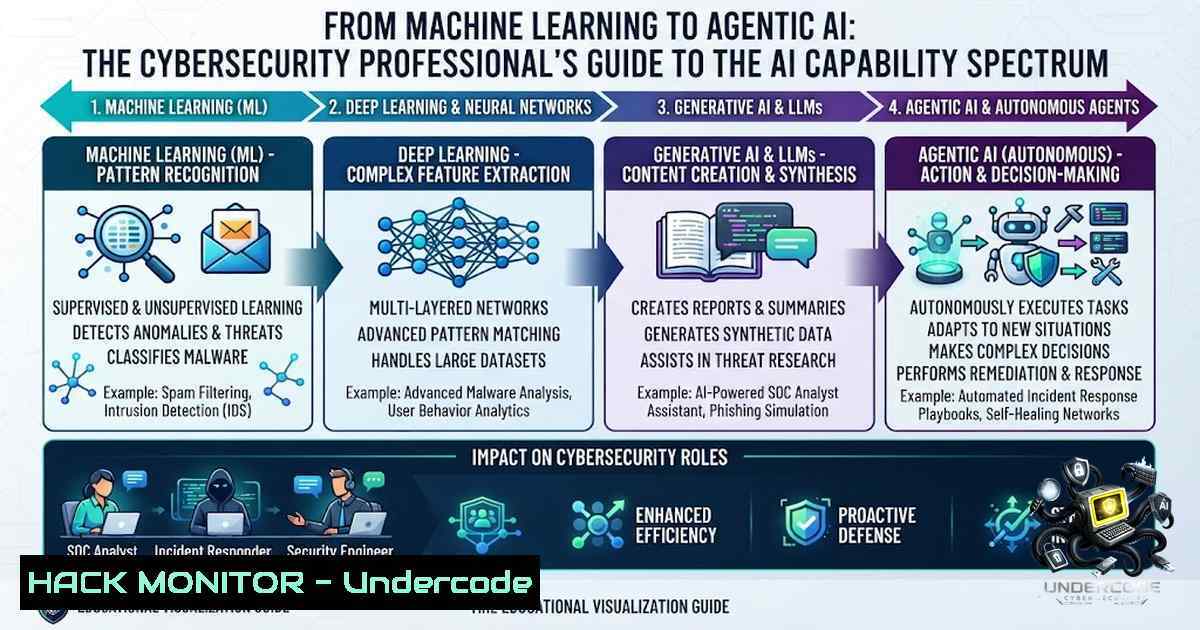
The artificial intelligence landscape is rapidly evolving, and for cybersecurity professionals, understanding the nuanced differences between Machine Learning, Generative AI, and Agentic AI is no longer optional—it’s a necessity for building resilient defense systems. While many confuse these terms, viewing them as a linear progression of the same technology, each represents a distinct capability that can be strategically applied to different security challenges, from predictive threat detection to autonomous incident response. This article demystifies the AI capability spectrum, providing a practical, hands-on guide for integrating these technologies into your security operations, complete with verified commands and configurations.
Learning Objectives:
- Differentiate between the five levels of AI—from Analyst to Organization—and map them to specific cybersecurity use cases.
- Implement practical AI and automation workflows using open-source tools and command-line interfaces across Linux and Windows environments.
- Apply security hardening techniques to AI models and APIs, mitigating risks associated with prompt injection, data poisoning, and model theft.
You Should Know:
- Decoding the AI Capability Spectrum for Security Operations
The LinkedIn post by Vijayaraj Suyambu introduces a crucial framework: the AI Capability Spectrum, remembered by the acronym A-E-C-M-O (Analyst, Expert, Creative, Manager, Organization). In a cybersecurity context, this spectrum translates directly into a hierarchy of defensive and offensive capabilities.
- Type 1: Machine Learning (The Analyst) – Turns raw data into insights, forecasts patterns, and classifies outcomes. In security, this is the foundation of anomaly detection. Tools like Splunk or Elasticsearch use ML to baseline “normal” network behavior and flag deviations.
- Type 2: Deep Learning (The Expert) – Models complex patterns at scale, powering vision, NLP, and speech systems. For cybersecurity, this means advanced malware classification using deep neural networks that analyze file signatures or network traffic patterns with superhuman accuracy.
- Type 3: Generative AI (The Creative Assistant) – Creates content, code, and designs at scale; summarizes, translates, and generates synthetic data. Red teams use GenAI to automate the creation of phishing emails or generate code for penetration testing, while blue teams use it to synthesize training data for security awareness programs.
- Type 4: AI Agents (The Manager) – Automates multi-step workflows end-to-end, uses tools, maintains context, and adapts in real-time. A security AI agent could autonomously triage alerts, correlate data from SIEM and EDR, and even execute predefined response playbooks.
- Type 5: Agentic AI (The Organization) – Coordinates multiple autonomous agents, self-corrects, and ensures compliance and safety. This is the holy grail of security automation: a system of AI agents working together to manage an entire security operations center (SOC), from threat hunting to patch management, with minimal human intervention.
The key takeaway is that it’s not about which AI is “better,” but about matching the capability to your specific security use case. Ask yourself: Do you need insights or actions? A single task or a multi-step workflow? Human oversight or full autonomy?
- Practical Implementation: Building Your First Security AI Agent (Linux)
To move from theory to practice, let’s build a simple AI agent capable of analyzing system logs for anomalies. We’ll use Python, the `transformers` library for NLP, and `subprocess` to interact with the system. This agent acts as a “Manager” (Type 4) by taking a multi-step workflow: read logs, analyze them with an LLM, and generate a summary report.
Step 1: Environment Setup (Linux)
 Update system and install Python virtual environment
sudo apt update && sudo apt install python3-pip python3-venv -y
python3 -m venv security_agent
source security_agent/bin/activate
Step 2: Install Dependencies
pip install transformers torch pandas
Step 3: Create the Agent Script
Create a file named `log_analyzer.py`:
import subprocess
import pandas as pd
from transformers import pipeline

Initialize the LLM for summarization
summarizer = pipeline("summarization", model="facebook/bart-large-cnn")

def get_recent_logs(lines=50):
"""Extract recent system logs using journalctl."""
result = subprocess.run(['journalctl', '-1', str(lines), '--1o-pager'],
capture_output=True, text=True)
return result.stdout

def analyze_logs(log_data):
"""Use LLM to identify potential security issues."""
 Truncate log data if too long for the model
if len(log_data) > 1024:
log_data = log_data[:1024]
summary = summarizer(log_data, max_length=150, min_length=30, do_sample=False)
return summary[bash]['summary_text']

if <strong>name</strong> == "<strong>main</strong>":
print("[] Fetching system logs...")
logs = get_recent_logs(100)
print("[] Analyzing logs for anomalies...")
analysis = analyze_logs(logs)
print("\n Security Agent Report ")
print(analysis)
print("--")
Step 4: Run the Agent
python log_analyzer.py
This script demonstrates a basic AI agent that automates the analysis of system logs. In a production environment, you would integrate this with a SIEM, add alerting mechanisms, and implement role-based access control.
- API Security: Hardening Your AI Models (Windows & Linux)
Deploying AI models often involves exposing them via REST APIs. This introduces significant security risks, including prompt injection, denial of service, and data leakage. Here’s how to harden your AI API endpoints.
- Input Validation and Sanitization: Always validate and sanitize inputs to prevent injection attacks. On both Linux and Windows, you can implement regex-based filtering or use libraries like `bleach` for Python.
- Rate Limiting: Prevent DoS attacks by limiting the number of requests per user. On Linux, you can use `fail2ban` or
iptables. On Windows, you can configure IIS or use a web application firewall (WAF). - Authentication and Authorization: Implement strong authentication using API keys or OAuth 2.0. Never hardcode credentials in your scripts.
Linux Command to Set Up a Basic Firewall for an AI API (Port 5000)
sudo ufw allow from 192.168.1.0/24 to any port 5000 proto tcp
sudo ufw enable
This restricts access to the AI API to only the local network.
Windows PowerShell Command for Network Security
New-1etFirewallRule -DisplayName "Allow AI API from Local Subnet" -Direction Inbound -LocalPort 5000 -Protocol TCP -Action Allow -RemoteAddress 192.168.1.0/24
4. Cloud Hardening for AI Workloads
When moving AI to the cloud, the attack surface expands. Key hardening steps include:
– Identity and Access Management (IAM): Enforce the principle of least privilege. For example, an AI model should not have write access to your production database.
– Data Encryption: Encrypt data at rest and in transit. Use AWS KMS, Azure Key Vault, or Google Cloud KMS.
– Secure Model Storage: Store trained models in secure, version-controlled repositories with access logging enabled.
– Vulnerability Scanning: Regularly scan your container images (e.g., Docker) for known vulnerabilities.
Dockerfile Security Best Practices Example
FROM python:3.9-slim
 Run as a non-root user
RUN useradd -m -u 1000 appuser
USER appuser
WORKDIR /app
COPY requirements.txt .
RUN pip install --1o-cache-dir -r requirements.txt
COPY . .
CMD ["python", "app.py"]
- Vulnerability Exploitation and Mitigation: The AI Attack Surface
Understanding the attack surface is crucial for both offense and defense. Common AI vulnerabilities include:
– Prompt Injection: Attackers craft inputs that manipulate the LLM into ignoring its system prompts and performing unintended actions. Mitigation: implement strict input filtering and context isolation.
– Data Poisoning: Attackers compromise the training data to introduce backdoors or biases. Mitigation: use data provenance tracking and anomaly detection on training datasets.
– Model Stealing: Attackers query the API repeatedly to replicate the model’s functionality. Mitigation: implement query rate limiting and add noise to outputs (differential privacy).
Linux Command to Monitor Unusual API Traffic
sudo tcpdump -i eth0 port 5000 -c 100 -w api_traffic.pcap
 Analyze with Wireshark or tshark
tshark -r api_traffic.pcap -Y "http.request.method == POST" -T fields -e ip.src -e http.request.uri
What Undercode Say:
- Key Takeaway 1: The AI capability spectrum is not a one-size-fits-all ladder; it’s a strategic framework. Cybersecurity teams must map their specific needs—whether it’s predictive threat intelligence (ML), automated playbooks (AI Agents), or full-scale orchestration (Agentic AI)—to the right AI type.
- Key Takeaway 2: Operationalizing AI in security requires more than just deploying a model. It demands a holistic approach that includes robust API security, cloud hardening, and continuous monitoring of the AI’s behavior to detect and mitigate novel attack vectors like prompt injection and model theft.
Analysis:
The post’s core message about the AI spectrum is particularly resonant for the cybersecurity industry, which is often caught between the promise of automation and the fear of loss of control. The distinction between an “AI Agent” (Manager) and “Agentic AI” (Organization) highlights a critical governance issue: while we can deploy agents to handle routine tasks, the shift to Agentic AI introduces complex challenges around accountability, compliance, and safety. The “A-E-C-M-O” model provides a common language for security architects to discuss AI capabilities with stakeholders, ensuring that the chosen solution aligns with the organization’s risk appetite. However, the post’s optimistic view of AI’s capabilities must be tempered with a realistic assessment of its vulnerabilities. As we move toward more autonomous systems, the security of the AI itself becomes paramount, requiring a new breed of security professional who understands both cybersecurity and AI fundamentals.
Prediction:
- +1 The adoption of Agentic AI in cybersecurity will significantly reduce mean time to respond (MTTR) to incidents, as autonomous agents can execute complex containment and remediation workflows in milliseconds, far outpacing human capabilities.
- -1 The rise of AI agents will create a massive new attack surface. Malicious actors will increasingly target the communication channels between agents, leading to a new class of “agent-to-agent” (A2A) attacks that could undermine entire security ecosystems.
- +1 The demand for cybersecurity professionals with AI and machine learning skills will skyrocket, creating lucrative opportunities for those who can bridge the gap between these two fields.
- -1 Without robust regulatory frameworks and industry standards, the deployment of Agentic AI could lead to catastrophic failures where a single compromised agent triggers a cascade of unintended actions across an entire organization’s infrastructure.
- +1 Open-source security tools integrated with AI agents will democratize advanced threat detection, enabling smaller organizations to compete with larger enterprises in terms of security posture.
▶️ Related Video (78% Match):
🎯Let’s Practice For Free:
🎓 Live Courses & Certifications:
Join Undercode Academy for Verified Certifications
🚀 Request a Custom Project:
Secure, high-velocity infrastructure and disruptive technological engineering. Contact our engineering team for high-tier development and proprietary systems:
[email protected]
💎 Smart Architecture | 🛡️ Secure by Design | ⭐ Trusted by Thousands
IT/Security Reporter URL:
Reported By: Vijay Software – Hackers Feeds
Extra Hub: Undercode MoN
Basic Verification: Pass ✅


