Listen to this Post
Introduction:
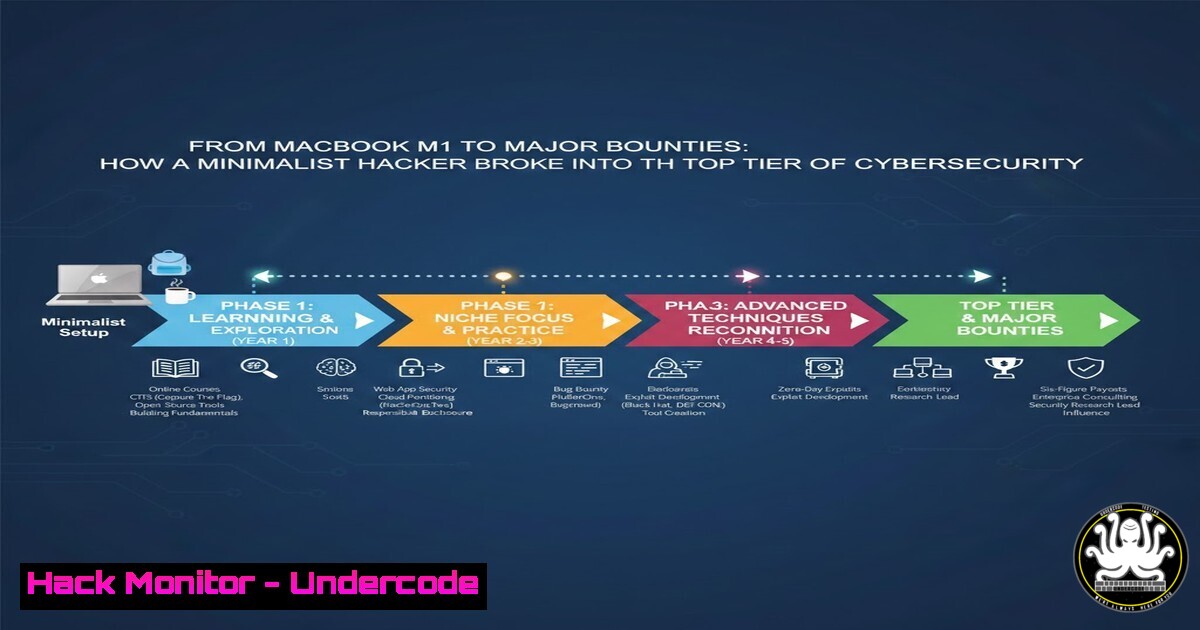
In a world where cybersecurity is often equated with expensive labs and advanced hardware, Arit Dutta’s journey shatters the myth. Using a standard M1 MacBook Air and a budget Android phone, he achieved elite status within a single year of bug bounty hunting, securing awards from industry giants like Google and HackerOne. His story underscores a fundamental truth in offensive security: mindset, methodology, and persistent learning trump a high-tech setup. This article deconstructs the practical, actionable skills and resource-efficient strategies that can propel any aspiring researcher from beginner to a financially independent professional.
Learning Objectives:
- Understand the core, low-cost toolkit and methodologies for effective bug bounty hunting.
- Learn fundamental reconnaissance and vulnerability validation techniques applicable across platforms.
- Develop a continuous learning framework using free and open-source resources to advance in cybersecurity.
You Should Know:
1. Building Your Zero-Cost Reconnaissance Engine
The cornerstone of any successful bug bounty hunt is reconnaissance (recon). Without a budget, you must master free, powerful tools that automate the discovery of assets and vulnerabilities.
Step‑by‑step guide:
Subdomain Enumeration: Use `subfinder` and assetfinder. These CLI tools scour numerous sources to find subdomains.
Linux/macOS Commands:
 Install the tools
go install github.com/projectdiscovery/subfinder/v2/cmd/subfinder@latest
go install github.com/tomnomnom/assetfinder@latest
 Basic enumeration
subfinder -d target.com -silent > subdomains.txt
assetfinder --subs-only target.com >> subdomains.txt
sort -u subdomains.txt -o final_subs.txt
Probing for Live Hosts & HTTP Servers: Feed your subdomain list into `httpx` to identify live web servers.
 Install httpx
go install github.com/projectdiscovery/httpx/cmd/httpx@latest
 Probe for live hosts
httpx -l final_subs.txt -title -status-code -tech-detect -o live_targets.txt
Crawling for Endpoints: Use `gau` (GetAllURLs) to fetch historical URLs from AlienVault’s OTX and Common Crawl.
 Install gau
go install github.com/lc/gau/v2/cmd/gau@latest
 Fetch URLs for a domain
gau target.com | grep -v ".png|.jpg|.css" > urls.txt
This automated pipeline, run from a simple terminal, creates a target-rich environment for manual testing at no cost.
- The Art of Manual Vulnerability Discovery & Validation
Automation finds surface areas; critical bugs are found through manual, intelligent testing. Focus on logic flaws and business-level vulnerabilities.
Step‑by‑step guide:
Identify Key Functionality: Map the application’s core features (e.g., user registration, payment flows, file uploads, role-based dashboards).
Test for Broken Access Control: This is a top OWASP risk. Log in as a low-privilege user and attempt to access administrative endpoints or another user’s data by manipulating object IDs (Insecure Direct Object References – IDOR).
Example: If a URL is https://app.com/user/account?id=456`, change the `id` parameter to457`. If you can view another user’s account, you’ve found a critical IDOR.
Validate with Simple Proofs: Use browser developer tools (F12) or a proxy like Burp Suite Community Edition.
Replay & Modify Requests: Capture a request, change parameters, and send it. A successful, unauthorized response confirms the bug. Always document the exact steps, HTTP requests, and responses.
3. Leveraging Free Training & Practice Labs
Continuous learning is non-negotiable. Dutta’s reference to “THM Top 1%” points to platforms like TryHackMe (THM) and Hack The Box (HTB) for structured, hands-on learning.
Step‑by‑step guide:
Start with Structured Paths: On TryHackMe, follow the “Complete Beginner” and “Web Fundamentals” paths.
Practice on Active Machines: On Hack The Box (free tier), start with “Starting Point” machines. They guide you through fundamental enumeration and exploitation techniques.
Simulate Real Bugs: Use intentionally vulnerable apps like OWASP Juice Shop or Damn Vulnerable Web Application (DVWA) on a local VM (using VirtualBox). Test your skills in a safe, legal environment.
4. Essential Open-Source Toolkit Configuration
Configure your MacBook or Linux machine with a standard, efficient toolkit.
Step‑by‑step guide:
Set Up a Coding/Note-taking Environment: Use VS Code with extensions for markdown (note-taking) and relevant programming languages.
Install a Proxy for Traffic Inspection: Burp Suite Community Edition is essential. Configure your browser to use it as a proxy (127.0.0.1:8080).
Master Command-Line Utilities: As shown in Section 1, proficiency in tools like grep, awk, sort, and `jq` (for parsing JSON) is critical for processing data.
 Example: Extracting specific JSON values from a tool's output
cat scan.json | jq '.hosts[] | .ip'  Parses and prints IPs
- Developing the Hacker Mindset: Curiosity & Pattern Recognition
Technical skill is half the battle. The “miracle” Dutta mentions is the shift to a persistent, curious mindset.
Step‑by‑step guide:
Ask “What If?” Constantly: For every parameter, ask: What if it’s negative? What if I change this user_id? What if I upload a `.jpg` with PHP code inside?
Document Everything: Keep a detailed log of tests performed, even failed ones. Patterns will emerge over time.
Learn from Public Reports: Study disclosed reports on HackerOne and Bugcrowd. Understand the researcher’s thought process, not just the bug.
- Navigating Bug Bounty Platforms & Writing Effective Reports
Finding a bug is only 50%; getting it triaged and paid requires clear communication.
Step‑by‑step guide:
Choose Programs Wisely: Start with programs that have a clear scope, a good volume of assets, and a reputation for fair triage (many beginners start with the public programs on OpenBugBounty or certain VDPs).
Craft a Compelling Report:
- Clear “IDOR on /api/v1/account leading to unauthorized access to user PII.”
- Detailed Steps: Numbered, reproducible steps with zero ambiguity.
- Proof of Concept (PoC): Include screenshots, videos, or curl commands.
- Impact Analysis: Explain the business risk (e.g., “This allows any user to view the personal data of all other users, violating GDPR and causing reputational damage.”).
7. Maintaining Operational Security (OpSec) & Ethics
Your activity can be mistaken for an attack. Protect yourself and operate ethically.
Step‑by‑step guide:
Use VPNs/Proxies: Always connect through a VPN to avoid having your home IP blacklisted by target systems.
Stay Within Scope: Only test domains and applications explicitly listed in the program’s scope. Testing out-of-scope assets can lead to legal trouble and program bans.
Do Not Exfiltrate Data: If you find a data leak, prove it with a limited, non-invasive sample (e.g., showing only your own test data or a few non-sensitive records). Never download large datasets.
What Undercode Say:
- The Barrier to Entry is Psychological, Not Financial. Arit Dutta’s success is a powerful antidote to imposter syndrome fueled by gear envy. The most sophisticated tool in your arsenal is your ability to learn, adapt, and think creatively. Free resources, community knowledge, and relentless practice are the true equalizers.
- Financial Independence is a Byproduct of Skill Mastery. The narrative shifts from “chasing bounties” to “mastering a craft.” The financial rewards in cybersecurity are a direct correlation to the value of your skills and the robustness of your methodology. Independence comes from becoming a consistent, reliable finder of critical security flaws.
Analysis: Dutta’s post is a nuanced critique of the influencer-driven culture that often plagues the security community. By explicitly rejecting referral links and paid courses, he highlights the saturated market of “shortcuts” and redirects focus to core, grind-based proficiency. His minimalist setup is not a limitation but a strategic advantage—it forces a deeper understanding of fundamentals over reliance on black-box automation. This approach breeds a more resilient and adaptable researcher, capable of working in resource-constrained environments, which is often the reality in real-world security assessments. The post ultimately champions a meritocratic path where success is dictated by output (valid bugs) rather than optics (fancy setups).
Prediction:
The “minimalist hacker” model will gain significant traction, leading to a democratization of bug bounty hunting and red teaming. We will see a rise in cloud-native, lightweight toolchains (like the PDAP – Project Discovery Attack Platform) that are accessible from any machine with a browser. Major platforms will likely invest more in integrated, low-footprint training environments to lower barriers further. Simultaneously, the market will demand higher-quality reports and deeper impact analysis, as the volume of hunters increases. This will bifurcate the community: those who rely on shallow, automated scanning will be filtered out, while critical thinkers with disciplined methodologies, regardless of their hardware, will become increasingly valuable and sought after.
▶️ Related Video (74% Match):
🎯Let’s Practice For Free:
IT/Security Reporter URL:
Reported By: Iamarit 1st – Hackers Feeds
Extra Hub: Undercode MoN
Basic Verification: Pass ✅


