Listen to this Post
Introduction:
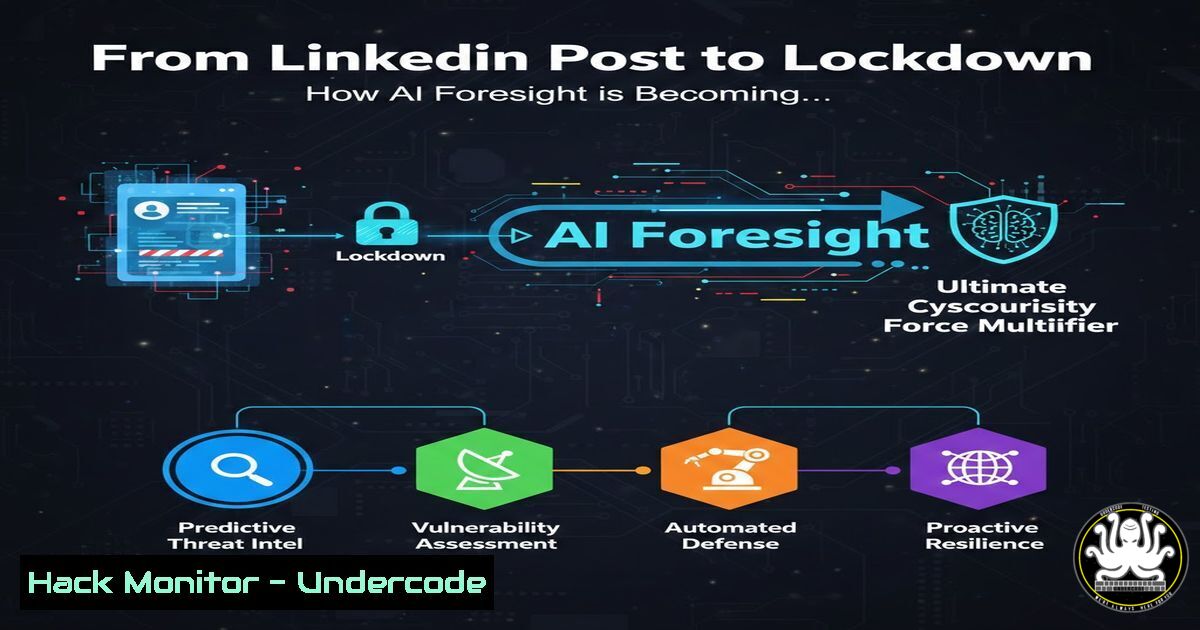
The completion of an advanced AI certificate program by a risk policy leader underscores a seismic shift in strategic defense. Beyond mere tool usage, the professional craft of AI-augmented foresight—combining disciplined scenario logic, bias awareness, and advanced prompt engineering—is emerging as a critical acceleration layer for cybersecurity and IT resilience. This approach transforms how organizations anticipate threats, automate responses, and harden systems against evolving attacks.
Learning Objectives:
- Integrate AI-driven scenario planning into cyber threat intelligence and incident response workflows.
- Master advanced prompt engineering techniques to generate decision-grade security analyses and automated mitigation scripts.
- Implement a structured “AI acceleration layer” to harden cloud architectures and API security under time pressure.
You Should Know:
1. Automating Threat Intelligence with AI-Powered Foresight
The core concept is using AI as an “acceleration layer for foresight” to explore alternative attack vectors faster. This involves feeding threat feeds, logs, and TTPs (Tactics, Techniques, and Procedures) into structured AI models to simulate potential future campaigns.
Step-by-step guide:
- Aggregate Data: Use tools like `curl` or Python’s `requests` library to pull from OSINT feeds (e.g., AlienVault OTX, MISP instances).
Example: Fetch recent IOC feed
curl -s -H "Authorization: Bearer $API_KEY" https://otx.alienvault.com/api/v1/pulses/subscribed
- Structure the Engineer a prompt for an LLM (like GPT-4 or Claude) or a specialized AI platform:
“Analyze the following list of IOCs [paste IOCs]. Generate three potential near-future attack scenarios targeting a financial cloud infrastructure. For each scenario, list: 1) Likely attacker profile, 2) Primary exploitation path, 3) Two critical MITRE ATT&CK techniques, 4) A one-line Sigma detection rule concept.” - Iterate and Calibrate: Refine prompts based on output relevance. Use constraints like “Prioritize scenarios involving supply chain compromises” to focus the AI.
- Integrate into Workflow: Feed AI-generated scenarios into a SIEM for hypothesis-driven hunting or into a SOAR for playbook development.
2. Advanced Prompt Engineering for Security Script Generation
Professional prompt engineering moves beyond simple queries to structured iteration and constraint design, producing actionable code.
Step-by-step guide:
- Define the Task Precisely: Instead of “write a security script,” use:
“Generate a Python script that: a) Takes a CIDR range as input, b) Performs a non-intrusive TCP SYN scan on ports 22, 443, 8443, c) Compares results against a known-good baseline JSON file, d) Outputs only NEW open ports with service banners. Include error handling and logging.”
2. Specify Environment & Constraints:
“Use the `socket` and `json` libraries only. Ensure the script runs on Python 3.8+ on Linux. Do not use scapy.”
3. Iterate for Security Hardening: Follow up with:
“Refactor the previous script to: 1) Run with minimal privileges (hint: drop capabilities after socket creation), 2) Add a configurable rate limit to 100 packets/second, 3) Validate input CIDR to prevent command injection.”
4. Test in Sandbox: Always run generated code in an isolated environment first.
 Isolate using a container
docker run --rm -it -v $(pwd)/script.py:/script.py python:3.10-slim python /script.py 10.0.0.0/24
3. Building “Scenario Architectures” for Incident Response
AI-sharpened scenario logic helps build resilient response playbooks that “hold together under stress.”
Step-by-step guide:
- Map Critical Assets & Dependencies: Use infrastructure-as-code (IaC) or CMDB exports to define the battlefield.
- Prompt for Failure Modes: “Given a Kubernetes cluster running microservices with a public-facing API gateway, describe three systemic failure scenarios where a container breakout leads to lateral movement. For each, provide a sequence of 5 commands an attacker would use, and the corresponding 5 commands for a defender to isolate and取证.”
Example Attacker Command: `kubectl get secrets –all-namespaces` (post-breakout).
Example Defender Response: kubectl cordon node <compromised-node> && kubectl drain --ignore-daemonsets <compromised-node>.
3. Stress-Test the Playbook: Use the AI to generate “what-if” mutations: “Now assume the attacker has disabled `kubectl` on the node. How does the response change?”
4. Automate Playbook Creation: Convert the validated scenario into an Ansible playbook or SOAR workflow.
4. AI-Calibrated Hardening for Cloud & API Security
Use AI to generate and verify hardening commands, ensuring consistency and compliance.
Step-by-step guide for AWS S3 Bucket Hardening:
- Prompt for Audit: “Generate an AWS CLI command to list all S3 buckets and their public access block configuration.”
aws s3api list-buckets --query "Buckets[].Name" --output text | xargs -I {} sh -c 'echo {} && aws s3api get-public-access-block --bucket {}' - Prompt for Remediation Script: “Write a Bash script that enables all four public access block settings on all buckets in an AWS account, skipping any that cause errors, and logs actions.”
- Prompt for API Security Validation: “Generate a `curl` command to test for missing security headers on an API endpoint, checking for
Strict-Transport-Security,Content-Security-Policy, andX-Content-Type-Options.”curl -I -s https://api.example.com/v1/user | grep -i "strict-transport-security|content-security-policy|x-content-type-options"
5. Quantifying Risk & Prioritization for Senior Leaders
Translate technical findings into executive risk briefs using AI as a translation and prioritization layer.
Step-by-step guide:
- Feed Raw Data: Input vulnerability scan results (e.g., Nessus CSV) and asset criticality scores.
- Structured “Analyze this vulnerability data. Categorize findings into ‘Critical’, ‘High’, ‘Medium’ based on CVSS score, exposed asset value, and existence of known exploitation. For the top 3 ‘Critical’ items, generate a two-sentence business risk explanation for a CEO, focusing on financial and reputational impact.”
- Generate Reporting Artifacts: Direct the AI to “Output the result in a markdown table suitable for a board report, including recommended immediate action and owner.”
What Undercode Say:
- AI is a Strategic Craft, Not a Magic Box: The true value lies in disciplined methodology—constraint design, structured iteration, and calibration—turning generative AI into a reliable partner for high-stakes security decisions.
- The Human-in-the-Loop is Non-Negotiable: AI accelerates foresight and automates tasks, but human expertise is required to validate outputs, apply ethical judgment, and manage bias awareness, especially when generating code or attack scenarios.
Analysis: The post highlights a maturation in AI adoption within risk and security domains. It’s no longer about asking ChatGPT “how to hack.” It’s about building a repeatable, professional discipline where AI handles the heavy lifting of data synthesis, scenario generation, and code creation, freeing experts to focus on strategic validation, decision-making, and managing systemic risk. This “acceleration layer” is becoming essential to keep pace with adversaries who may themselves be leveraging similar technologies. The integration into real-world workflows—from prompt to production script to hardened cloud config—demonstrates the operational readiness of this approach.
Prediction:
Within 2-3 years, AI-augmented security orchestration will become standard in SOCs and cyber risk management. We will see the rise of “Security Foresight Engineers” who specialize in calibrating AI models for threat simulation and automated mitigation. Concurrently, a new attack surface will emerge: the poisoning and manipulation of these very AI models that organizations rely on for defense. The next frontier will be “AI-on-AI” security, where defenders use their own AI systems to detect and neutralize adversarial AI attempts to corrupt scenario planning, prompt injection, and automated response systems, leading to an algorithmic arms race in cybersecurity.
▶️ Related Video (78% Match):
🎯Let’s Practice For Free:
IT/Security Reporter URL:
Reported By: Ivan Savov – Hackers Feeds
Extra Hub: Undercode MoN
Basic Verification: Pass ✅


