Listen to this Post
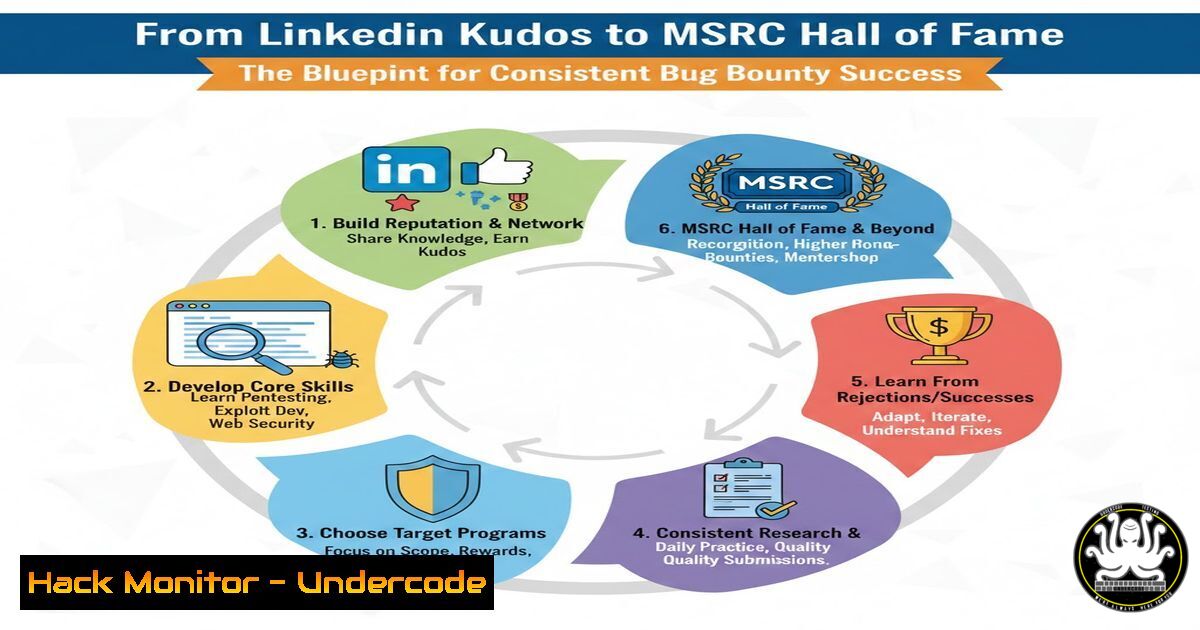
Introduction:
The journey from an independent security researcher to being formally acknowledged by the Microsoft Security Response Center (MSRC) represents a significant career milestone, built on a foundation of ethical hacking, persistent testing, and responsible disclosure. This achievement, as highlighted by a recent researcher’s recognition, underscores a critical pathway within the cybersecurity community where individual skill directly contributes to global platform safety. The MSRC operates as the central hub for this collaboration, managing vulnerability reports across Microsoft’s vast ecosystem—from cloud services like Microsoft 365 and Azure to endpoints like Windows and Linux.
Learning Objectives:
- Understand the structure, scope, and financial incentives of Microsoft’s Bug Bounty Programs.
- Learn the technical process of responsible vulnerability discovery and reporting to the MSRC.
- Identify common high-impact vulnerability classes and the techniques to exploit and mitigate them.
You Should Know:
- Navigating the MSRC Bounty Ecosystem: Where to Hunt and What’s at Stake
The MSRC oversees a diversified portfolio of bug bounty programs, each with specific scopes and award potentials. For cloud services like Microsoft 365 (encompassing Office 365, Teams, SharePoint Online), awards range from $1,250 to $19,500, with “High Impact Scenarios” like remote code execution or cross-tenant data leaks earning bonus multipliers. Other high-value targets include Microsoft Identity (up to $100,000), Microsoft Azure (up to $60,000), and the Microsoft Copilot AI experience (up to $30,000). The most critical vulnerabilities in products like Hyper-V can yield up to $250,000. Crucially, only vulnerabilities rated Critical or Important severity, as defined by Microsoft’s classification system, are eligible for awards.
Step‑by‑step guide explaining what this does and how to use it.
1. Choose Your Program: Identify your target area (e.g., M365, Azure, Windows). Carefully review the official “Rules of Engagement” and “Bounty Program Guidelines” for your chosen program to understand in-scope and out-of-scope targets.
2. Set Up a Legal Test Environment: Never test on production systems you do not own. For cloud services, use the official channels to create test accounts. Microsoft recommends including the string “MSOBB” in your account or tenant name to identify it for security research.
3. Understand Severity Classifications: Familiarize yourself with the “Microsoft Vulnerability Severity Classification for Online Services.” A vulnerability’s severity is determined by the data classification it impacts (Highly Confidential, Confidential, etc.) and the ease of exploitation. For example, an SSRF that leads to cross-tenant information disclosure is rated Critical.
- The Art of the Report: Crafting a High-Quality MSRC Submission
Acknowledgment and reward are contingent not just on finding a bug, but on submitting a high-quality report. The MSRC explicitly states that submissions with clear reproduction steps, proof-of-concept code, and detailed analysis qualify for higher awards as they accelerate triage and reduce risk faster. Your report must demonstrate a clear, direct security impact on customers. The process is governed by Coordinated Vulnerability Disclosure (CVD), which requires private reporting and allowing Microsoft time to develop and deploy a fix before any public discussion.
Step‑by‑step guide explaining what this does and how to use it.
1. Document Everything Methodically: Prepare a report with a clear title, detailed description of the vulnerability, and the specific component or endpoint affected.
2. Provide PoC and Reproduction Steps: Include a step-by-step guide to reproduce the issue. If possible, provide a non-destructive proof-of-concept (PoC) code or script. For web vulnerabilities, this could be a crafted HTTP request.
3. Submit via the Official Portal: All reports must be submitted through the MSRC Researcher Portal. Adhere to CVD principles; do not disclose details publicly until Microsoft addresses the issue.
- From Recon to RCE: Analyzing a Real-World SharePoint Exploit Chain
Recent attacks provide a masterclass in chaining vulnerabilities for severe impact. Nation-state actors exploited CVE-2025-49706 (a spoofing/auth bypass flaw) and CVE-2025-49704 (a remote code execution flaw) in on-premises SharePoint servers. Attackers sent a crafted POST request to upload a web shell (e.g.,spinstall0.aspx) to the server. This script was used to steal ASP.NET MachineKey data, which could facilitate further authentication forgery.
Step‑by‑step guide explaining what this does and how to use it.
Attacker Perspective (For Understanding): The exploit chain allowed unauthenticated remote code execution. A tool like `curl` could be used to deliver the malicious payload.
curl -X POST https://<target-sharepoint>/_layouts/15/ToolPane.aspx... --data-binary @spinstall0.aspx
Defender Perspective (Mitigation): Immediate patching is non-negotiable. Furthermore, enable Antimalware Scan Interface (AMSI) in Full Mode on all SharePoint servers and rotate machine keys using PowerShell.
 Example: Rotate machine keys using SharePoint PowerShell
Set-SPMachineKey
 Followed by an IIS reset
iisreset
- Privilege Escalation Playbook: Windows CLFS and Linux Nimbuspwn
Elevation of privilege (EoP) vulnerabilities are crown jewels for attackers post-initial access. A recent Windows zero-day, CVE-2025-29824 in the Common Log File System (CLFS), was exploited by ransomware actors. The exploit used `NtQuerySystemInformation` to leak kernel addresses and manipulated CLFS buffers to overwrite a process token, granting SYSTEM privileges. On Linux, the “Nimbuspwn” vulnerabilities (CVE-2022-29799 & CVE-2022-29800) in the `networkd-dispatcher` service allowed directory traversal and race condition attacks to execute arbitrary code as root.
Step‑by‑step guide explaining what this does and how to use it.
Windows Defender Command (Detection): Hunt for CLFS exploitation artifacts.
 KQL query for Microsoft Defender for Endpoint/Sentinel
DeviceFileEvents
| where FolderPath has "C:\ProgramData\SkyPDF\" and FileName endswith ".blf"
Linux Mitigation Command: Ensure system services are updated. For historical Nimbuspwn, updating `networkd-dispatcher` was critical.
sudo apt update && sudo apt upgrade networkd-dispatcher
- Building Your Researcher Toolkit: From SAST to Active Hunting
Effective researchers blend automated and manual techniques. Microsoft’s Security Development Lifecycle (SDL) emphasizes Static Application Security Testing (SAST) using tools like CodeQL or DevSkim, and Dynamic Application Security Testing (DAST). Beyond tools, adopt the mindset demonstrated by MSRC’s own researchers: perform code reviews on services running at high privileges (like root), listen to inter-process communication channels (like D-Bus on Linux), and analyze odd behavioral patterns.
Step‑by‑step guide explaining what this does and how to use it.
1. Integrate SAST: Use GitHub’s CodeQL in your CI/CD pipeline or for analyzing open-source components. It lets you query code to find vulnerability patterns.
2. Practice Dynamic Analysis: Use web proxy tools (Burp Suite, OWASP ZAP) to fuzz parameters and endpoints of in-scope web applications.
3. Hunt for Logic Flaws: Move beyond common bugs. Look for “Confused Deputy” problems (SSRF), insecure deserialization, and broken access control schemes where user input can affect security logic.
What Undercode Say:
- Consistency is the Real Currency: The adage “Do it once, it’s luck. Do it twice, it’s skill. Do it three times, it’s consistency” captures the core truth of professional security research. MSRC acknowledgments are a lagging indicator of a sustained process involving continuous learning, systematic testing, and meticulous reporting.
- The Ecosystem is the Engine: Individual success is facilitated by a structured, incentivized, and protected ecosystem. Microsoft’s provision of safe harbor, clear rules, and financial rewards creates a sustainable model that channels adversarial creativity into defensive strengthening. The researcher’s call to join communities underscores that knowledge sharing multiplies this defensive impact.
Prediction:
The future of MSRC and bug bounty research will be dominated by the convergence of AI and automation. As Microsoft integrates Copilot and AI across its stack, novel vulnerability classes in AI pipelines—such as prompt injection, training data poisoning, and model manipulation—will emerge as high-priority, high-reward research areas. Simultaneously, the researcher’s toolkit will evolve, with AI-assisted code review and vulnerability prediction becoming standard, making the discovery process faster but also raising the bar for finding unique, deep, and critical flaws. This will place an even higher premium on the creative, logical, and persistent human mindset that no tool can fully automate.
▶️ Related Video (78% Match):
🎯Let’s Practice For Free:
IT/Security Reporter URL:
Reported By: Rivektamang Msrc – Hackers Feeds
Extra Hub: Undercode MoN
Basic Verification: Pass ✅


