Listen to this Post
Introduction:
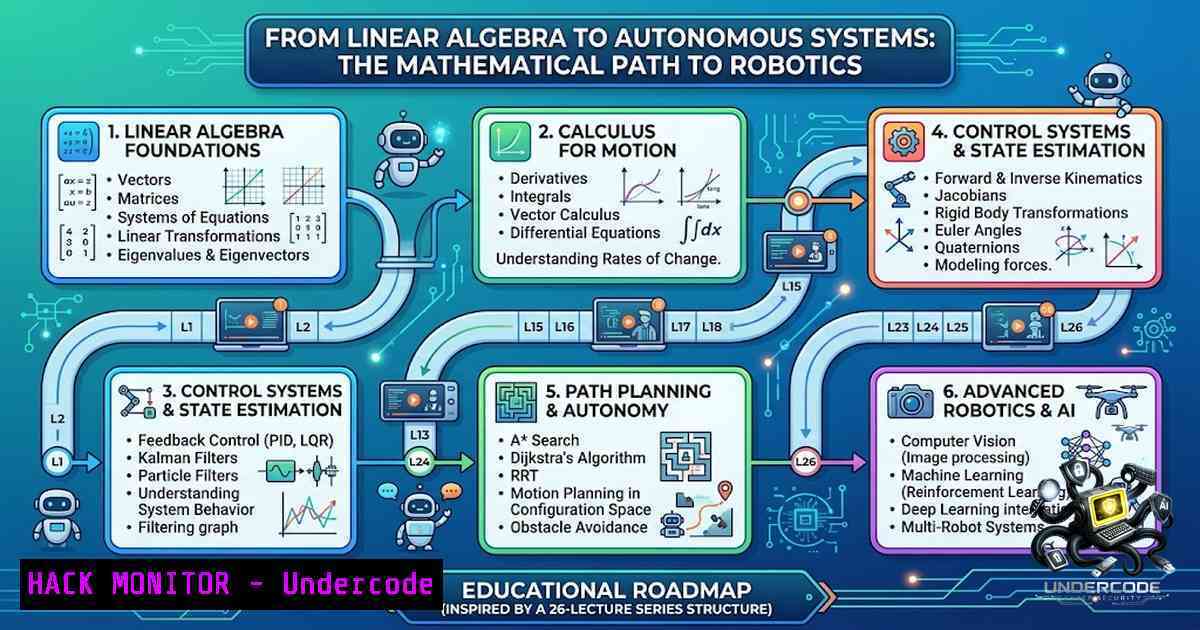
In the rapidly evolving landscape of artificial intelligence and autonomous systems, the ability to simply call a library function is no longer a differentiator—understanding the mathematical engines that power these systems is what separates architects from assemblers. The University of Michigan’s ROB 501: Mathematics for Robotics is a graduate-level course that strips away the abstraction, offering a rigorous, 26-lecture deep dive into the applied mathematics that enable state estimation, control, and machine learning in robotics. For cybersecurity professionals, this knowledge is equally critical, as the integrity of autonomous systems—from self-driving cars to industrial drones—hinges on the robustness of the algorithms that process sensor data and make decisions.
Learning Objectives:
- Master abstract linear algebra concepts, including vector spaces, linear operators, and eigenvalues, to model robotic systems mathematically.
- Understand and implement probabilistic state estimation techniques like the Kalman filter and recursive least squares for sensor fusion.
- Develop proficiency in nonlinear optimization methods, including the Newton-Raphson algorithm and convex optimization, to solve complex robotics problems.
You Should Know:
- Abstract Linear Algebra: The Foundation of Robotic State Representation
Before you can control a robot, you must be able to represent its state mathematically. This section of the course focuses on abstract linear algebra, moving beyond simple matrix multiplication to understand the underlying structure of vector spaces, subspaces, and linear independence. This is not just academic; the configuration space of a robotic arm or the state space of a drone is a vector space. Understanding these concepts allows you to reason about degrees of freedom, constraints, and the transformations that govern movement.
Step-by-step guide to understanding linear operators in robotics:
- Define the State Vector: In robotics, the state vector `x` often contains position, velocity, and orientation. For a simple 2D robot,
x = [x, y, θ]^T. - Model the System Dynamics: The evolution of the state over time is often modeled as a linear system:
x_{k+1} = A x_k + B u_k + w_k, where `A` is the state transition matrix (a linear operator), `B` is the control input matrix, `u` is the control vector, and `w` is process noise. - Compute Eigenvalues for Stability: The eigenvalues of the matrix `A` determine the system’s stability. If any eigenvalue has a magnitude greater than 1, the system is unstable. In Linux, you can use tools like Octave or Python to compute these.
– Linux (Python with NumPy):
import numpy as np
A = np.array([[0.9, 0.1], [0.0, 0.8]])
eigenvalues, eigenvectors = np.linalg.eig(A)
print(eigenvalues)
– Windows (MATLAB):
A = [0.9, 0.1; 0.0, 0.8];
eig(A)
4. Interpret the Results: If all eigenvalues are within the unit circle (magnitude < 1), the system is stable and will converge to a steady state.
- The Kalman Filter: Fusing Noisy Sensor Data for Accurate State Estimation
Robots rarely have perfect information. Sensors like GPS, IMUs, and cameras are noisy. The Kalman filter, a core topic in this course, is the optimal recursive algorithm for fusing these noisy measurements to produce a statistically optimal estimate of the system’s state. It is the workhorse of autonomous navigation, used in everything from spacecraft docking to missile guidance.
Step-by-step guide to implementing a Kalman filter for a simple 1D position tracking:
1. Define the State and Measurement Models:
- State: `x_k` (position at time k)
- State Transition: `x_{k+1} = x_k + v_k dt` (where `v` is velocity and `dt` is time step)
- Measurement: `z_k = x_k + noise`
2. Initialize: Start with an initial estimate `x_0` and an initial error covarianceP_0.
3. Predict (Time Update):
- Predict the next state: `x_{k|k-1} = F x_{k-1|k-1} + B u_k`
– Predict the error covariance: `P_{k|k-1} = F P_{k-1|k-1} F^T + Q` (where `Q` is the process noise covariance).
4. Update (Measurement Update):
- Compute the Kalman Gain: `K_k = P_{k|k-1} H^T (H P_{k|k-1} H^T + R)^-1` (where `H` is the measurement matrix and `R` is the measurement noise covariance).
- Update the state estimate: `x_{k|k} = x_{k|k-1} + K_k (z_k – H x_{k|k-1})`
– Update the error covariance: `P_{k|k} = (I – K_k H) P_{k|k-1}`
- The Newton-Raphson Algorithm: Solving Nonlinear Problems in Robotics
Many robotics problems, from inverse kinematics to camera calibration, are inherently nonlinear. The Newton-Raphson algorithm is a powerful iterative method for finding the roots of a real-valued function, and it forms the basis for many nonlinear solvers used in robotics.
Step-by-step guide to using Newton-Raphson for inverse kinematics:
- Define the Forward Kinematics: This is the function `f(θ)` that maps joint angles `θ` to the end-effector position
x. - Define the Error: The error `e(θ) = x_desired – f(θ)` is what we want to minimize.
- Compute the Jacobian: The Jacobian `J(θ)` is the matrix of partial derivatives of `f` with respect to
θ. This is the core of the algorithm. - Iterate: Update the joint angles using the formula:
θ_{new} = θ_{old} + J(θ_{old})^+ e(θ_{old}), where `J^+` is the pseudo-inverse of the Jacobian. - Convergence Check: Repeat until the error `e(θ)` is below a certain threshold or the change in `θ` is negligible.
-
QR Factorization: A Robust Tool for Solving Least Squares Problems
The course dedicates significant time to matrix factorizations, including QR factorization. This is a numerically stable method for solving linear least squares problems, which are ubiquitous in robotics for tasks like system identification and sensor calibration. Unlike the normal equations, which can be ill-conditioned, QR factorization provides a more robust solution.
Step-by-step guide to using QR factorization for linear regression:
- Formulate the Problem: Given a set of data points
(x_i, y_i), we want to find the line `y = mx + b` that best fits the data. This can be written asA c = y, where `A` is a matrix of `[x_i, 1]` andc = [m, b]^T. - Perform QR Factorization: Decompose the matrix `A` into
A = Q R, where `Q` is an orthogonal matrix and `R` is an upper triangular matrix. - Solve the System: The least squares solution `c` can be found by solving
R c = Q^T y. Because `R` is upper triangular, this can be done quickly using back-substitution.
– Linux/Windows (Python with NumPy):
import numpy as np
A = np.array([[1, 1], [2, 1], [3, 1]])
y = np.array([2, 4, 5])
Q, R = np.linalg.qr(A)
c = np.linalg.solve(R, Q.T @ y)
print(c)  Output: [m, b]
- Convex Optimization: The Engine of Modern Control and Planning
The course covers convexity and linear and quadratic programs. Convex optimization is the mathematical backbone of many modern control and planning algorithms. The key property of a convex function is that any local minimum is also a global minimum, making these problems tractable and solvable with high reliability. This is crucial for path planning, trajectory optimization, and model predictive control (MPC) in autonomous vehicles.
Step-by-step guide to formulating a simple quadratic program (QP) for control:
- Define the Objective: We want to find a control input `u` that minimizes a cost function, typically of the form
J = (x - x_ref)^T Q (x - x_ref) + u^T R u, where `x_ref` is the desired state, and `Q` and `R` are weighting matrices. - Define the Constraints: The system dynamics and actuator limits impose constraints, often linear: `x_{k+1} = A x_k + B u_k` and
u_min <= u_k <= u_max. - Solve the QP: This is a standard problem that can be solved using libraries like `OSQP` or
CVXOPT. The solution gives the optimal control sequence.
What Undercode Say:
- Key Takeaway 1: The course provides a rigorous, graduate-level foundation in the mathematics that underpin modern robotics and AI, moving beyond high-level APIs to the core principles.
- Key Takeaway 2: The freely available materials, including 26 video lectures, a comprehensive textbook, and a GitHub repository with all assignments and solutions, make this an unparalleled resource for self-study.
Analysis: The decision by the University of Michigan to open-source this entire course is a significant boon for the global tech community. For cybersecurity professionals, this knowledge is not just about building robots; it’s about securing them. Understanding the mathematical intricacies of algorithms like the Kalman filter is essential for identifying potential attack vectors, such as sensor spoofing that could corrupt state estimates. For AI and ML engineers, this course bridges the gap between theory and practice, providing the mathematical maturity needed to innovate rather than just integrate. The course’s focus on fundamental concepts like linear algebra, optimization, and probability ensures that learners can adapt to new technologies as they emerge, rather than being locked into specific frameworks.
Prediction:
- +1 The democratization of high-level robotics education through free, open-source courses like ROB 501 will accelerate the development of autonomous systems across industries, from agriculture to logistics.
- +1 As the line between AI and robotics blurs, a deep understanding of the mathematical principles taught in this course will become a mandatory skill for senior engineers and architects in the tech industry.
- -1 The increasing accessibility of this knowledge also lowers the barrier to entry for malicious actors who could use it to develop more sophisticated autonomous weapons or cyber-physical attacks.
- -1 The reliance on complex mathematical algorithms without a corresponding emphasis on robust security practices could lead to systems that are brittle and vulnerable to adversarial attacks, such as data poisoning or model inversion.
▶️ Related Video (74% Match):
🎯Let’s Practice For Free:
🎓 Live Courses & Certifications:
Join Undercode Academy for Verified Certifications
🚀 Request a Custom Project:
Secure, high-velocity infrastructure and disruptive technological engineering. Contact our engineering team for high-tier development and proprietary systems:
[email protected]
💎 Smart Architecture | 🛡️ Secure by Design | ⭐ Trusted by Thousands
IT/Security Reporter URL:
Reported By: Curiouslearner Learn – Hackers Feeds
Extra Hub: Undercode MoN
Basic Verification: Pass ✅


