
Listen to this Post
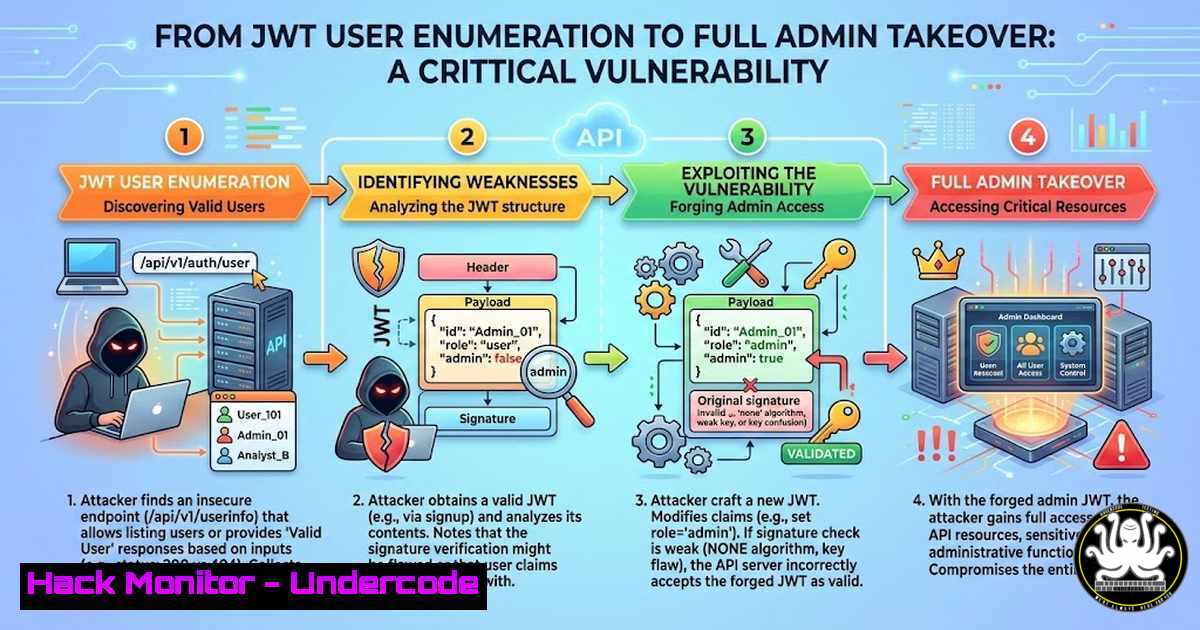
Introduction:
In the world of web application security, user enumeration is often dismissed as a low-risk informational finding. However, when combined with flawed Role-Based Access Control (RBAC) and JSON Web Token (JWT) mismanagement, this seemingly minor issue can serve as the gateway to a complete administrative account takeover. This article dissects a real-world attack chain where API-based user enumeration reveals a broken authorization model, ultimately allowing a low-privileged user to escalate privileges, access admin panels, and seize full control over the application.
Learning Objectives:
- Understand how user enumeration via API endpoints can indicate deeper authorization flaws beyond information disclosure.
- Analyze the relationship between JWT implementation and RBAC enforcement to identify privilege escalation vectors.
- Execute a step-by-step penetration testing methodology to test for and exploit broken access controls leading to admin account creation.
You Should Know:
- Phase 1: Reconnaissance and User Enumeration via API
The attack begins with discovering an API endpoint that discloses user information. Unlike a standard login page that returns a generic “invalid credentials” message, this endpoint (e.g.,/api/v1/users/list) is accessible to authenticated users and returns a list of usernames, including administrative accounts.
Step‑by‑step guide:
- Intercept traffic using Burp Suite or OWASP ZAP while navigating the authenticated application.
- Identify API calls that return user data. Look for endpoints like
/api/users,/admin/getUsers, or GraphQL queries. - Send a request to the endpoint as a low-privileged user. If the response contains a list of all users (including admins), you have found a user enumeration vulnerability.
Example using curl
curl -X GET https://target.com/api/v1/users/list \
-H "Authorization: Bearer <low_priv_user_jwt>" \
-H "Content-Type: application/json"
- Note the structure of user objects, specifically any fields indicating roles (e.g.,
"role": "admin","isAdmin": true). -
Phase 2: Analyzing the JWT and Role-Based Access Control
With the user list in hand, the next step is to verify whether the JWT is the sole source of authorization or if the backend also enforces RBAC. If RBAC is missing or weakly enforced, the application may trust the role information sent from the client.
Step‑by‑step guide:
- Decode the JWT obtained from the low-privileged user using a tool like `jwt.io` or the command line.
Decode JWT (example using jwt-cli)
echo "<your_jwt>" | jwt decode -
- Examine the payload for claims like
role,group, orpermissions. Example:{ "sub": "1234567890", "name": "John Doe", "role": "user", "iat": 1516239022 } - Attempt to modify the role claim and re-encode the JWT (if the secret is known or none). If the backend does not verify the signature properly or trusts the payload, this indicates a critical flaw.
– For HS256 tokens, if the secret is weak, crack it with `hashcat` or john.
– For RS256, check if the server accepts `none` algorithm or exposes its public key.
- Phase 3: Testing for Horizontal and Vertical Privilege Escalation
Now that you suspect broken RBAC, test if a regular user can perform admin-level actions. The user enumeration endpoint itself may be an admin-only resource that is improperly accessible.
Step‑by‑step guide:
- Identify admin-specific functions. These could include creating new users, changing roles, or accessing admin dashboards.
- Attempt to access these functions with the low-privileged user’s token. For example, try to create a new user with admin privileges via an API endpoint:
curl -X POST https://target.com/api/admin/createUser \ -H "Authorization: Bearer <low_priv_user_jwt>" \ -H "Content-Type: application/json" \ -d '{"username": "hacker", "password": "P@ssw0rd", "role": "admin"}' - If the request succeeds, you have confirmed that RBAC is not enforced on the server side. The application trusts the client-provided role.
-
Phase 4: Exploiting the Flaw to Create an Admin Account
If the user creation endpoint is accessible, you can now create a new administrative account, effectively bypassing all access controls.
Step‑by‑step guide:
- Using the low-privileged user’s JWT, send a POST request to the user creation endpoint.
curl -X POST https://target.com/api/admin/createUser \ -H "Authorization: Bearer <low_priv_user_jwt>" \ -H "Content-Type: application/json" \ -d '{"username": "myadmin", "email": "[email protected]", "password": "ComplexP@ss123", "role": "admin"}' - Verify the account was created by attempting to log in with the new credentials.
- Once logged in as an admin, enumerate further endpoints, access the admin panel, and exfiltrate data or perform system-level changes.
5. Phase 5: Advanced Exploitation and Persistence
With admin access, the attacker can now pivot to other parts of the infrastructure, such as databases, internal networks, or cloud environments.
Step‑by‑step guide:
- From the admin panel, look for features that allow command execution, file uploads, or database queries.
- Test for server-side vulnerabilities like SQL injection, file inclusion, or remote code execution using the elevated privileges.
- Establish persistence by creating backdoor admin users, modifying system files, or deploying web shells.
Example: If the application runs on Windows and allows command execution
whoami
ipconfig /all
Attempt to add a local admin user
net user backdoor Passw0rd! /add
net localgroup administrators backdoor /add
6. Phase 6: Mitigation and Hardening Techniques
To prevent such attacks, developers must enforce RBAC on the server side for every request, regardless of the JWT payload. The JWT should be treated as an identifier, not an authorization mechanism.
Step‑by‑step guide for defenders:
- Implement middleware that checks the user’s role against a server-side database or cache for every sensitive operation.
// Node.js example with Express function authorize(roles = []) { return (req, res, next) => { const userRole = req.user.role; // Retrieved from database, not token if (!roles.includes(userRole)) { return res.status(403).json({ message: 'Forbidden' }); } next(); }; } - Ensure API endpoints are not accessible by default. Use a deny-by-default approach.
- Conduct regular penetration tests focusing on broken access controls (OWASP API Security Top 10).
What Undercode Say:
- Never trust the client: Authorization decisions must be made on the server side based on a trusted source (database), not solely on the JWT payload.
- Context is everything in security: A “low-severity” finding like user enumeration can be the tip of an iceberg. Always investigate the underlying authorization logic when user lists are exposed.
This attack chain demonstrates that modern web applications, despite using robust authentication mechanisms like JWT, often fail at the authorization layer. The transition from a simple user enumeration to full admin takeover is a stark reminder that security is a chain, and the weakest link is frequently the gap between authentication and authorization. Developers must adopt a zero-trust model for every API request, and penetration testers must look beyond the surface to uncover these critical, chained vulnerabilities.
Prediction:
As API-driven architectures and microservices continue to dominate, the complexity of managing authorization across distributed systems will increase. We predict a surge in attacks exploiting RBAC misconfigurations and JWT trust issues. This will drive the adoption of more sophisticated, policy-based access control systems like OPA (Open Policy Agent) and a shift towards short-lived, context-aware tokens that are continuously validated against centralized authorization servers. The era of trusting the JWT in isolation is ending.
▶️ Related Video (76% Match):
🎯Let’s Practice For Free:
IT/Security Reporter URL:
Reported By: Sabuhi Mammadov – Hackers Feeds
Extra Hub: Undercode MoN
Basic Verification: Pass ✅


