
Listen to this Post
Introduction:
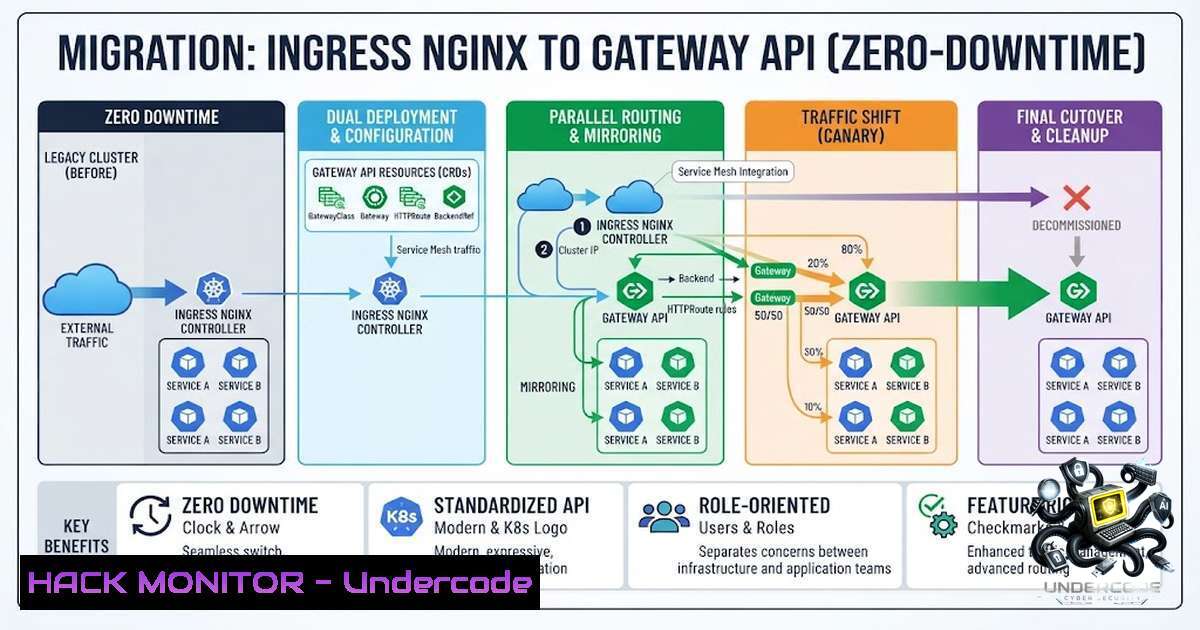
The Kubernetes ecosystem is undergoing a significant shift as the community-maintained ingress-1ginx controller approaches its official retirement in March 2026. For platform and DevOps teams running production workloads, this isn’t just another upgrade—it’s a forced migration that demands careful planning, architectural rethinking, and execution under real traffic conditions. This article distills the hard-won lessons from a recent production cluster migration, walking through the evaluation framework, the mechanical translation process, and the traffic cutover strategies that made zero-downtime possible.
Learning Objectives:
- Understand why the Kubernetes community is retiring ingress-1ginx and why Gateway API represents the future of Kubernetes traffic management
- Learn how to evaluate Gateway API implementations against real production requirements like CORS, WAF, and multi-gateway topologies
- Master the step-by-step process of translating Ingress resources to Gateway API objects using automation tools and manual inventory
- Implement safe traffic cutover strategies using weighted DNS for NLB environments and understand the special considerations for ALB setups
- Apply security hardening and validation techniques throughout the migration lifecycle
You Should Know:
1. Why Gateway API and Why Now?
The retirement of ingress-1ginx isn’t arbitrary—it’s a direct response to the controller becoming “too widely used and security-sensitive for the current maintainer team to handle safely”. The community couldn’t keep pace with the volume of CVEs and expectations around a critical-path networking component, leading to a controlled retirement rather than allowing it to quietly decay. After March 2026, the repository will be archived, with no new releases, bugfixes, or security patches.
Gateway API represents a fundamental architectural improvement over Ingress. Rather than scattering configuration across annotations and ConfigMaps that are difficult to audit, Gateway API splits responsibility across typed, validated objects. The cluster admin owns the Gateway, while application teams own HTTPRoutes—resources that are validated at the API level rather than parsed from string annotations at runtime. As one engineer demonstrated, an annotation typo that would fail silently in Ingress NGINX would be rejected at apply time by Gateway API. This separation also enables better traffic control, including weighted routing between backends using only HTTPRoute fields, no service mesh required.
2. Choosing the Right Gateway Implementation
Selecting a Gateway API implementation requires evaluating multiple factors against your specific traffic needs. For this migration, the team evaluated Envoy Gateway, Cilium Gateway, Traefik, and nginx Gateway Fabric before landing on kgateway. The decision hinged on three key criteria:
Maturity: kgateway began as Gloo by Solo.io in 2018 and was accepted into the CNCF Sandbox in March 2025—production history matters when you’re migrating critical infrastructure.
Feature Coverage: The client needed Cross-Origin Resource Sharing (CORS) support, a Web Application Firewall (WAF) with customizable rulesets, and a replacement for ExternalName services—kgateway covered all three.
Architecture: Some implementations only support a single Gateway per cluster due to control and data plane coupling, which is a real constraint if you need separate internal and external gateways.
Before committing to any implementation, verify that it supports your specific requirements by checking the project’s documentation.
- Translating Ingress to Gateway API: The Mechanical Work
Before touching any automation tooling, map out your gateway topology and listener structure. Decisions about how many Gateways you need, whether they’re external or internal, and whether you’re using wildcard certs or per-host TLS affect your Gateway and listener structure and are harder to change mid-migration.
The kgateway ingress2gateway tool handles much of the mechanical translation. It’s a fork of the upstream tool with expanded ingress-1ginx annotation support and generates kgateway-specific resources like TrafficPolicy and BackendConfigPolicy directly. Run it with:
ingress2gateway --providers=ingress-1ginx --emitter=kgateway
Against your cluster or against files. You’ll need a GatewayClass in your cluster before any Gateway resources will work—think of it the same way as IngressClass.
Critical Warning: The tool doesn’t handle pathType: ImplementationSpecific. If any of your Ingress objects use that path type, the tool errors out for those objects and produces nothing. Most instances can be updated to `pathType: Prefix` without behavior changes, but review each one before making that decision.
Beyond the automated translation, annotations that controlled proxy behavior, timeouts, buffer sizes, and redirects now live in ListenerPolicy, TrafficPolicy, or BackendConfigPolicy objects—each targeting a specific Gateway, HTTPRoute, or Service. A timeout that was a single annotation becomes a separate YAML object applied independently.
4. Moving Traffic Safely: NLB vs. ALB Strategies
The cutover strategy differs significantly between Network Load Balancer (NLB) and Application Load Balancer (ALB) setups, so know which you’re on before you start.
For NLB Environments: Use weighted DNS via external-dns to cut over without downtime. Add weighted routing annotations to the existing Ingress, deploy the HTTPRoute with its Route 53 DNS record at a weight of zero, verify both paths independently, then gradually shift traffic by adjusting the weighted DNS records.
Example annotations for the existing Ingress:
annotations:
external-dns.alpha.kubernetes.io/aws-weight: "100"
external-dns.alpha.kubernetes.io/set-identifier: ingress-
For the HTTPRoute (starting at zero):
annotations:
external-dns.alpha.kubernetes.io/aws-weight: "0"
external-dns.alpha.kubernetes.io/set-identifier: httproute-
Once the HTTPRoute’s DNS record reaches a weight of 100, retire the Ingress. Critical catch: `spec.hostnames` on the HTTPRoute must match the production ingress hostname exactly when you’re ready to switch over. If you tested with a wildcard or different subdomain level, update `spec.listeners.hostnames` on the Gateway itself.
For ALB Environments: The weighted cutover doesn’t apply. ALBs use a different provisioning path: the Envoy service runs as ClusterIP, kgateway creates an Ingress object for it, and that Ingress carries the ALB annotations. When external-dns sees that Ingress, it will try to create Route 53 records pointing at the ClusterIP, which isn’t externally routable. Add `external-dns.alpha.kubernetes.io/exclude: “true”` to any HTTPRoute that shouldn’t get its own DNS record.
5. Security Hardening Throughout the Migration
Migration presents an ideal opportunity to tighten security posture. Key security considerations include:
Network Security Audit: Use automated tools to review ACLs, firewalls, and network policies thoroughly. The Gateway API’s typed resources make it easier to audit traffic policies compared to scattered Ingress annotations.
Pod Security Standards: If you’re migrating from PodSecurityPolicies, map them to Pod Security Standards for enforcement with the Pod Security Admission controller. Follow the Kubernetes guide on Mapping PSPs to Pod Security Standards.
RBAC and Least Privilege: Implement strict RBAC—least privilege is non-1egotiable. The Gateway API’s separation of responsibilities between cluster admins and application teams naturally enforces this principle.
CIS Benchmark Compliance: Use CIS Benchmarks for Kubernetes as your security baseline. Apply hardening guides before installing or migrating workloads.
6. The Velero Option for Comprehensive Migration
For teams migrating entire clusters rather than just ingress controllers, Velero (formerly Heptio Ark) provides a battle-tested backup and restore framework. Velero enables you to:
- Take backups of your cluster and restore in case of loss
- Migrate cluster resources to other clusters
- Back up persistent volumes using integrated Restic support
The typical migration flow follows an extract-transform-migrate pattern:
- Extract: Pull all resources from the source cluster into structured JSON
- Transform: Process and adapt resources for target environment compatibility
- Migrate: Deploy resources to the target cluster with validation
This non-destructive approach allows you to test the new environment before making the switch.
What Undercode Say:
- Key Takeaway 1: The retirement of ingress-1ginx isn’t optional—it’s a hard deadline that demands proactive migration planning. Teams running ingress-1ginx in production after March 2026 will be operating an unmaintained, internet-facing component accumulating security and compliance risk.
-
Key Takeaway 2: Gateway API represents not just a replacement but a fundamental improvement in Kubernetes traffic management. The typed, validated resource model eliminates entire classes of configuration errors and enables safer, more auditable traffic policies.
Analysis: The migration from ingress-1ginx to Gateway API exemplifies a broader trend in cloud-1ative infrastructure: the move from annotation-based, string-parsed configuration to strongly-typed, API-validated resources. This shift reduces operational risk, improves developer experience, and enables better security practices through clear separation of responsibilities. The availability of automation tools like ingress2gateway significantly reduces the mechanical burden of translation, but the real work lies in understanding your topology, mapping your traffic patterns, and carefully executing the cutover. Organizations that treat this migration as an opportunity to reassess their traffic architecture—rather than a rote translation exercise—will emerge with more resilient, maintainable infrastructure. The 12-24 month timeline typical of Kubernetes migrations underscores the importance of starting early and moving methodically through assessment, parallel operation, and gradual cutover.
Prediction:
- +1 The standardization around Gateway API will accelerate multi-cluster and multi-cloud traffic management patterns, enabling more sophisticated canary deployments, A/B testing, and failure recovery strategies without proprietary service mesh overlays.
- +1 The typed resource model of Gateway API will enable a new generation of policy-as-code tools and CI/CD integrations that can validate traffic configurations before they reach production, reducing human error and improving deployment velocity.
- -1 Organizations that delay their ingress-1ginx migration past the March 2026 retirement date will face increasing security vulnerabilities and compatibility issues, potentially leading to incident response scenarios that could have been avoided with earlier planning.
- -1 The fragmentation among Gateway API implementations (Envoy Gateway, kgateway, Cilium Gateway, etc.) may create vendor lock-in risks for teams that don’t carefully evaluate implementation-specific extensions and policy resources against their long-term architectural goals.
▶️ Related Video (72% Match):
🎯Let’s Practice For Free:
🎓 Live Courses & Certifications:
Join Undercode Academy for Verified Certifications
🚀 Request a Custom Project:
Secure, high-velocity infrastructure and disruptive technological engineering. Contact our engineering team for high-tier development and proprietary systems:
[email protected]
💎 Smart Architecture | 🛡️ Secure by Design | ⭐ Trusted by Thousands
IT/Security Reporter URL:
Reported By: How We – Hackers Feeds
Extra Hub: Undercode MoN
Basic Verification: Pass ✅


