Listen to this Post
Introduction:
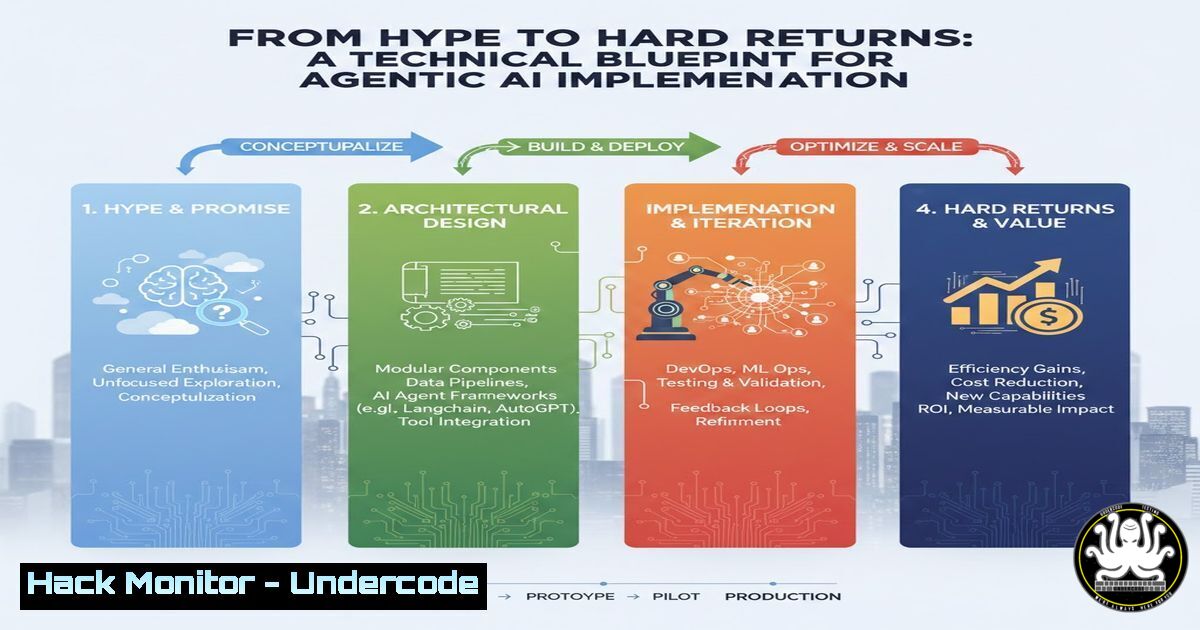
The discourse surrounding Agentic AI is currently dominated by speculative hype and theoretical debates, creating a significant gap between its perceived potential and its practical, value-driven application. This article moves beyond the buzz to provide a technical framework for implementing Agentic AI as a core component of your IT and cybersecurity infrastructure, transforming it from a conversational toy into a productivity engine that delivers measurable operational outcomes.
Learning Objectives:
- Understand the core technical architecture required to deploy autonomous AI agents.
- Learn to automate critical IT and security workflows using scripting and API integrations.
- Develop a strategy to measure the ROI and security posture improvements delivered by Agentic AI systems.
You Should Know:
- Architecting Your First Autonomous Agent: Beyond Simple Chatbots
The fundamental shift to “Agentic” AI involves moving from reactive Q&A systems to proactive, goal-oriented systems. These agents utilize a reasoning loop (Think -> Act -> Observe) and are equipped with tools to interact with their environment, such as APIs, databases, and command-line interfaces.
Step-by-step guide explaining what this does and how to use it:
1. Choose Your Foundation Model: Start with a powerful, API-accessible LLM like OpenAI’s GPT-4, Anthropic’s Claude 3, or a self-hosted open-source model like Llama 3. This will be the “brain” of your agent.
2. Define the Agent’s Core Loop: Implement a simple loop that allows the agent to plan, execute a tool, and then reflect on the outcome.
Python Pseudo-Code:
 Example using LangChain framework
from langchain.agents import AgentExecutor, create_tool_calling_agent
from langchain_core.prompts import ChatPromptTemplate
from langchain_openai import ChatOpenAI

<ol>
<li>Define tools the agent can use (e.g., run a shell command, call an API)
tools = [get_website_tool, run_shell_command_tool]</p></li>
<li><p>Construct the agent prompt with instructions
prompt = ChatPromptTemplate.from_messages([
("system", "You are a helpful IT automation assistant."),
("human", "{input}"),
])</p></li>
<li><p>Create the agent and executor
llm = ChatOpenAI(model="gpt-4")
agent = create_tool_calling_agent(llm, tools, prompt)
agent_executor = AgentExecutor(agent=agent, tools=tools, verbose=True)</p></li>
<li><p>Run the agent with a goal-oriented task
result = agent_executor.invoke({"input": "Check the disk usage on the server and summarize the top 3 directories consuming the most space."})
print(result["output"])
- Tool Integration: The agent’s power comes from its tools. Start by granting it safe, sandboxed access to run read-only system diagnostics.
2. Automating IT Operations: Proactive System Management
Agentic AI can transition IT teams from fire-fighting to strategic oversight by handling routine checks and alerts.
Step-by-step guide explaining what this does and how to use it:
1. Task: Create an agent to monitor disk space and generate a report.
2. Implementation:
Tool Creation: Create a tool that allows the agent to execute a secure shell (SSH) command on a target server.
Agent Instruction: Prompt the agent to run `df -h` and analyze the output.
Action: The agent connects to the server, runs the command, and parses the result.
Output: It generates a natural language summary and can be configured to send an alert to a Slack channel via a webhook if usage exceeds 90%.
Example Linux Command the Agent Would Execute:
`df -h / | awk ‘NR==2{print $5 ” ” $1}’` // Extracts the percentage and filesystem for the root partition.
3. Bolstering Cybersecurity Posture with AI Agents
Integrate agents into your Security Operations Center (SOC) to triage alerts and perform initial incident response, reducing mean time to detection (MTTD).
Step-by-step guide explaining what this does and how to use it:
1. Task: Triage a surge in failed login attempts.
2. Implementation:
Tool Creation: Provide the agent with tools to query your SIEM (e.g., Splunk, Elasticsearch) via API and to run commands on security appliances.
Agent Instruction: “Analyze the last hour of authentication logs from the SIEM for the IP range `192.168.1.0/24` and identify any potential brute-force attacks.”
Action: The agent uses the SIEM API to fetch logs, identifies a suspicious IP with hundreds of failed attempts, and can then execute a command to temporarily block that IP at the firewall.
Example Windows Command (if agent has access to a DC):
`Get-WinEvent -FilterHashtable @{LogName=’Security’; ID=4625; StartTime=(Get-Date).AddHours(-1)} | Select-Object -First 20` // Gets recent failed login events.
4. Hardening Your AI Agent: Security is Non-Negotiable
An agent with system access is a powerful attack vector if compromised. Securing it is paramount.
Step-by-step guide explaining what this does and how to use it:
1. Principle of Least Privilege: Never run your agent with root or administrator privileges. Create a dedicated service account with the minimum permissions required to perform its specific tasks.
2. Input/Output Sanitization: Implement strict validation for any user input the agent receives and sanitize all commands it generates to prevent injection attacks.
3. Audit Logging: Log every action, command, and API call the agent makes for security auditing and debugging.
Example Linux Command to Create a Restricted User:
`sudo useradd -r -s /bin/bash -d /home/agentuser agentuser` // Creates a system user for the agent.
5. Measuring ROI: From Demos to Data-Driven Decisions
To justify further investment, you must track key performance indicators (KPIs) that demonstrate value.
Step-by-step guide explaining what this does and how to use it:
1. Identify Metrics: Track time saved on automated tasks (e.g., “Reduced daily system health checks from 30 minutes to 2 minutes”).
2. Quantify Risk Reduction: Measure improvements in security metrics like MTTD. For example, “AI agent automatically identified and contained a brute-force attack 45 minutes before analyst review.”
3. Calculate Hard Savings: Document the reduction in ticket volume for automated tasks and the associated labor cost savings. Use a simple formula: (Time_Saved Hourly_Rate Frequency) = ROI.
What Undercode Say:
- The Tool is a Fraction of the Value. The real investment isn’t in the AI model, but in the integration, security hardening, and process re-engineering required to make it effective.
- Start with a Pain Point, Not a Technology. Successful adoption begins by identifying a specific, high-frequency, low-risk task that causes operational friction, not by seeking a problem for your new AI solution.
The meme’s brilliance lies in exposing a universal truth in tech adoption: the crowd is often in the wrong room. The transition from hype to hardened implementation requires a disciplined, technical, and security-first approach. Organizations that treat Agentic AI as a capability to be engineered—not just a trend to be discussed—will build a significant and sustainable competitive advantage. This involves making tangible investments in skills, infrastructure, and security protocols to ensure these systems are not just impressive demos, but reliable components of the operational stack.
Prediction:
Within two years, “Agentic AI” will cease to be a distinct buzzword and will simply become a standard, embedded layer of the enterprise IT stack, much like cloud computing or databases did before it. The competitive divide will not be between those who have AI and those who don’t, but between organizations that mastered the secure integration and operational governance of autonomous systems and those who were left debating the hype. We will see the emergence of dedicated C-suite roles, such as the Head of AI Operations, responsible for managing a fleet of AI agents that handle everything from internal IT and security to customer-facing processes, fundamentally reshaping organizational structures and efficiency benchmarks.
🎯Let’s Practice For Free:
IT/Security Reporter URL:
Reported By: Jharrison15 This – Hackers Feeds
Extra Hub: Undercode MoN
Basic Verification: Pass ✅


