Listen to this Post
Introduction:
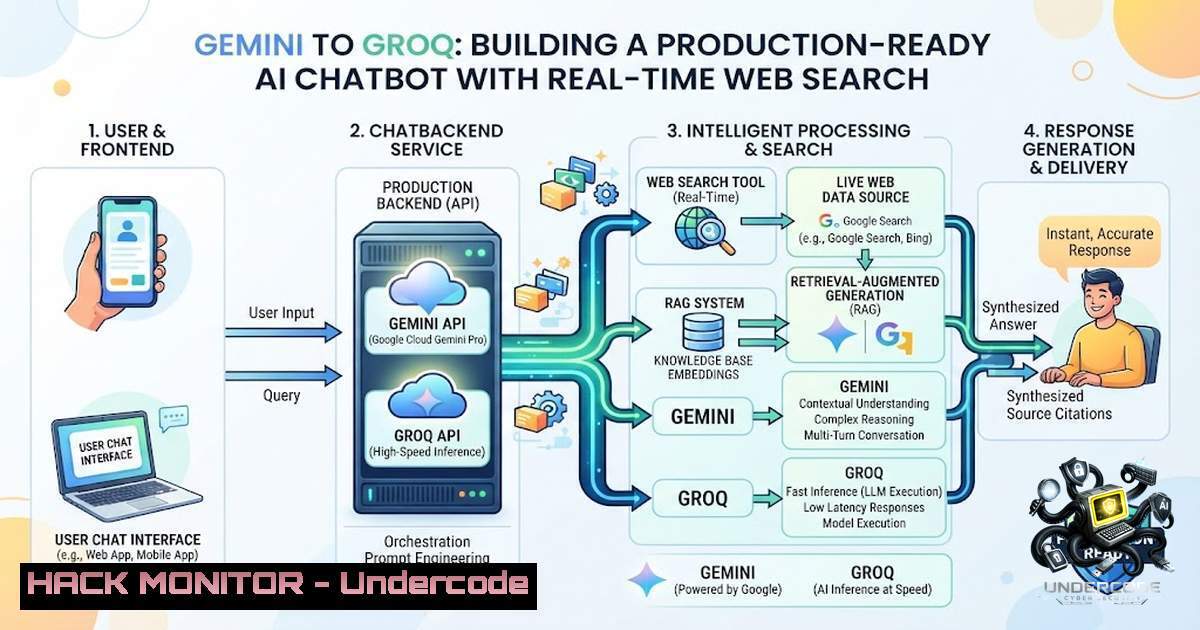
The rapid evolution of Large Language Models (LLMs) has transformed how developers approach application development, moving from simple rule-based chatbots to sophisticated AI agents capable of reasoning and real-time data retrieval. This shift necessitates a deep understanding of model selection, integration trade-offs, and performance optimization within a full-stack environment. This article dissects the architecture of a modern AI chatbot, exploring the technical journey from prototyping with Gemini to deploying with Groq, and integrating Tavily for live search capabilities, while providing actionable commands and configuration steps for IT professionals, developers, and cybersecurity enthusiasts.
Learning Objectives:
- Understand the architectural differences and performance trade-offs between commercial LLMs like Gemini and high-performance inference engines like Groq.
- Implement real-time data retrieval using Tavily to enhance LLM responses with current information, mitigating model knowledge cutoffs.
- Deploy and secure a full-stack AI application using React, FastAPI, and PostgreSQL, including environment configuration and API security best practices.
You Should Know:
- Evaluating LLM Performance and Operational Constraints: Gemini vs. Groq
The choice of an LLM backend is critical for both functionality and cost. Initially, the developer integrated Gemini for its multimodal capabilities, specifically image generation. However, deployment constraints and usage limits posed significant challenges.
To understand these limits, one must examine API rate limits and quota management. For instance, Gemini API has tiered pricing and rate limits based on requests-per-minute (RPM) and tokens-per-minute (TPM). When deploying a public-facing application, these limits can be quickly exhausted, leading to service degradation or additional costs.
Conversely, Groq offers a distinct advantage in inference speed due to its custom hardware (LPUs), making it highly performant for text-based interactions. The trade-off, as noted, is the lack of native image generation. This decision highlights a common architectural pattern: separating core conversational logic from specialized generative tasks, potentially using a microservices approach where image generation is offloaded to a dedicated, cost-optimized service.
 Example: Checking API quotas using cURL (Gemini)
curl -X GET "https://generativelanguage.googleapis.com/v1beta/models/gemini-pro:generateContent?key=$GEMINI_API_KEY"
 This would return model info, but quotas are typically checked via the cloud console.
- Enhancing Relevance with Tavily: Real-Time Web Search Integration
A primary limitation of all LLMs is their reliance on a static training dataset. To solve the problem of outdated information, the developer integrated Tavily, a search API optimized for LLMs. Tavily performs web searches, scrapes the results, and returns concise, relevant snippets.
From a systems perspective, this involves an orchestration pattern: The user query is sent to the LLM, which identifies a need for current data. The application then calls Tavily, retrieves the data, and injects it into the prompt context for the final generation. This is a form of Retrieval-Augmented Generation (RAG) but with a live web corpus instead of a private vector database.
 Python (FastAPI) snippet for Tavily integration
from tavily import TavilyClient
import os

tavily = TavilyClient(api_key=os.getenv("TAVILY_API_KEY"))

def augment_with_search(query: str):
try:
response = tavily.search(query=query, search_depth="advanced")
 Extract the most relevant content
context = "\n".join([result['content'] for result in response['results']])
return context
except Exception as e:
print(f"Search failed: {e}")
return ""
For Linux users running the FastAPI server, it is crucial to manage environment variables securely. Use `.env` files and libraries like python-dotenv.
 Linux/macOS command to set environment variables securely
export TAVILY_API_KEY="your_tavily_api_key"
export GROQ_API_KEY="your_groq_api_key"
3. Backend Architecture and API Security with FastAPI
FastAPI serves as the middleware, handling WebSocket or RESTful connections between the React frontend and the LLM providers. It manages user sessions, database interactions (PostgreSQL for history), and API key rotations.
Securing this layer is paramount, especially when dealing with external API calls. Implement rate limiting on your own endpoints to prevent abuse and excessive costs from malicious actors. Additionally, validate all user inputs both on the client-side and server-side to prevent injection attacks.
 FastAPI dependency for API Key validation
from fastapi import FastAPI, Depends, HTTPException, Security
from fastapi.security import APIKeyHeader

app = FastAPI()
api_key_header = APIKeyHeader(name="X-API-Key")

async def validate_api_key(api_key: str = Security(api_key_header)):
if api_key != os.getenv("INTERNAL_API_KEY"):
raise HTTPException(status_code=403, detail="Invalid API Key")
return api_key

@app.get("/secure-query")
async def secure_query(query: str, api_key: str = Depends(validate_api_key)):
 ... process query
To ensure your server is hardened, run security audits using tools like `bandit` for Python code.
 Linux/Windows (via pip) command to scan FastAPI code for vulnerabilities
bandit -r ./app
4. Frontend Optimization and Deployment: React + TypeScript
The frontend is built with React and TypeScript, providing a robust type-safe environment. Key considerations include state management for chat history, WebSocket handling for streaming responses, and error handling for API timeouts.
A significant security consideration for React apps is the exposure of API keys. Never embed API keys in client-side code. The FastAPI backend acts as a secure proxy, and the React app communicates solely with this internal API.
 Windows command (using PowerShell) to build React for production
Set-ExecutionPolicy -Scope Process -ExecutionPolicy Bypass
npm run build
 For Linux/macOS
npm run build
To deploy on a Linux server (e.g., Nginx), configure a reverse proxy to serve the static React files and forward API calls to the FastAPI backend.
 Nginx configuration snippet (Linux)
location /api/ {
proxy_pass http://localhost:8000/api/;
proxy_set_header Host $host;
proxy_set_header X-Real-IP $remote_addr;
}
5. Database Management and Session Persistence with PostgreSQL
PostgreSQL is utilized to store user interactions, session data, and potentially metadata for fine-tuning. When dealing with AI applications, consider the data privacy implications. Implement data encryption at rest and in transit.
Using SQLAlchemy ORM with Alembic for migrations helps manage schema changes. A typical model might include user_id, prompt, response, and timestamp.
 Python (SQLAlchemy) model definition
from sqlalchemy import Column, Integer, String, DateTime
from database import Base

class ChatHistory(Base):
<strong>tablename</strong> = "chat_history"
id = Column(Integer, primary_key=True, index=True)
user_id = Column(String, index=True)
prompt = Column(String)
response = Column(String)
timestamp = Column(DateTime)
For Windows administrators, ensure PostgreSQL is running as a service and is properly firewalled to allow only local connections from the FastAPI application.
 Windows command to check PostgreSQL service status
sc query postgresql-x64-16
 Linux command
systemctl status postgresql
6. Git Branching Strategy for Multi-Model Development
A crucial takeaway from this project is the use of separate Git branches to maintain different model implementations (Gemini vs. Groq). This allows for A/B testing and feature toggling without breaking the main production branch.
 Linux/Windows Git commands to manage branches
git checkout -b feature/gemini-implementation
 ... make changes
git push origin feature/gemini-implementation

git checkout main
git checkout -b feature/groq-production
 ... integrate Groq and Tavily
This strategy is essential for DevOps. It allows developers to test bleeding-edge features in isolation while maintaining a stable, deployable main branch.
7. Monitoring and Observability
For a production-grade application, implement logging and monitoring. Use Python’s `logging` module to capture errors, latency, and token usage. Tools like Prometheus and Grafana can be integrated to visualize API performance and cost metrics.
 Python logging configuration
import logging
logging.basicConfig(level=logging.INFO)
logger = logging.getLogger(<strong>name</strong>)

Log an event
logger.info(f"Groq API call successful. Tokens used: {tokens_used}")
What Undercode Say:
- Key Takeaway 1: Model selection is not just about capability; it’s a business decision involving performance, cost, and feature sets. Developers must be prepared to swap out AI providers based on evolving requirements and constraints.
- Key Takeaway 2: Integrating real-time search (Tavily) is a superior method to update model knowledge. This architecture mitigates hallucinations and increases user trust by citing sources, which is critical for enterprise applications.
- Analysis: The project perfectly illustrates the “LLM as an orchestrator” pattern. The application doesn’t just pass a prompt; it intelligently routes queries to search APIs, processes results, and generates a response, creating a robust agent-like system. This setup also introduces a new attack surface: prompt injection. Malicious users could craft prompts that manipulate the Tavily search to return harmful content. To counter this, input sanitization and output filtering (using another AI model) are recommended future enhancements. The decision to branch implementations rather than use feature flags in the codebase shows maturity in development workflow, enabling isolated testing of new providers like Claude or Cohere without affecting the live environment. Finally, this architecture serves as a blueprint for building vertical AI agents in specific domains like legal tech (real-time statute lookup) or financial analysis (stock price retrieval).
Prediction:
+1: This architecture will become the standard template for enterprise AI applications, enabling companies to switch between LLM providers to optimize for cost and latency without rewriting the entire application logic.
+1: The integration of real-time search will evolve into a standard feature, pressuring LLM providers to include built-in web search capabilities to compete with open-source frameworks like LangChain.
-1: The complexity of managing multiple API keys, rate limits, and response formats will create a demand for new AI orchestration and abstraction layers, increasing the attack surface for API key leaks and credential theft.
+1: Skills in multi-model integration and prompt engineering will be in high demand, with specialists capable of optimizing cross-provider performance commanding top salaries.
-1: The reliance on external services like Tavily introduces a single point of failure and potential privacy concerns, as sensitive queries could be logged by third-party search engines.
+1: The use of PostgreSQL for persistence allows for future fine-tuning and personalization, enabling models to learn from historical user interactions securely.
▶️ Related Video (82% Match):
🎯Let’s Practice For Free:
🎓 Live Courses & Certifications:
Join Undercode Academy for Verified Certifications
🚀 Request a Custom Project:
Secure, high-velocity infrastructure and disruptive technological engineering. Contact our engineering team for high-tier development and proprietary systems:
[email protected]
💎 Smart Architecture | 🛡️ Secure by Design | ⭐ Trusted by Thousands
IT/Security Reporter URL:
Reported By: Rajeev Lochan – Hackers Feeds
Extra Hub: Undercode MoN
Basic Verification: Pass ✅


