Listen to this Post
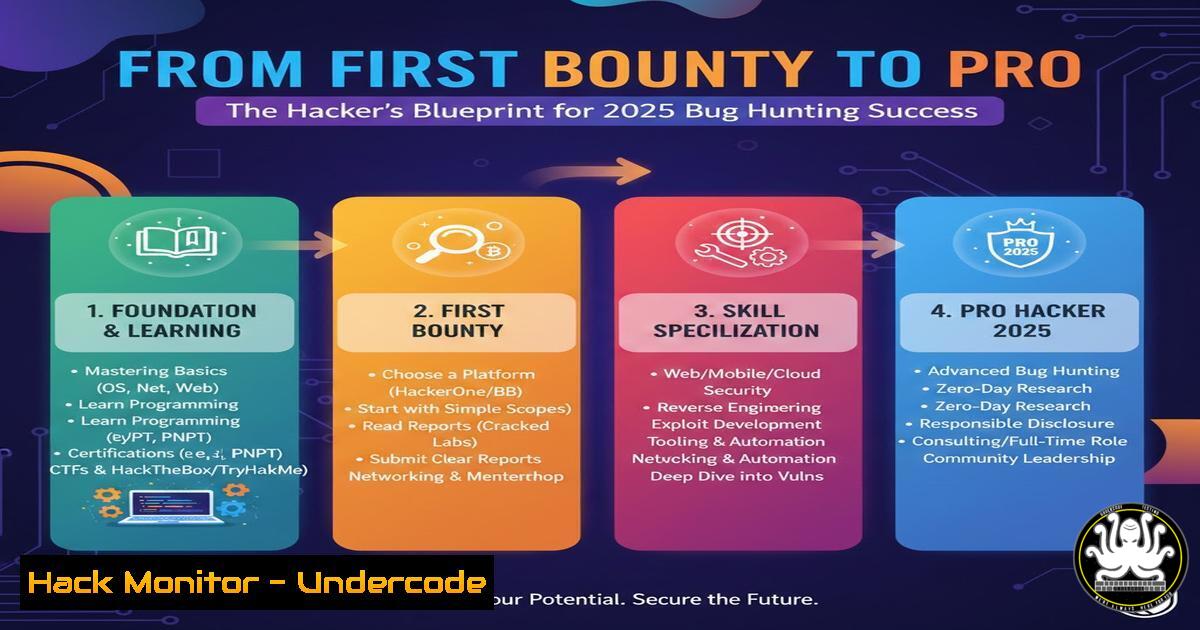
Introduction:
The journey from aspiring security enthusiast to a rewarded bug bounty hunter is a pivotal transition in a cybersecurity career. As exemplified by a researcher’s successful 2025 collaboration and first bounty, this path requires a systematic methodology, the right tools, and an understanding of responsible disclosure protocols. This article deconstructs the essential technical workflow that transforms vulnerability discovery into recognized, compensated security contributions.
Learning Objectives:
- Master the core reconnaissance and scanning methodology used by professional bug hunters.
- Learn to validate and responsibly exploit common web application vulnerabilities.
- Understand the tools, command-line skills, and reporting practices essential for successful collaboration and bounty acquisition.
You Should Know:
- The Reconnaissance Foundation: Passive & Active Intel Gathering
Before testing a single endpoint, comprehensive reconnaissance maps the attack surface. This involves passive data collection to avoid detection and active probing to discover live assets.
Step‑by‑step guide:
- Passive Subdomain Enumeration: Use tools like `amass` and `subfinder` to discover targets.
Linux/macOS
amass enum -passive -d target.com -o subdomains.txt
subfinder -d target.com -o subfinder_results.txt
- DNS Intelligence: Query DNS records for IP addresses, mail servers, and name servers.
Linux/Windows (via WSL or dig install)
dig any target.com @8.8.8.8
nslookup -type=MX target.com
- Archive Analysis: Use `waybackurls` to find historical endpoints and parameters from Wayback Machine data.
echo "target.com" | waybackurls > urls_historical.txt
2. Vulnerability Scanning & Initial Assessment
With a target list, automated scanners can identify low-hanging fruit and guide manual testing.
Step‑by‑step guide:
- Port & Service Scanning: Use `Nmap` to identify open ports and running services.
nmap -sV -sC -O -p- -T4 target_ip -oN full_scan.nmap
Windows alternative: Advanced IP Scanner (GUI) or PowerShell Test-NetConnection
- Web Vulnerability Scanning: Employ `nikto` for quick web server checks and `OWASP ZAP` or `Burp Suite` for automated application scanning.
nikto -h https://target.com -o nikto_scan.html
Configure Burp Suite’s “Scanner” to crawl the site automatically after proxy setup.
3. Manual Vulnerability Validation: Beyond Automated Tools
True critical bugs are often found manually. Focus on business logic flaws, authorization bypasses, and complex injection attacks.
Step‑by‑step guide for Testing IDOR (Insecure Direct Object Reference):
1. Log into an application with two user accounts (e.g., `userA` and userB).
2. Identify API endpoints or URLs that access objects by ID (e.g., /api/v1/user/12345/profile).
3. In Burp Suite’s Repeater tab, replace the object ID from userA‘s request with an ID belonging to userB.
4. Send the request. If `userA` can access userB‘s data, you’ve found a critical IDOR vulnerability. Document the request/response cycle.
4. Proof-of-Concept Exploitation: SQL Injection Example
A scanner might flag a potential SQLi. A hunter must prove impact.
Step‑by‑step guide:
- Locate a potentially vulnerable parameter: `https://target.com/products?id=1`
- Test with basic payloads: Append `’` (single quote) and observe for SQL errors.
3. Use `sqlmap` for automated exploitation and proof:
sqlmap -u "https://target.com/products?id=1" --batch --risk=3 --level=5 --dbs
 To extract data from a specific database:
sqlmap -u "https://target.com/products?id=1" -D customer_db --tables
Note: Only use on authorized targets (bug bounty programs).
- The Art of Responsible Disclosure & Report Crafting
A well-structured report is what turns a finding into a bounty.
Step‑by‑step guide:
- Follow Program Rules: Adhere strictly to the VDP/Bug Bounty platform’s scope and rules.
2. Structure Your Report:
Clear and concise (e.g., “IDOR allows any user to view all support tickets via /api/ticket/
</code>").

<h2 style="color: yellow;"> Vulnerability Details: Include classification (CWE), affected component/URL.</h2>

Proof of Concept: Step-by-step reproduction instructions, with annotated screenshots, curl commands, or video.
 Impact Analysis: Explain the potential business impact (data breach, financial loss, reputational damage).
 Remediation Recommendation: Suggest a fix (e.g., implement proper authorization checks).

<h2 style="color: yellow;">6. Collaboration and Knowledge Sharing</h2>

As highlighted in the original post, collaborating with senior researchers accelerates growth.

<h2 style="color: yellow;">Step‑by‑step guide:</h2>

<ol>
<li>Engage in Communities: Participate in platforms like Stack Overflow (Security), Discord servers for bug bounty programs, and local OWASP chapters.</li>
<li>Contribute to Open Source Tools: Fork a tool like `nuclei` or `ffuf` on GitHub, study its code, and consider contributing templates or fixes.</li>
<li>Peer Review: Before submitting a complex report, ask a trusted peer to review your methodology and proof-of-concept for clarity and accuracy.</li>
</ol>

<h2 style="color: yellow;">7. Building Your Persistent Testing Lab</h2>

<h2 style="color: yellow;">Continuous learning requires a safe environment to practice.</h2>

<h2 style="color: yellow;">Step‑by‑step guide to a Local Lab:</h2>

<ol>
<li>Set Up a VM: Use VirtualBox or VMware. Install Kali Linux (attacker) and OWASP Broken Web Applications (victim) VMs.</li>
<li>Dockerized Labs: Run vulnerable applications quickly with Docker.
[bash]
Run a deliberately vulnerable web app (DVWA)
docker run --rm -it -p 8080:80 vulnerables/web-dvwa
What Undercode Say:
- Methodology Over Tools: Success is 20% tools and 80% process. A disciplined, documented approach to recon, testing, and validation separates hobbyists from professionals.
- Impact is Currency: Clearly articulating the technical and business impact of a finding is the single most important factor in achieving higher severity ratings and bounties. A minor bug with demonstrable, severe consequences is a critical bug.
Analysis: The original post underscores a non-technical but critical pillar of security research: the human element. The combination of personal perseverance ("valuable experience") and collaborative learning ("collaboration with a senior") mirrors the industry's evolution. Bug bounty ecosystems thrive on shared knowledge. Platforms are not just payment processors but communities where mentorship happens organically. The researcher's gratitude for "responsible reporting" highlights the matured ethos of modern cybersecurity—adversarial testing is a service, not an antagonistic act. This mindset, coupled with deep technical rigor, is what defines the next generation of security professionals.
Prediction:
The trajectory for 2025 and beyond points towards the increased integration of AI-assisted bug hunting, where tools will automate deeper levels of context-aware fuzzing and logic flaw discovery. However, this will elevate, not replace, the human researcher. The premium will shift further towards hunters who can understand complex business logic, chain multiple low-severity issues into a critical exploit chain, and communicate risk in boardroom terms. Collaboration, as mentioned in the post, will become more formalized through hunter syndicates and platform-featured team challenges, making the lone-wolf hunter model less competitive. Bug bounty programs will become a primary, continuous audit layer for enterprises, embedded directly into DevSecOps pipelines.
▶️ Related Video (82% Match):
🎯Let’s Practice For Free:
IT/Security Reporter URL:
Reported By: Muhamad Nur - Hackers Feeds
Extra Hub: Undercode MoN
Basic Verification: Pass ✅


