
Listen to this Post
Introduction:
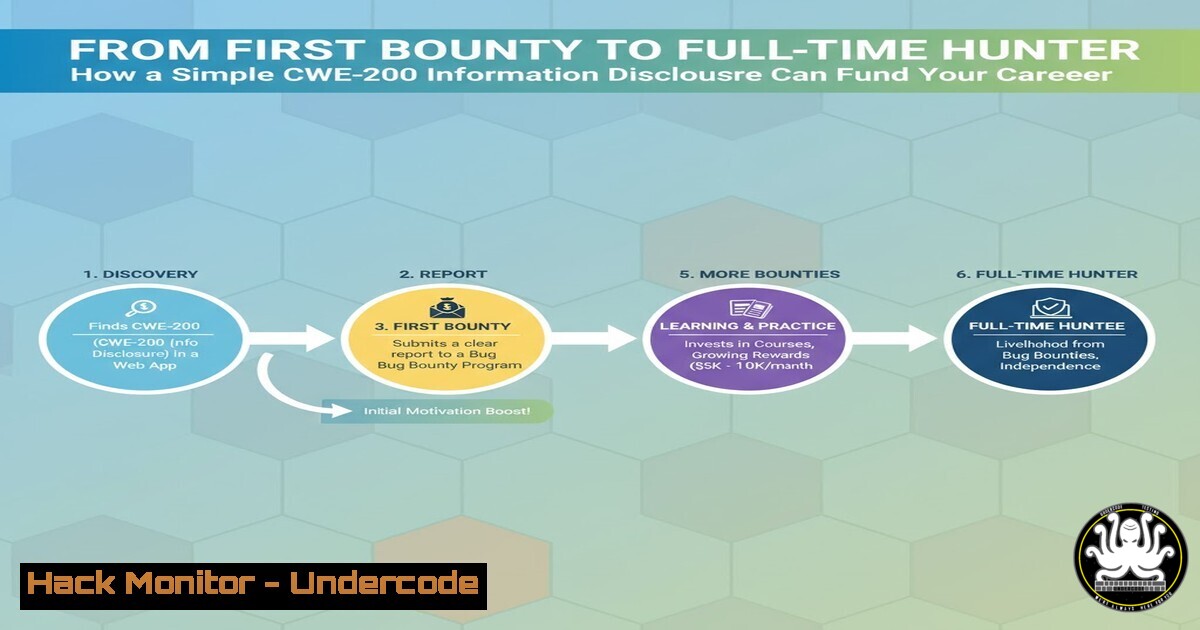
In the high-stakes world of bug bounty hunting, not all vulnerabilities come with dramatic crashes or remote code execution. Sometimes, the most critical findings are the quietest. A recent milestone shared by a French cybersecurity engineer, Sara L., highlights this perfectly: her first solo bounty was for an “Information Disclosure” (CWE-200) rated 5.3 (Medium) on the CVSS scale. While the score may seem modest, the implication for security professionals is massive. Information disclosure flaws are the gateway to catastrophic breaches; they leak the secrets—API keys, internal paths, user lists, and cloud metadata—that enable privilege escalation and full system compromise. This article deconstructs how to find, exploit, and document these elusive bugs using real-world techniques and command-line tooling.
Learning Objectives:
- Understand the mechanics of CWE-200 and why “Low” severity findings often lead to “Critical” payouts.
- Master the use of automated crawlers and manual fuzzing techniques to uncover hidden endpoints and exposed files.
- Learn to validate findings using cURL, Nmap scripts, and browser developer tools to eliminate false positives.
- Explore mitigation strategies for cloud storage buckets and web servers leaking sensitive data.
You Should Know:
1. The Anatomy of Information Disclosure (CWE-200)
Information Disclosure occurs when an application reveals sensitive data to users who are not authorized to see it. This isn’t just about showing a database error; it includes exposed `.git` folders, world-readable cloud storage buckets, JavaScript files containing hardcoded API keys, or server responses revealing internal IP addresses.
In Sara’s case, the finding likely involved a URL or endpoint returning data it shouldn’t. Bug bounty platforms like YesWeHack and HackerOne classify these under CWE-200. The CVSS score of 5.3 usually indicates a moderate impact due to confidentiality loss, but the real danger lies in the context. An exposed AWS Access Key ID allows an attacker to use the cloud infrastructure for free or access sensitive databases.
Step‑by‑step guide to discovery:
- Step 1: Reconnaissance. Use tools like `gau` (GetAllUrls) or `waybackurls` to fetch historical URLs.
echo "target.com" | gau | tee urls.txt
- Step 2: Filtering. Look for specific file extensions or keywords.
cat urls.txt | grep -E ".git|.env|.json|swagger|api-docs|backup|config" >> potential_leaks.txt
- Step 3: Validation. Use cURL to check the response headers and body. Look for `X-Powered-By` headers revealing server versions, or `200 OK` responses on sensitive paths.
curl -I -L "https://target.com/.git/config"
curl -s "https://target.com/server-status"
2. Digging Deeper: Automated Fuzzing for Hidden Directories
If you suspect a directory structure exists but isn’t linked anywhere, you need a fuzzer. `ffuf` (Fuzz Faster U Fool) is the industry standard for this.
Step‑by‑step guide to fuzzing:
- Step 1: Install ffuf. (Requires Go installation)
go install github.com/ffuf/ffuf@latest
- Step 2: Run a directory scan. Use a common wordlist like `directory-list-2.3-medium.txt` from SecLists.
ffuf -u https://target.com/FUZZ -w /usr/share/wordlists/seclists/Discovery/Web-Content/directory-list-2.3-medium.txt -ac -c -t 100
Flag explanation: `-ac` auto-calibrates responses to filter false positives; `-t` sets threads for speed.
- Step 3: Analyze results. Pay attention to response sizes that differ from the baseline 404 page. A `200 OK` on `/backup/` or `/private/` is a valid finding. Download the content for proof:
wget -r -np -nH --cut-dirs=1 https://target.com/backup/
3. The JavaScript Goldmine: Hunting Hardcoded Secrets
Modern web applications are heavy with JavaScript. Developers often mistakenly hardcode API keys, subdomain endpoints, or internal paths directly into the client-side code. This is a classic CWE-200 vector.
Step‑by‑step guide to JS analysis:
- Step 1: Gather JS URLs. Use `subjs` or
getJS.echo "https://target.com" | getJS --complete | tee js_files.txt
- Step 2: Download and grep. Use a tool like `LinkFinder` or simply `curl` and `grep` for common patterns.
cat js_files.txt | while read url; do curl -s $url | grep -E "api_key|apikey|secret|token|aws|password|firebase" >> secrets.txt; done
- Step 3: Manual Inspection. Open the browser’s Developer Tools (F12), go to the Sources tab, and pretty-print the minified JavaScript. Look for hardcoded Firebase URLs or API endpoints that start with
http://localhost` orhttp://192.168.`.
4. Cloud Storage Misconfigurations: The Low-Hanging Fruit
Companies often use Amazon S3, Azure Blob, or Google Cloud Storage to host static assets. If these buckets are misconfigured to allow “List” access to “Everyone,” you can browse the entire directory.
Step‑by‑step guide to bucket enumeration:
- Step 1: Identify bucket names. Look for URLs like `s3.amazonaws.com/[bucket-name]` or `[bucket-name].s3.amazonaws.com` in the source code or network tab.
- Step 2: Use cloud tools. The `awscli` tool is essential for testing.
Test if listing is allowed
aws s3 ls s3://bucket-name --no-sign-request

If successful, sync the bucket to your machine
aws s3 sync s3://bucket-name ./local-dir --no-sign-request
- Step 3: Manual browser test. Simply navigate to `http://[bucket-name].s3.amazonaws.com/` in a browser. If it returns an XML list of files instead of an access denied error, you have a finding. This exposes customer data, backups, and even source code.
5. Exploiting the Leak: From Disclosure to Critical
Finding the leak is only half the battle; you must prove the impact. If you find a database backup file (e.g., backup.sql) or a `.env` file containing database credentials, your report becomes critical.
Step‑by‑step guide to exploitation (Proof of Concept):
- Step 1: Connect to the database. If the `.env` file reveals a publicly accessible MySQL host, credentials, and database name, attempt to connect from your machine.
mysql -h leaked-db-host.amazonaws.com -u leaked_user -pLeakedPassword -D leaked_db
- Step 2: Extract a sample. Run a `SHOW TABLES;` and `SELECT FROM users LIMIT 1;` to demonstrate data access. Do not download entire databases; just prove connectivity.
- Step 3: Document the chain. In your bug bounty report, show the initial URL where the `.env` was found, the contents (redacted password partially), and the successful connection to the database. This elevates the severity from “Medium” to “High” or “Critical.”
6. Windows & Linux Server Hardening Commands
To understand how to find these flaws, you must understand how to prevent them. These commands are used by sysadmins to secure servers against the exact issues you hunt.
Linux Hardening:
- Prevent directory listing in Apache/NGINX:
Apache: Edit .htaccess or httpd.conf
echo "Options -Indexes" >> /var/www/html/.htaccess

NGINX: In server block, ensure autoindex is off
autoindex off;
- Remove sensitive files from web root:
find /var/www/html -name ".bak" -delete
find /var/www/html -name ".env" -delete
Windows Server (IIS) Hardening:
- Remove directory browsing feature via PowerShell:
Remove-WebConfigurationProperty -Filter "system.webServer/directoryBrowse" -Name enabled -Value $false -PSPath IIS:\Sites\Default Web Site
- Scan for hidden files:
Get-ChildItem -Path C:\inetpub\wwwroot -Recurse -Force | Where-Object { $_.Attributes -match "Hidden" }
7. Writing the Report That Gets Paid
Your technical skill got you the data, but your communication gets you the bounty. Sara mentioned the importance of methodology. Your report must be clear and reproducible.
Step‑by‑step guide to reporting:
- Step 1: Summary. Start with a one-liner: “The endpoint `https://target.com/api/debug` returns the full server environment variables including database credentials.”
- Step 2: Steps to Reproduce. Provide raw HTTP requests via cURL.
curl -v "https://target.com/api/debug"
- Step 3: Impact. Explain the worst-case scenario. “An attacker can use these credentials to access the production database, leading to a full data breach of PII.”
- Step 4: Remediation. Suggest a fix. “Implement strict access controls on the `/api/debug` endpoint, removing it entirely in production, or restricting it to internal IPs only.”
What Undercode Say:
- Persistence Over Genius: Sara’s journey underscores that bug bounty success is not about finding a zero-day on your first day. It’s about enduring duplicates and rejections, refining your methodology with tools like ffuf and gau, and consistently checking for the basics—like exposed .git folders—until you hit that first valid report. The first bounty is the hardest; after that, you understand the signal-to-noise ratio.
- Low Severity, High Value: Never ignore a “Medium” finding. Information Disclosure is the skeleton key to the castle. A single exposed AWS key in a JavaScript file can lead to a complete cloud account takeover. Treat every CWE-200 with the respect of a potential Critical; investigate its context thoroughly.
Prediction:
As AI-generated code becomes more prevalent, the frequency of CWE-200 vulnerabilities will likely spike. AI assistants trained on public codebases may inadvertently suggest insecure coding patterns or hardcode secrets directly into the generated snippets. Bug bounty hunters who specialize in “secret sniffing” and automated recon will become invaluable. The future of hunting will shift from manual brute-forcing to intelligent, AI-assisted analysis of traffic patterns and code anomalies, making the ability to interpret and chain simple disclosures into complex exploits the most sought-after skill in the industry.
▶️ Related Video (76% Match):
🎯Let’s Practice For Free:
IT/Security Reporter URL:
Reported By: Sara Lemarie – Hackers Feeds
Extra Hub: Undercode MoN
Basic Verification: Pass ✅


