Listen to this Post
Introduction:
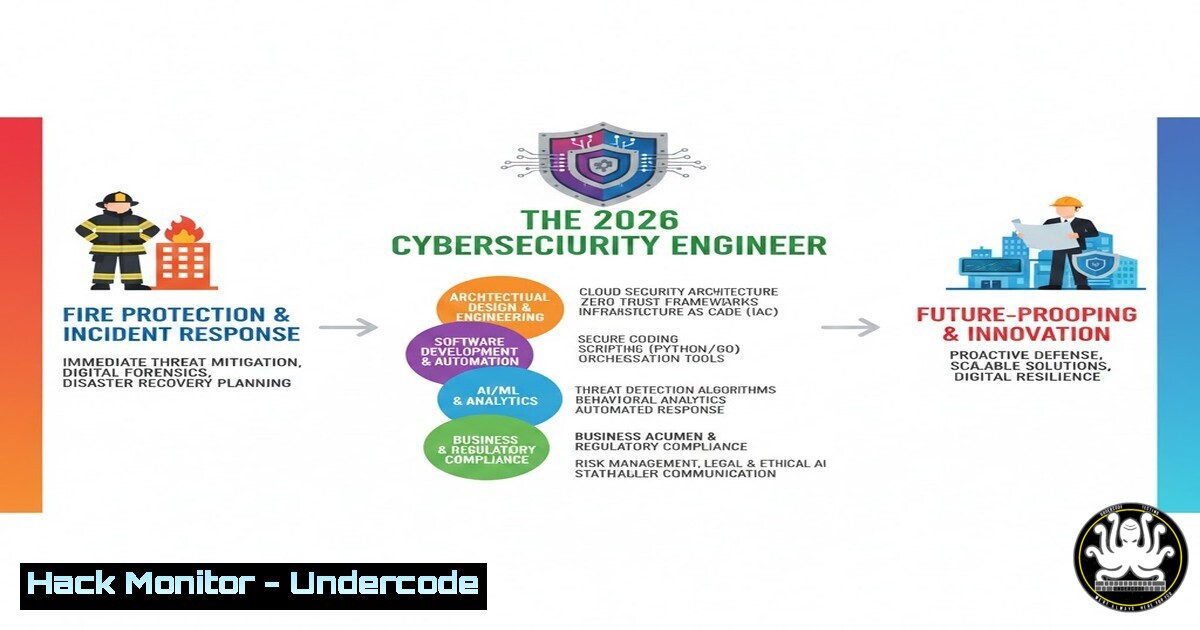
The cybersecurity landscape is no longer defined by reactive tool operators but by proactive system engineers who understand risk at a fundamental level. The journey to becoming a relevant security engineer in 2026 hinges on prioritizing architectural understanding and secure design over mere tool proficiency. This article deconstructs the essential skill tiers, translating them into actionable technical objectives and commands to transform your approach from incident response to threat prevention.
Learning Objectives:
- Architect secure systems by mastering identity, cloud, and AI governance fundamentals.
- Implement proactive security controls for APIs, containers, and infrastructure-as-code.
- Transition from operating tools like EDR and SIEM to engineering layered, intelligent defenses.
You Should Know:
- S-Tier Foundation: Engineering Identity and Secure Cloud Architecture
The cornerstone of modern security is a deep understanding of how systems authenticate, authorize, and communicate. This moves beyond basic IAM console clicks to the underlying principles and enforcement mechanisms.
Step-by-step guide explaining what this does and how to use it:
A. Implement Zero-Trust Identity Checks: Move beyond simple passwords. Enforce Multi-Factor Authentication (MFA) and conditional access at the infrastructure level.
Linux (Using `pam_google_authenticator` for SSH):
 1. Install the PAM module
sudo apt-get install libpam-google-authenticator -y  Debian/Ubuntu
sudo yum install google-authenticator -y  RHEL/CentOS

<ol>
<li>Run the authenticator to generate a secret QR code for the user
google-authenticator</p></li>
<li><p>Edit the PAM configuration for SSH to require the token
sudo vim /etc/pam.d/sshd
Add the line: auth required pam_google_authenticator.so</p></li>
<li><p>Edit the SSH daemon config to use challenge-response
sudo vim /etc/ssh/sshd_config
Ensure or add: ChallengeResponseAuthentication yes
sudo systemctl restart sshd
B. Secure Cloud Infrastructure Beyond the Console: Use Infrastructure as Code (IaC) to embed security. Define and enforce network segmentation and data encryption.
AWS CloudFormation Snippet (Restricting S3 Bucket Access):
Resources:
SecureS3Bucket:
Type: 'AWS::S3::Bucket'
Properties:
BucketName: my-encrypted-data-bucket
AccessControl: Private
BucketEncryption:
ServerSideEncryptionConfiguration:
- ServerSideEncryptionByDefault:
SSEAlgorithm: AES256
PublicAccessBlockConfiguration:
BlockPublicAcls: true
BlockPublicPolicy: true
IgnorePublicAcls: true
RestrictPublicBuckets: true
2. A-Tier Proactivity: Threat Modeling and API-First Security
At this tier, you anticipate attacks. This involves modeling threats against your architecture, especially for AI-integrated apps, and building security directly into your API fabric.
Step-by-step guide explaining what this does and how to use it:
A. Conduct a Basic Threat Modeling Session: Use the STRIDE model to systematically identify threats.
1. Diagram your application’s data flow (e.g., User -> Web App -> API -> Database -> AI Microservice).
2. Classify threats for each element:
Spoofing: Can an attacker fake the user or API identity?
Tampering: Can they modify data in transit?
Repudiation: Can a user deny an action? Are logs immutable?
Information Disclosure: Is sensitive data (e.g., AI prompts) exposed?
Denial of Service: Can the API or AI model be overwhelmed?
Elevation of Privilege: Can a user gain unauthorized access to the AI model’s admin functions?
3. Document and Mitigate (e.g., for Tampering: enforce TLS 1.3; for Info Disclosure: encrypt prompts at rest).
B. Harden Your API Gateway: Implement rate limiting and strict schema validation.
NGINX (as API Gateway) Configuration for Rate Limiting:
http {
limit_req_zone $binary_remote_addr zone=api_per_ip:10m rate=10r/s;

server {
listen 443 ssl;
location /api/ {
limit_req zone=api_per_ip burst=20 nodelay;
 Proxy pass to your actual API service
proxy_pass http://api_backend;
 Validate Content-Type
if ($content_type !~ "application/json") {
return 415;
}
}
}
}
3. B-Tier Operational Excellence: Mastering the Security Toolchain
Tools like EDR, SIEM, and vulnerability scanners are force multipliers for engineers who understand the “why.” The goal is to move from alert fatigue to intelligent detection engineering.
Step-by-step guide explaining what this does and how to use it:
A. Write a Custom SIEM Detection Rule (Sigma Rule Example): Instead of just reading alerts, create rules for your specific threat model.
title: Suspicious Process Injection via Windows PowerShell
id: a5f93b5c-1234-5678-90ab-cdef01234567
status: experimental
description: Detects process injection techniques commonly performed via PowerShell scripts, a technique often used post-exploitation.
author: Your Name
references:
- https://attack.mitre.org/techniques/T1055/
logsource:
category: process_creation
product: windows
detection:
selection:
Image|endswith: '\powershell.exe'
CommandLine|contains|all:
- 'VirtualAlloc'
- 'CreateThread'
- 'WriteProcessMemory'
condition: selection
falsepositives:
- Legitimate security testing or advanced administrative scripts
level: high
B. Perform Authenticated Vulnerability Scanning with `curl` & jq: Go beyond automated scanners with targeted checks.
 Example: Check a web API for missing security headers
curl -sI https://api.yourcompany.com/v1/health | grep -i "strict-transport-security|x-frame-options|content-security-policy"

Example: Query the NVD API for a specific CVE (CVE-2024-12345) and filter results
curl -s "https://services.nvd.nist.gov/rest/json/cves/2.0?cveId=CVE-2024-12345" | jq '.vulnerabilities[bash].cve.descriptions[bash].value'
4. C-Tier Baseline: Automating the “Expected” Security
OWASP Top 10 mitigations are table stakes. The engineer’s role is to automate these controls into the development pipeline, making them invisible and unavoidable.
Step-by-step guide explaining what this does and how to use it:
Integrate Secret Scanning into a GitHub Action: Prevent hard-coded secrets from ever reaching production.
 .github/workflows/secret-scanning.yml
name: Secret Scanning
on: [push, pull_request]
jobs:
trufflehog:
runs-on: ubuntu-latest
steps:
- name: Checkout code
uses: actions/checkout@v3
 Fetch all history for deep scanning
with:
fetch-depth: 0
- name: Run TruffleHog
uses: trufflesecurity/trufflehog@main
with:
path: ./
base: ${{ github.event.repository.default_branch }}
head: HEAD
 Fail the build if any new secrets are found
fail: true
- D-Tier Business Alignment: Translating Technical Risk into Business Impact
The irreplaceable engineer bridges the gap between technical vulnerabilities and business risk, framing discussions in terms of financial, regulatory, and reputational impact.
Step-by-step guide explaining what this does and how to use it:
Create a Risk Register Entry from a Technical Finding:
1. Technical Finding: “Public S3 bucket discovered (acme-customer-data) containing unencrypted PII.”
2. Business Translation:
Risk: Unauthorized access & data breach.
Impact: Regulatory fines (GDPR/CCPA), loss of customer trust, competitive disadvantage.
Likelihood: High (bucket is internet-facing and discovered by scanners).
Recommended Action: Apply bucket encryption & strict access controls (see S-Tier CloudFormation example).
Owner: Cloud Platform Team.
Due Date: [Priority Date].
This framework shifts the conversation from “we need to fix a misconfiguration” to “we need to mitigate a material business risk.”
What Undercode Say:
- Tool Mastery is a Dead-End Strategy: The market is saturating with professionals who can run a scanner but cannot architect a secure system or explain the risk of a finding. Long-term relevance requires ascending the skill tier stack, focusing on the S and A Tiers.
- AI Governance is the New Cloud Security: As AI integrates into products, engineers must expand threat modeling to include data poisoning, prompt injection, and model theft. Security must be part of the AI development lifecycle from day one, not a bolt-on.
The tier list presents a strategic blueprint, not just a learning path. The “F-Tier” mindset leads to obsolescence because it treats security as a series of roadblocks rather than an enabling product feature. The future belongs to engineers who embed security into the design of identity systems, cloud infrastructure, and AI-powered features, making them inherently resilient. This requires a foundational understanding of computing systems that no isolated tool training can provide.
Prediction:
By 2026, the hiring divide in cybersecurity will be stark. On one side, “alert jockeys” reliant on pre-packaged tools will face shrinking roles due to automation and AI-driven SOCs. On the other, engineers with deep system comprehension, who can design secure architectures for hybrid cloud and AI-native applications, will command premium roles. The most impactful security vulnerabilities will increasingly stem from architectural flaws in identity federation, AI pipelines, and complex service meshes, not simple OWASP Top 10 bugs. Consequently, security training and certifications will pivot heavily towards secure software development lifecycle (SSDLC), cloud-native architecture, and AI risk management, leaving behind those who failed to build the foundational S-Tier knowledge.
▶️ Related Video (86% Match):
🎯Let’s Practice For Free:
IT/Security Reporter URL:
Reported By: Vitorluigi A – Hackers Feeds
Extra Hub: Undercode MoN
Basic Verification: Pass ✅


