Listen to this Post
Introduction:
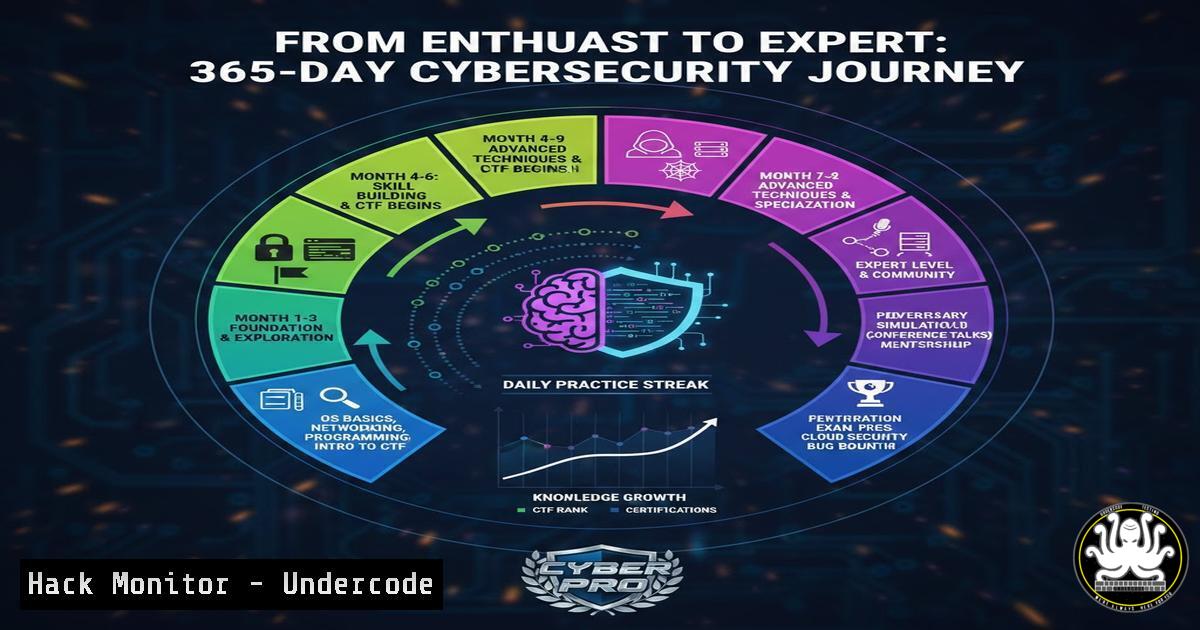
In the dynamic world of cybersecurity, theoretical knowledge pales in comparison to hands-on, persistent practice. The journey of a dedicated enthusiast, who maintained a 365-day training streak on TryHackMe while actively competing in Capture The Flag (CTF) events, provides a blueprint for skill mastery. This article deconstructs that journey into actionable steps, transforming personal achievement into a professional development roadmap for aspiring security professionals, complete with technical commands and hardening strategies.
Learning Objectives:
- Understand how to structure a daily, hands-on cybersecurity practice regimen using platforms like TryHackMe and Hack The Box.
- Learn key technical commands and methodologies for vulnerability assessment, privilege escalation, and network analysis.
- Develop a systematic approach to building foundational programming and reverse engineering skills critical for advanced security roles.
You Should Know:
1. Building Immersion: The 365-Day Hands-On Streak Methodology
The core of rapid skill acquisition is consistent, daily exposure to practical challenges. Platforms like TryHackMe (THM) and HackTheBox (HTB) provide curated, gamified environments. The goal is not just completion, but deep understanding.
Step-by-Step Guide:
- Platform Setup: Start with TryHackMe’s beginner paths. Use the in-browser VPN or connect via OpenVPN.
Linux Command: `sudo openvpn user-config.ovpn`
- Daily Routine: Dedicate 1-2 hours daily. Complete one “room” (a guided scenario). Use the “Walkthrough” only after significant personal effort.
- Note-Taking & Documentation: For every room, maintain an organized notes file. Record:
Reconnaissance commands used (e.g.,nmap -sC -sV -oA scan_target)
Found vulnerabilities and their Common Vulnerabilities and Exposures (CVE) identifiers.
Exploitation steps and proof-of-concept (PoC) code.
Privilege escalation vectors (e.g., checking sudo -l, SUID binaries with find / -perm -u=s -type f 2>/dev/null).
4. Progression: After foundational paths, move to HTB for more challenging, unguided machines. Use the TJ Null list of OSCP-like boxes for targeted practice.
- Mastering the CTF Mindset: From Solo Practice to Team Competition
CTFs like 07CTF and HTB University 2025 simulate real-world attack/defense scenarios. Transitioning from solo learning to team play sharpens collaboration, time management, and specialization.
Step-by-Step Guide:
- Skill Specialization: In a team, roles emerge. Deliberately practice one:
Web/Pwnable: Focus on OWASP Top 10, binary exploitation. Tools: Burp Suite,gdb,pwntools.
Forensics/OSINT: Analyze memory dumps, network packets, social media. Tools:volatility,Wireshark,exiftool.
Cryptography/Reverse Engineering: Learn basic crypto attacks, use disassemblers like `Ghidra` orradare2. - Pre-CTF Recon: Research past CTF write-ups from the same organizers. Set up a collaborative workspace (e.g., Discord + shared notes on a Kali Linux instance).
- During CTF: Use enumeration scripts. A basic web directory brute-force command:
ffuf -u http://target/FUZZ -w /usr/share/wordlists/dirb/common.txt. Always document findings for teammates. -
Fortifying the Foundation: Programming & Assembly for Security
Advanced exploits, custom tools, and reverse engineering demand programming literacy. “Polishing foundational basics” in C++, Python, and Assembly is non-negotiable.
Step-by-Step Guide:
- Python for Automation: Write scripts to automate boring tasks. Example: a simple port scanner.
import socket target = "192.168.1.1" for port in range(1, 1000): s = socket.socket(socket.AF_INET, socket.SOCK_STREAM) s.settimeout(1) result = s.connect_ex((target, port)) if result == 0: print(f"Port {port} is open") s.close() - C/C++ for Exploit Development: Understand buffer overflows. Compile a vulnerable C program:
gcc -fno-stack-protector -z execstack vuln.c -o vuln. Use `gdb` to analyze memory corruption. - Assembly (x86/x64) for RE: Use `objdump -d ./binary` to disassemble. Start by understanding registers, the stack, and common instructions (
mov,call,ret). Practice on CTF “crackme” challenges.
4. System Hardening: Applying Defensive Lessons Offensively
Understanding defense makes you a better attacker. Use insights from vulnerable machines to harden real systems.
Step-by-Step Guide (Linux Server Hardening):
- Minimize Attack Surface: Uninstall unnecessary packages:
sudo apt purge --auto-remove [bash]. Disable unused services:sudo systemctl disable [bash]. - Secure SSH: Disable root login and use key-based authentication.
Edit `/etc/ssh/sshd_config`: `PermitRootLogin no`, `PasswordAuthentication no`.
Reload: `sudo systemctl reload sshd`.
- Configure Firewall: Use
ufw:sudo ufw enable, `sudo ufw allow 22/tcp` (SSH). - Audit Permissions: Regularly check for misconfigured SUID/SGID files and world-writable directories:
find / -type f -perm /6000 2>/dev/null.
5. Cloud & API Security Fundamentals
Modern infrastructure lives in the cloud. Basic cloud security knowledge is essential.
Step-by-Step Guide (AWS S3 Bucket & API Security):
1. Reconnaissance: Discover S3 buckets: Use tools like `s3scanner` or manually check common names. A misconfigured bucket can lead to data leaks.
2. Testing API Endpoints: For a discovered API (e.g., api.target.com/v1/users), test for common flaws:
Broken Object Level Authorization (BOLA): Change the user ID in a GET request: curl -H "Authorization: Bearer [bash]" https://api.target.com/v1/users/123` → try../124.for i in {1..100}; do curl -s [bash] & done`.
Rate Limiting: Test with a simple bash loop:
3. Mitigation: Always implement principle of least privilege, use API keys/secrets securely (never in client-side code), and validate all input.
6. Vulnerability Management: From Exploitation to Patch
The cycle doesn’t end with exploitation. Understanding the vulnerability’s root cause and patch is key.
Step-by-Step Guide:
- Identify CVE: When you exploit a service (e.g., ProFTPD), search for its version and associated CVEs:
searchsploit proftpd 1.3.5. - Analyze the Patch: Find the patch commit on the software’s GitHub/Git repository. Read the diff to understand the faulty code and the fix.
- Write a Simple Detection Rule: For a vulnerability like Log4Shell (CVE-2021-44228), a basic network detection rule for Snort might look for the JNDI payload pattern.
What Undercode Say:
- Consistency Trumps Intensity: A sustainable, daily practice of 1-2 hours is far more effective than binge-learning. It builds muscle memory and a resilient problem-solving mindset.
- The Tool is the Mind: The real skill is not knowing 100 tools, but understanding the underlying protocol (HTTP, TCP/IP, SMB) well enough to craft your own simple tool or adapt when standard tools fail.
This journey underscores a critical shift in cybersecurity readiness: moving from passive consumption to active, daily creation and problem-solving. The integration of offensive practice, defensive hardening, and core programming creates a T-shaped skill profile—broad awareness with deep technical spikes. This is the profile that withstands evolving threats.
Prediction:
The future of cybersecurity expertise will be credential-agnostic and portfolio-driven. Employers will increasingly value verifiable, continuous hands-on engagement—like year-long streaks and competitive CTF rankings—over static certifications alone. Platforms integrating AI-generated, dynamic attack simulations tailored to an individual’s skill gap will become the standard for professional development, creating a generation of practitioners who are adaptive by design. The line between “enthusiast” and “professional” will blur, defined solely by the rigor and consistency of one’s practice.
▶️ Related Video (78% Match):
🎯Let’s Practice For Free:
IT/Security Reporter URL:
Reported By: Shubhranil Paul – Hackers Feeds
Extra Hub: Undercode MoN
Basic Verification: Pass ✅


