
Listen to this Post
Introduction:
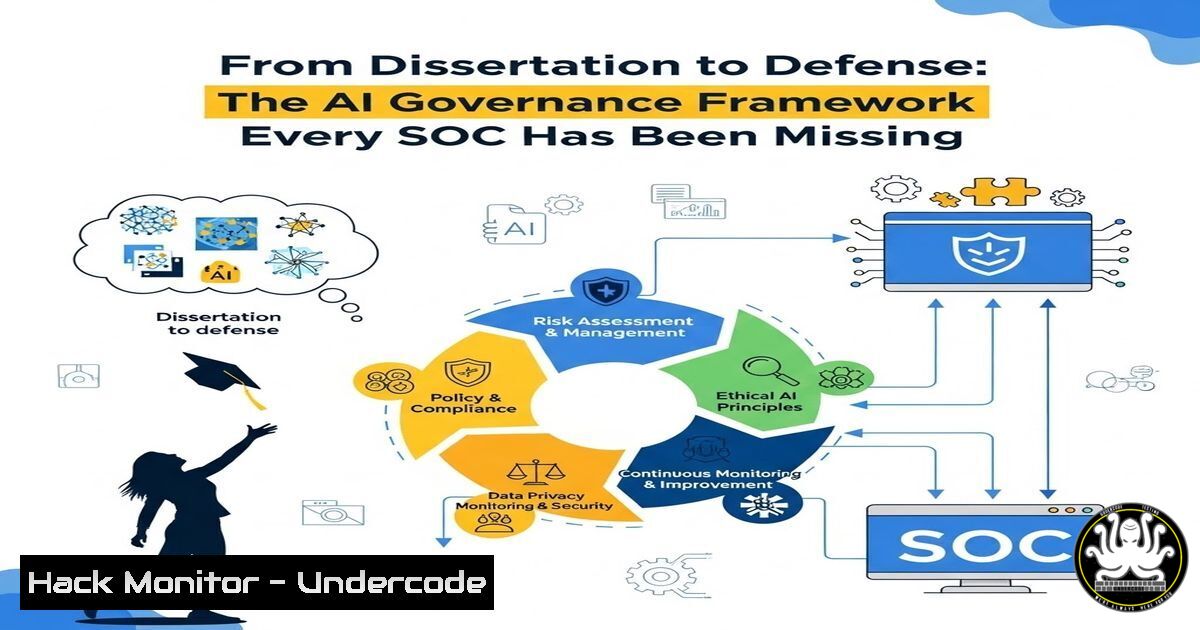
As Security Operations Centers (SOC) aggressively integrate Artificial Intelligence (AI) for threat detection and response, a critical gap has emerged: operational governance. The absence of a structured framework to manage AI accountability, ethics, and compliance is creating unseen risks. This article deconstructs a practitioner-developed framework, born from research in Critical National Infrastructure (CNI), that bridges the chasm between high-level standards like ISO 42001/NIST AI RMF and the daily realities of SOC analysts.
Learning Objectives:
- Understand the core components of a practical AI Governance Framework for SOCs.
- Learn to implement key governance checks, from model procurement to ethical readiness assessments.
- Apply actionable commands and scripts to enforce governance policies in both Linux and Windows SOC environments.
You Should Know:
- Mapping the RACI Matrix: Who Owns the AI in Your SOC?
A Responsible, Accountable, Consulted, Informed (RACI) matrix is the bedrock of AI governance, preventing critical tasks from falling between the cracks. Without it, model drift goes unmonitored, and bias investigations have no owner.
Step‑by‑step guide:
- Identify AI Assets: Catalogue all AI/ML models in use (e.g., UEBA classifiers, phishing detection ML, SIEM correlation engines).
- Define Key Activities: List lifecycle stages: Procurement/Development, Deployment, Monitoring, Incident Response, Retraining, Decommissioning.
- Assign Roles: For each activity, assign RACI against roles: SOC Manager (A), Lead Analyst (R), Threat Intel (C), CISO (I).
- Implement Technical Enforcement: Use your SIEM or ticketing system to tag AI-related alerts with the pre-assigned “Accountable” owner. For example, a Linux command to query an Elasticsearch SIEM for unassigned AI-model alerts could be:
curl -X GET "localhost:9200/soc_alerts-/_search" -H 'Content-Type: application/json' -d'
{
"query": {
"bool": {
"must": [
{ "match": { "source": "AI_Model_XYZ" } },
{ "match": { "assigned_owner": "" } }
]
}
}
}'
2. Operationalizing Explainability: Beyond the “Black Box”
The EU AI Act mandates explainability for high-risk systems. In a SOC, this means an analyst must understand why an AI flagged an incident to respond effectively and meet compliance.
Step‑by‑step guide:
- Integrate Explainability Tools: For custom models, use libraries like SHAP (SHapley Additive exPlanations) or LIME. Require these outputs to be logged.
- Create an Explainability Report: Automate a report generation for high-severity alerts. A Python snippet using SHAP might be:
import shap import json Assuming `model` is your classifier and `alert_data` the input explainer = shap.TreeExplainer(model) shap_values = explainer.shap_values(alert_data) Generate a summary and write to a security log explanation = { "alert_id": "ALERT123", "prediction": model.predict(alert_data)[bash], "top_features": dict(sorted(zip(feature_names, shap_values[bash]), key=lambda x: abs(x[bash]), reverse=True)[:5]) } with open('/var/log/soc/ai_explanations.log', 'a') as f: f.write(json.dumps(explanation) + '\n') - SOC Workflow Integration: Configure your SOAR platform to retrieve and attach this explanation log to the corresponding incident ticket.
3. Building Ethical Readiness: The Pre-Deployment Checklist
Ethical readiness is not philosophical; it’s a set of technical and procedural controls tested before an AI model touches production data.
Step‑by‑step guide:
- Constitute a Review Board: Assemble a cross-functional team (Legal, Compliance, Ethics, Senior Analysts).
2. Execute a Technical Assessment:
Bias Testing: Run the model against a diverse, labeled dataset. Calculate metrics like Demographic Parity Difference. Use `AI Fairness 360` (aif360) toolkit.
Adversarial Testing: Simulate attacks (e.g., data poisoning, evasion attacks) in a sandbox.
Data Provenance: Verify training data sources. Use command-line tools like `hashdeep` to generate and verify audit trails of datasets:
hashdeep -r /opt/soc/models/training_dataset/ > dataset_manifest.txt
3. Document & Sign-Off: A “Model Ethical Readiness Certificate” must be signed by the SOC Manager and Legal before deployment.
4. Governing Procurement: Vetting the Vendor’s AI
Most SOCs use vendor AI. Your governance framework must extend to third-party supply chains, mandating specific clauses and demonstrations.
Step‑by‑step guide:
1. Update Procurement Policy: Require vendors to provide:
A standardized model card detailing performance, bias metrics, and training data.
Access to an explainability interface for their model.
A right-to-audit clause for the AI component.
- Technical Evaluation in PoC: During Proof of Concept, replicate your production environment. Test vendor AI with your own data and adversarial examples. Use network logging (
tcpdump) to monitor unexpected data exfiltration to vendor clouds:sudo tcpdump -i eth0 host vendor-api.com -w procurement_test.pcap
- Contractual Binding: Ensure all technical and transparency requirements are explicitly written into the Service Level Agreement (SLA).
-
Continuous Monitoring & The AI Incident Response Plan
AI models decay and can be attacked. Monitoring and a dedicated AI incident response plan are non-negotiable.
Step‑by‑step guide:
- Define Key Metrics: Monitor for model drift (e.g., PSI – Population Stability Index), accuracy drop, and spike in false positives.
- Automate Alerts: Set thresholds in your monitoring system. An example PowerShell command to check an API endpoint for model performance metrics could be:
$metrics = Invoke-RestMethod -Uri "https://internal-api/soc/model/performance" -Method GET if ($metrics.psi -gt 0.25) { Send-MailMessage -To "[email protected]" -Subject "ALERT: Significant Model Drift Detected" } - Create an AI-Specific IR Playbook: This should include steps for: immediate model quarantine, rollback to a previous version, forensic data preservation for the model’s decision logs, and stakeholder notification as per the RACI matrix.
What Undercode Say:
- Governance is a Force Multiplier, Not an Overhead: A structured framework turns AI from a mysterious “black box” into a disciplined, accountable member of the SOC team, increasing trust and operational efficiency.
- The Devil is in the (Automated) Details: Theoretical policies fail. Governance only works when baked into automated technical checks, SIEM queries, SOAR playbooks, and procurement scripts.
Prediction:
Within the next 18-24 months, regulatory pressure from the EU AI Act and sector-specific guidelines will make a formal AI governance framework a mandatory requirement for any credible SOC, especially those handling critical infrastructure. SOCs that have integrated these practices early will gain a significant compliance and operational advantage, while others will face costly, reactive scrambles. The market for specialized “SOC AI Governance” courses and tooling will explode, validating the need for the exact practical knowledge this framework provides.
▶️ Related Video (82% Match):
🎯Let’s Practice For Free:
IT/Security Reporter URL:
Reported By: Kenny Holmes – Hackers Feeds
Extra Hub: Undercode MoN
Basic Verification: Pass ✅


