Listen to this Post
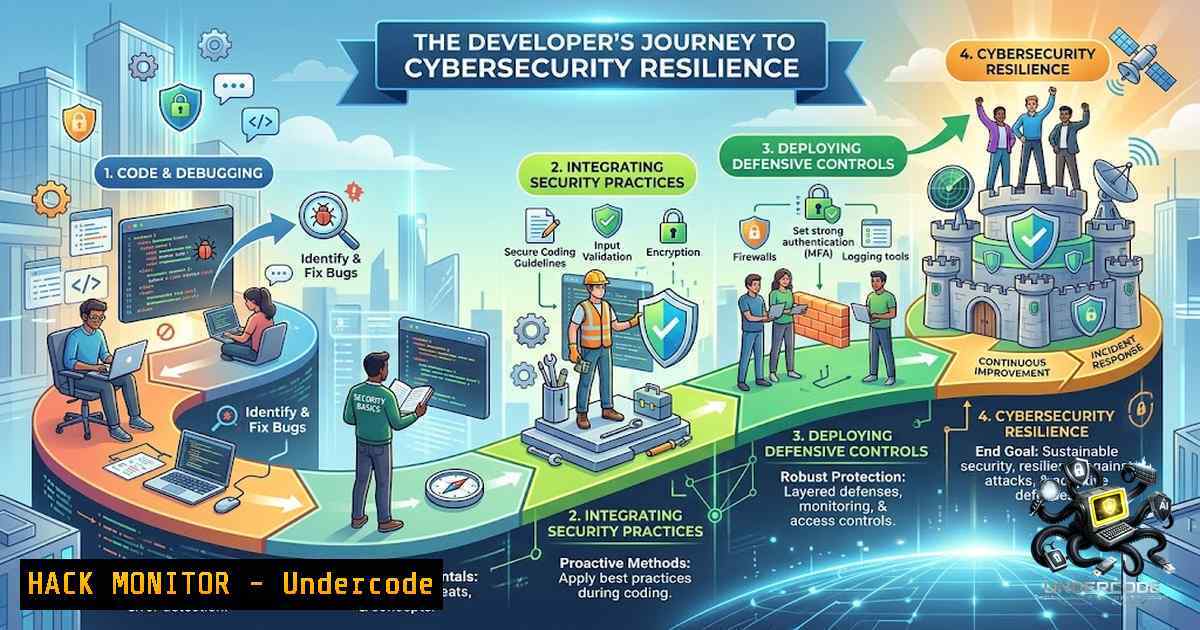
Introduction:
The path from computer science student to security-conscious engineer is paved with late-1ight debugging sessions, emergency tool adoptions, and the humbling realization that solo coding prowess means little without collaborative problem-solving. As highlighted in a recent reflection by a CS student, every project teaches something beyond syntax—sometimes it is hours of troubleshooting, sometimes it is mastering a new framework overnight, and often it is understanding that teamwork matters as much as technical skill. This philosophy is the bedrock of modern cybersecurity, where defensive thinking must be woven into every stage of development, from initial commit to production deployment.
Learning Objectives:
- Master systematic debugging and log analysis techniques across Linux and Windows environments.
- Implement API security best practices and harden cloud-1ative applications against common vulnerabilities.
- Develop a repeatable incident response workflow using open-source tools and automation.
- Cultivate a growth mindset that treats every security incident as a learning opportunity.
1. Systematic Debugging and Log Analysis
Debugging is not guesswork; it is a forensic exercise. Whether you are chasing a segmentation fault in a C program or investigating an anomalous spike in network traffic, the methodology remains consistent: isolate, replicate, and trace.
Linux Command-Line Debugging Toolkit:
– `strace -p
– `gdb ./binary core` – Post-mortem analysis of core dumps. Use `bt` (backtrace) to view the call stack at the point of crash.
– `journalctl -u nginx -f` – Real-time log following for systemd services. Combine with `grep ERROR` to filter critical events.
– `tcpdump -i eth0 -w capture.pcap` – Capture raw packets for offline analysis in Wireshark.
Windows PowerShell Debugging Commands:
– `Get-Process | Where-Object { $_.CPU -gt 50 }` – Identify processes consuming excessive CPU resources.
– `Get-WinEvent -LogName Application -MaxEvents 50` – Retrieve the latest 50 application event logs.
– `Test-1etConnection google.com -Port 443` – Validate TLS connectivity and firewall rules.
Step‑by‑Step Debugging Workflow:
- Reproduce the issue in a controlled staging environment.
- Enable verbose logging for the affected service (e.g., `set -x` in bash scripts, `–debug` flags in Python applications).
- Isolate variables by comparing a working baseline configuration against the failing state.
- Use binary search on code commits if the issue appeared after a recent deployment (
git bisect). - Document the root cause and the resolution steps for future reference.
2. API Security: Authentication, Authorization, and Input Validation
APIs are the backbone of modern applications, and they are also the most frequently attacked surface. The OWASP API Security Top 10 highlights broken object-level authorization (BOLA) and excessive data exposure as critical risks.
Hardening RESTful APIs:
- Use JWT with short expiration times and implement refresh token rotation. Example (Node.js):
const jwt = require('jsonwebtoken'); const token = jwt.sign({ userId: 123 }, process.env.JWT_SECRET, { expiresIn: '15m' }); - Validate all input against a strict allowlist. For Python Flask:
from marshmallow import Schema, fields
class UserSchema(Schema):
email = fields.Email(required=True)
age = fields.Int(validate=Range(min=0, max=120))
- Implement rate limiting to mitigate brute-force attacks. Use Redis-backed counters for distributed environments.
Windows-Specific API Security:
- Use Windows Authentication (Kerberos/NTLM) for internal APIs to avoid passing plaintext credentials.
- Leverage PowerShell to test API endpoints:
$headers = @{ "Authorization" = "Bearer $token" }
Invoke-RestMethod -Uri "https://api.example.com/users" -Headers $headers
Step‑by‑Step API Security Audit:
- Map all endpoints and their associated HTTP methods.
- Verify that each endpoint enforces proper authorization checks (not just authentication).
- Test for injection vulnerabilities by sending malformed JSON/XML payloads.
- Review error messages to ensure they do not leak stack traces or database schema details.
- Enable audit logging for all authentication and authorization events.
3. Cloud Hardening: Securing Infrastructure as Code
With the shift to cloud-1ative architectures, misconfigured S3 buckets and overly permissive IAM roles have become the new “default passwords.” Infrastructure as Code (IaC) tools like Terraform and AWS CloudFormation offer an opportunity to bake security into the provisioning process.
Key Cloud Hardening Practices:
- Enable MFA for all root users and enforce IAM roles with least privilege.
- Use AWS Config or Azure Policy to continuously monitor for compliance drift.
- Encrypt data at rest using KMS-managed keys and enforce TLS 1.3 for data in transit.
Terraform Security Example:
resource "aws_s3_bucket" "secure_bucket" {
bucket = "my-secure-bucket"
acl = "private"
versioning { enabled = true }
server_side_encryption_configuration {
rule { apply_server_side_encryption_by_default { sse_algorithm = "AES256" } }
}
}
Windows Azure CLI Commands for Hardening:
az storage account update --1ame mystorageaccount --https-only true
az role assignment create --assignee <principal-id> --role "Reader" --scope /subscriptions/<sub-id>
Step‑by‑Step Cloud Hardening Review:
- Inventory all cloud resources using native tools (AWS Resource Groups, Azure Resource Graph).
- Run a security assessment tool like Prowler or ScoutSuite to identify misconfigurations.
- Remediate high-severity findings (publicly exposed storage, open security groups).
- Implement automated remediation via AWS Lambda or Azure Functions for common issues.
- Schedule quarterly reviews of IAM policies and remove unused roles.
-
Vulnerability Exploitation and Mitigation: Understanding the Attacker Mindset
To defend effectively, one must think like an attacker. This does not mean becoming malicious, but rather understanding the tools and techniques used in real-world breaches.
Common Exploitation Techniques:
- SQL Injection: Using `’ OR ‘1’=’1` to bypass login forms.
- Cross-Site Scripting (XSS): Injecting `` into unsanitized input fields.
- Command Injection: `; rm -rf /` in poorly coded web applications.
Mitigation Strategies:
- Use parameterized queries (e.g., Python’s `sqlite3` with `?` placeholders).
- Implement Content Security Policy (CSP) headers to restrict script sources.
- Escape all user input before rendering in HTML or executing in shells.
Linux Command to Test for Open Ports (Reconnaissance):
nmap -sV -p- 192.168.1.100
This scans all ports and identifies service versions, which can reveal outdated and vulnerable software.
Windows PowerShell for Port Scanning:
Test-1etConnection -ComputerName 192.168.1.100 -Port 80
Step‑by‑Step Vulnerability Assessment:
- Conduct an asset inventory to know what you are protecting.
- Run an automated vulnerability scanner (Nessus, OpenVAS) to identify known CVEs.
- Manually verify critical findings to eliminate false positives.
- Prioritize patches based on CVSS scores and exploitability.
5. Re-scan after patching to confirm remediation.
- Building a Security-First Culture Through Collaboration and Continuous Learning
The most sophisticated technical controls are useless if the team lacks a security mindset. Collaboration—pair programming, code reviews, and threat modeling sessions—transforms security from a checklist into a shared responsibility.
Practical Steps to Foster Security Culture:
- Conduct regular “lunch and learn” sessions covering OWASP Top 10, recent breaches, and new attack vectors.
- Implement a bug bounty program (even internally) to incentivize finding vulnerabilities.
- Use gamification in training: capture-the-flag (CTF) events for developers and IT staff.
Linux Command to Monitor Failed Login Attempts:
grep "Failed password" /var/log/auth.log | awk '{print $9}' | sort | uniq -c
Windows Event Log Analysis for Security Incidents:
Get-WinEvent -LogName Security | Where-Object { $_.Id -eq 4625 } | Select-Object TimeCreated, Message
Step‑by‑Step Incident Response Playbook:
- Detection: Identify the anomaly via SIEM alerts or user reports.
- Containment: Isolate affected systems (network segmentation, firewall rules).
- Eradication: Remove the root cause (patch, delete malicious files).
- Recovery: Restore from clean backups and verify integrity.
- Lessons Learned: Conduct a post-mortem and update controls.
What Undercode Say:
- Debugging is a security skill. Every hour spent tracing a memory leak or analyzing a log file builds the forensic mindset needed for incident response.
- Security is not a destination. It is a continuous process of learning, adapting, and sharing knowledge—much like the student’s journey described in the original post.
Analysis: The original post emphasizes that real growth happens during the building process, not just at the final product. In cybersecurity, this translates to embracing failures—whether a misconfigured firewall or a bypassed authentication control—as stepping stones. The most resilient teams are those that treat every security alert as a teaching moment, document their findings, and iterate on their defenses. The student’s reflection on teamwork is particularly poignant; security is rarely a solo endeavor. Cross-functional collaboration between developers, operations, and security professionals is the only sustainable way to outpace adversaries. Finally, the acknowledgment that “each mistake makes the next solution a little better” is the essence of a growth mindset, which is indispensable in a field where zero-day exploits and evolving threats are the norm.
Prediction:
- +1 The increasing integration of AI into debugging and security tools will reduce mean time to detection (MTTD) and mean time to response (MTTR), empowering junior engineers to perform at senior levels.
- +1 Open-source security frameworks (e.g., OPA, Falco) will become the standard for cloud-1ative environments, democratizing access to enterprise-grade protection.
- -1 The rapid adoption of generative AI for code completion will introduce new classes of vulnerabilities, as models may inadvertently suggest insecure patterns or expose sensitive data in training sets.
- -1 Supply chain attacks will intensify, targeting dependencies in popular package managers (npm, PyPI, NuGet), necessitating stricter provenance and signing mechanisms.
- +1 Security training that emphasizes hands-on, project-based learning—mirroring the student’s “build in public” approach—will produce more job-ready professionals and close the cybersecurity talent gap.
▶️ Related Video (88% Match):
🎯Let’s Practice For Free:
🎓 Live Courses & Certifications:
Join Undercode Academy for Verified Certifications
🚀 Request a Custom Project:
Secure, high-velocity infrastructure and disruptive technological engineering. Contact our engineering team for high-tier development and proprietary systems:
[email protected]
💎 Smart Architecture | 🛡️ Secure by Design | ⭐ Trusted by Thousands
IT/Security Reporter URL:
Reported By: Ajaykrishna P – Hackers Feeds
Extra Hub: Undercode MoN
Basic Verification: Pass ✅


