
Listen to this Post
Introduction:
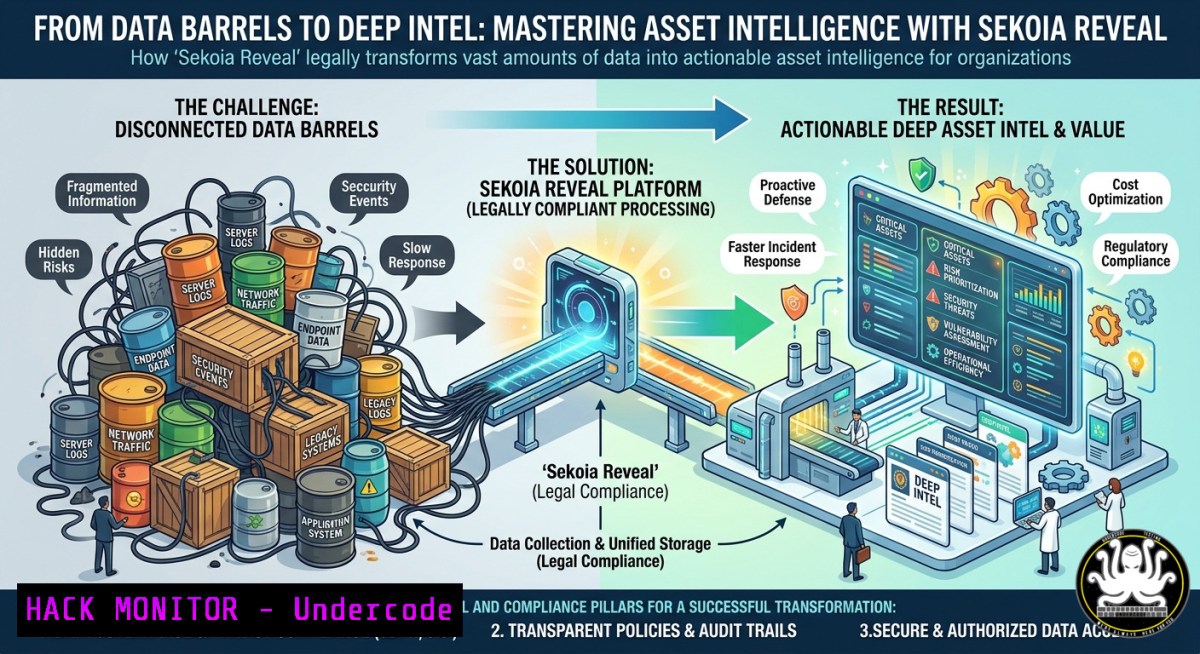
Modern Security Operations Centers (SOCs) are drowning in data but dying for context. The average enterprise generates billions of security signals daily, yet fragmented alerts and siloed asset inventories force analysts into the impossible role of digital archaeologists. Sekoia.io’s new Reveal module directly tackles this crisis by moving beyond basic asset visibility—it delivers real-time, unified asset intelligence. This article dives into how AI-powered behavioral analytics and automated asset discovery can eliminate analyst blind spots and transform your SOC from reactive to proactive.
Learning Objectives:
- Implement automated asset discovery workflows to eliminate manual inventory errors and shadow IT blind spots.
- Leverage UEBA-driven Points of Interest (PoI) to detect weak signals and anomalous behavior before they escalate into full-blown incidents.
- Correlate vulnerability data, security detections, and asset criticality to prioritize risks with precision and operational confidence.
You Should Know:
- Zero-Trust Asset Discovery: From Spreadsheets to Live Inventory
The foundation of any effective defense is knowing exactly what you are protecting. Static CMDBs and manual spreadsheets are obsolete the moment they are saved. Sekoia Reveal’s asset intelligence layer continuously ingests data from endpoints, EDRs, cloud services, and identity providers to build a unified, live inventory. This process transforms raw telemetry into an attack surface map, automatically identifying not just managed workstations, but also rogue IoT devices, ephemeral cloud workloads, and shadow IT assets.
Step-by-step guide to understanding asset enrichment and discovery:
- Manual Sweep (Windows/Linux): Before automation, manually inventory your subnet using native tools to identify gaps. On Windows CMD, run a ping sweep to populate the ARP cache. `for /L %i in (1,1,254) do ping -n 1 192.168.1.%i` followed by `arp -a` to list discovered IPs and MAC addresses. On Linux, use `ip neigh` to inspect the neighbor table after a similar sweep.
- Nmap Network Mapping: Use the industry standard for deeper fingerprinting. Run `sudo nmap -sn 192.168.1.0/24` for a ping sweep (host discovery), followed by `sudo nmap -sV 192.168.1.10` to probe open ports and service versions on a single host.
- API-driven Enrichment: Modern SOC platforms automate this via REST APIs. Sekoia.io’s public API allows external apps to ingest this asset data programmatically, ensuring the CMDB is always current without manual intervention. A typical `cURL` enrichment request to a security platform looks like:
curl -X POST https://api.sekoia.io/v1/assets -H "Authorization: Bearer $API_KEY" -d '{"asset_ip": "10.10.10.10"}'. - Correlation: The platform then cross-references discovered assets against vulnerability scanners and threat intelligence feeds. For instance, if Nmap finds an outdated SSH service, the platform flags that specific IP for immediate remediation.
-
Behavioral Triage: Cutting Through Alert Fatigue with Points of Interest (PoI)
Most attacks do not announce themselves with a screaming alarm; they begin with slow, quiet anomalies—an unexpected PowerShell command, a login from a weird geolocation, irregular data exfiltration patterns. Traditional SIEMs generate hundreds of low-fidelity alerts, leading to crippling analyst fatigue. Sekoia Reveal introduces Points of Interest (PoI), an AI-driven behavioral detection framework that surfaces these weak signals within the asset’s contextual timeline.
Step-by-step guide to configuring UEBA and contextual triage:
- Baselining Behavior (Linux): Configure auditd to track critical command-line executions. In
/etc/audit/rules.d/audit.rules, add `-w /usr/bin/ -p x -k command_activity` to monitor changes in binary directories. For SIEM ingestion, forward these logs via `auditd` to a central collector. - Windows Event Log Analysis: Enable advanced auditing via PowerShell. Run
auditpol /set /category:"Detailed Tracking" /subcategory:"Process Creation" /success:enable. Use `Get-WinEvent -FilterHashtable @{LogName=’Security’; ID=4688}` to query for new process creations. - Automated Correlation: In platforms like Sekoia, the AI engine maps these events against user behavior profiles. If `auditd` logs a `wget` download of a suspicious binary from an internal server that normally only manages DNS, the PoI engine flags this as a high-fidelity point of interest, bypassing the low-level alert pipeline.
- Asset-Centric Investigation: Open the asset context panel. Instead of viewing 100 separate firewall alerts, the analyst sees a single PoI: “Asset: Fileserver-01 – Anomaly: Total bytes transferred to external IP increased by 600% in the last hour.” This transforms the investigation from log-staring to threat hunting.
3. Attack Path Visualization: Proactive Risk Remediation
Knowing an asset has a critical vulnerability is useless without understanding the blast radius. A missing patch on a non-critical development sandbox is less urgent than the same vulnerability on a domain controller exposed to the internet. Sekoia Reveal visualizes attack paths, showing exactly how a compromised low-value asset could be pivoted to a critical crown jewel. This shifts the SOC from reactive patching to proactive disruption of the actual kill chain.
Step-by-step guide to context-aware prioritization and mitigation:
- Automated Inventory Tagging: Ensure assets are tagged by criticality (e.g., “Crown Jewel,” “DMZ,” “Workstation”) within the platform. In open-source tools like Wazuh, you can add custom labels via `ossec.conf` or API calls.
- Vulnerability Scanning Integration: Run a credentialed scan using
nmap’s NSE scripts:nmap -sV --script vuln 10.0.0.5 -p 443. Export the results in a standard format like CSV or JSON. - Path Analysis: The SOC platform builds a graph database of network relationships. It analyzes firewall rules, Active Directory (AD) delegation, and SSH trust relationships. A typical command to check trust relationships on Linux is `ss -tunap | grep ESTABLISHED` to see active connections; on Windows, `netstat -an | findstr EST` serves a similar purpose.
- Remediation Playbooks: Once an attack path is identified (e.g., Workstation A → File Server B → Domain Controller via Admin Creds), execute targeted mitigation. Linux: `sudo iptables -A INPUT -s [bash] -j DROP` to isolate the node. Windows:
Set-NetFirewallRule -DisplayName "Block Workstation" -RemoteAddress [bash] -Action Block.
What Undercode Say:
- Key Takeaway 1: Asset Visibility is dead; Asset Intelligence is the mandatory evolution. Simply knowing an asset exists is a liability if you do not understand its behavior, exposures, and relationships.
- Key Takeaway 2: AI-powered behavioral analytics (UEBA) is the only scalable solution to alert fatigue. Moving from rule-based alerts to Points of Interest shifts SOC focus from triaging noise to hunting real anomalies.
While Sekoia Reveal does not eliminate the need for a skilled analyst, it removes the manual grunt work of data stitching. By unifying the asset journey—from discovery through vulnerability assessment to real-time behavior—it recenters the SOC on the only thing that matters: the asset’s risk impact. The future of security is not about collecting more logs; it is about delivering the right context at the exact moment of investigation.
Prediction:
By 2028, isolated asset inventories and standalone vulnerability scanners will be considered legacy security artifacts. The market will fully converge into Unified Asset Intelligence Platforms where AI-driven context is not an add-on but the core operating system of the SOC. Solutions like Sekoia Reveal will dominate, forcing traditional SIEMs and EDRs to either build deep asset-centric engines or become relegated to mere data pipes. The security analyst of the future will spend zero time querying databases; instead, they will simply ask questions of an intelligence layer that understands the entire estate as a single, living entity.
▶️ Related Video (84% Match):
🎯Let’s Practice For Free:
IT/Security Reporter URL:
Reported By: Georges Bossert – Hackers Feeds
Extra Hub: Undercode MoN
Basic Verification: Pass ✅


