Listen to this Post
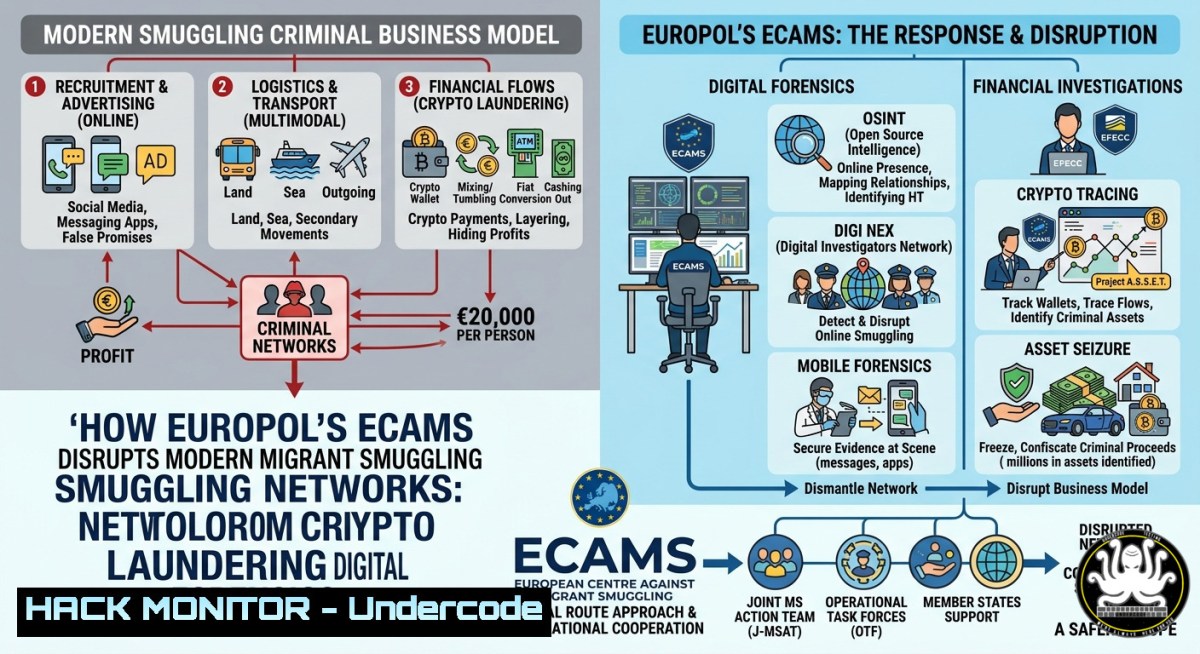
Introduction:
Migrant smuggling has evolved into a sophisticated digital enterprise where criminal networks leverage encrypted communications, cryptocurrency money laundering, and online recruitment to exploit vulnerable individuals. Europol’s new European Centre Against Migrant Smuggling (ECAMS) represents a paradigm shift in law enforcement’s response, moving from reactive border interdiction to intelligence-driven, data-centric operations that systematically dismantle the financial and technological infrastructure of transnational criminal organizations.
Learning Objectives:
- Understand how modern criminal networks utilize AI, encrypted platforms, and blockchain technologies to facilitate migrant smuggling and money laundering
- Master digital forensic techniques for electronic evidence extraction, cryptocurrency tracing, and OSINT investigations
- Implement advanced analytical methodologies used by Europol to map criminal networks and identify High Value Targets
You Should Know:
1. Intelligence-Driven OSINT and Digital Footprint Analysis
Modern migrant smuggling networks operate extensively in the digital realm, advertising services, recruiting associates, and coordinating logistics through encrypted communications and social media platforms. The DigiNeX network of digital investigators coordinates open-source monitoring, detection, and analysis across Member States. To conduct similar investigations, leverage the following Linux/Windows command toolkit:
Linux OSINT Toolkit:
 Extract metadata from online images using ExifTool
exiftool -j -all suspected_image.jpg | grep -E "GPS|DateTime"

Capture website reconnaissance with theHarvester
theHarvester -d suspicious-smuggling-site.com -b all

Perform DNS enumeration and subdomain discovery
dnsrecon -d target-domain.com -t axfr -c subdomains.csv

Monitor encrypted Telegram channels using Pyrogram (Python library)
python3 -c "from pyrogram import Client; app = Client('my_account'); app.run()"
Windows PowerShell OSINT Commands:
 Extract IP geolocation data
Invoke-RestMethod -Uri "http://ip-api.com/json/203.0.113.5" | Select-Object city, country, isp

Analyze URL structure and redirect chains
Invoke-WebRequest -Uri "https://suspicious-link.com" -MaximumRedirection 0

Extract social media metadata using built-in web requests
Invoke-RestMethod -Uri "https://api.twitter.com/1.1/statuses/oembed.json?id=12345" -Headers @{"Authorization"="Bearer $TOKEN"}
Step‑by‑Step Guide: Begin by establishing a dedicated investigation virtual machine with Kali Linux for offensive OSINT capabilities. Configure Firefox with FoxyProxy and install the OSINT Framework browser extension. Use `theHarvester` to enumerate email addresses and subdomains associated with suspected smuggling domains. Deploy `sherlock` to locate associated social media accounts across 300+ platforms. Cross-reference this data with Europol-style intelligence databases using Python scripts to automate correlation between digital identities and physical locations.
- Advanced Digital Forensics: Extracting Evidence from Seized Electronic Devices
In the recent Europol operation, electronic devices and documents relevant to the investigation were seized, forming critical evidence against criminal networks. The SIRIUS project phase 3 enhances cross-border access to electronic evidence through investigative tools, training programs, and expanded capacity building for law enforcement agencies.
Linux Forensic Acquisition:
 Create a forensic image of a USB device using dd
sudo dd if=/dev/sdb of=evidence.dd bs=4096 conv=noerror,sync
 Verify image integrity with SHA-256 hashing
sha256sum evidence.dd > evidence.dd.sha256

Recover deleted files using TestDisk
sudo photorec /dev/sdb

Extract browser history from Chrome (Linux)
sqlite3 ~/.config/google-chrome/Default/History "SELECT url, title, last_visit_time FROM urls ORDER BY last_visit_time DESC LIMIT 50;"
Windows PowerShell Forensic Commands:
 Extract Windows Event Logs related to suspicious activity
Get-WinEvent -FilterHashtable @{LogName='Security'; ID=4624,4625} | Export-Csv -Path "logon_events.csv"

Analyze prefetch files for executed programs
Get-ChildItem "C:\Windows\Prefetch" -Filter .pf | ForEach-Object { $_.Name }

Extract USB device connection history
Get-ItemProperty -Path "HKLM:\SYSTEM\CurrentControlSet\Enum\USBSTOR\" | Select-Object FriendlyName, Mfg, Service
Step‑by‑Step Guide: Upon seizure, immediately isolate electronic devices using Faraday bags to prevent remote wiping. Boot the device using a forensic Linux distribution like CAINE or Paladin to maintain evidentiary chain of custody. Create bit-for-bit disk images using `dd` with write-blocking hardware. Extract volatile memory (RAM) data using `memdump` or Windows `WinPMEM` driver before power-off. Analyze browser artifacts, chat logs, and cryptocurrency wallet files using tools like Autopsy or the Sleuth Kit. Deploy password cracking via John the Ripper or Hashcat against encrypted containers. Generate a forensic timeline using `log2timeline` from the plaso framework to reconstruct suspect activities.
3. Cryptocurrency Tracing and Anti-Money Laundering Methodologies
Europol’s recent takedown of a cryptocurrency fraud network laundering over EUR 700 million demonstrates the agency’s sophisticated blockchain analysis capabilities. Smuggling networks increasingly rely on multi-layered financial infrastructures, including underground banking systems and cryptocurrency mixing services like Cryptomixer.io, to move and conceal criminal profits.
Blockchain Analysis Commands:
 Install and use BlockCypher API for transaction tracing
curl -X GET "https://api.blockcypher.com/v1/btc/main/addrs/1A1zP1eP5QGefi2DMPTfTL5SLmv7DivfNa/full"

Query Bitcoin transaction details via command line
python3 -c "import requests; txid='your_txid'; r=requests.get(f'https://blockchain.info/rawtx/{txid}'); print(r.json())"

Use Python with web3.py for Ethereum analysis
from web3 import Web3; w3 = Web3(Web3.HTTPProvider('https://mainnet.infura.io/v3/YOUR_KEY'))
tx = w3.eth.get_transaction('0x...'); print(f"From: {tx['from']}, To: {tx['to']}, Value: {w3.fromWei(tx['value'], 'ether')}")
Windows PowerShell for AML Investigation:
 Query blockchain APIs for suspicious patterns
$uri = "https://api.blockchair.com/bitcoin/dashboards/address/1A1zP1eP5QGefi2DMPTfTL5SLmv7DivfNa"
Invoke-RestMethod -Uri $uri | ConvertTo-Json -Depth 10

Parse CSV exports from centralized exchanges (e.g., Binance, Coinbase) for transaction pattern analysis
Import-Csv "exchange_transactions.csv" | Group-Object -Property Currency | Select-Object Name, Count
Step‑by‑Step Guide: Begin by extracting wallet addresses from seized device chat logs and browser history. Input these addresses into blockchain explorers (Blockchair, Etherscan) to visualize transaction flows. Use GraphSense or CypherTrace for clustering analysis to identify associated wallets. Track funds through mixing services using heuristic analysis and time-correlation techniques. Leverage Europol’s analytical reporting methodology to produce financial flow diagrams identifying layering, placement, and integration stages of money laundering. Cross-reference identified wallets with centralized exchange KYC data through legal Mutual Legal Assistance (MLA) requests as facilitated by the SIRIUS project.
- Artificial Intelligence for Predictive Policing and Network Mapping
Europol warns that AI is fundamentally transforming organized crime, with criminal networks increasingly using generative AI for deepfake scams, automated social engineering, and sophisticated cyberattacks. Simultaneously, Europol advocates for law enforcement integration of AI for predictive analytics, pattern recognition, and network mapping while adhering to accountability and transparency standards.
AI/ML Python Code for Network Analysis:
 Social network analysis of smuggling connections using NetworkX
import networkx as nx
import pandas as pd
 Build graph from communication metadata
G = nx.Graph()
communication_data = pd.read_csv('contact_network.csv')
for _, row in communication_data.iterrows():
G.add_edge(row['source_id'], row['target_id'], weight=row['frequency'])
 Apply PageRank algorithm to identify key facilitators
centrality_scores = nx.pagerank(G)
leaders = sorted(centrality_scores.items(), key=lambda x: x[bash], reverse=True)[:10]

Predictive hotspot mapping using Scikit-learn
from sklearn.cluster import DBSCAN
import numpy as np
coords = np.array([[lat, lon] for lat, lon in smuggling_incidents])
clusters = DBSCAN(eps=0.5, min_samples=5).fit(coords)
Command-Line AI Integration:
 Deploy pre-trained BERT model for natural language processing on intercepted messages
python3 -c "from transformers import pipeline; classifier = pipeline('text-classification', model='bert-base-uncased'); result = classifier('Suspicious message about border crossing'); print(result)"

Use Ollama for local LLM-based evidence summarization
ollama pull llama2
echo "Analyze this chat log for smuggling indicators: " | ollama run llama2
Step‑by‑Step Guide: Aggregate structured and unstructured data from multiple intelligence sources into a centralized data lake. Implement automated entity resolution algorithms to link aliases, phone numbers, and cryptocurrency addresses across disparate datasets. Deploy graph databases (Neo4j) with custom Cypher queries to visualize hierarchical network structures. Train supervised ML models on historical smuggling cases to predict emerging smuggling routes based on geopolitical and economic indicators. Integrate Europol-style advanced analytical tools for mapping criminal networks and prioritising high-risk targets. Ensure all AI implementations comply with the EU AI Act and data protection regulations before operational deployment.
What Undercode Say:
- Key Takeaway 1: Europol’s ECAMS represents a data-driven paradigm shift, integrating OSINT, financial forensics, and advanced analytics to dismantle smuggling business models rather than merely intercepting individual migrants.
- Key Takeaway 2: The intersection of AI-enabled crime and AI-powered law enforcement creates an escalating technological arms race, requiring continuous investment in training, cross-border collaboration, and ethical deployment frameworks.
Prediction:
As smuggling networks adopt generative AI for creating synthetic identities, automated negotiation bots, and deepfake-based recruitment videos, Europol and ECAMS will increasingly rely on federated learning models to analyze sensitive data across jurisdictions without centralizing personal information. Expect widespread deployment of automated blockchain surveillance tools by 2027, enabling real-time tracking of illicit fund flows. The EU will likely mandate encrypted backdoor access for law enforcement within communication platforms, sparking significant privacy debates while providing enhanced investigative capabilities against transnational organized crime.
▶️ Related Video (78% Match):
🎯Let’s Practice For Free:
IT/Security Reporter URL:
Reported By: Europol Migrantsmuggling – Hackers Feeds
Extra Hub: Undercode MoN
Basic Verification: Pass ✅
🎓 Live Courses & Certifications:
Join Undercode Academy for Verified Certifications
🚀 Request a Custom Project:
Secure, high-velocity infrastructure and disruptive technological engineering. Contact our engineering team for high-tier development and proprietary systems:
[email protected]


