Listen to this Post
Introduction:
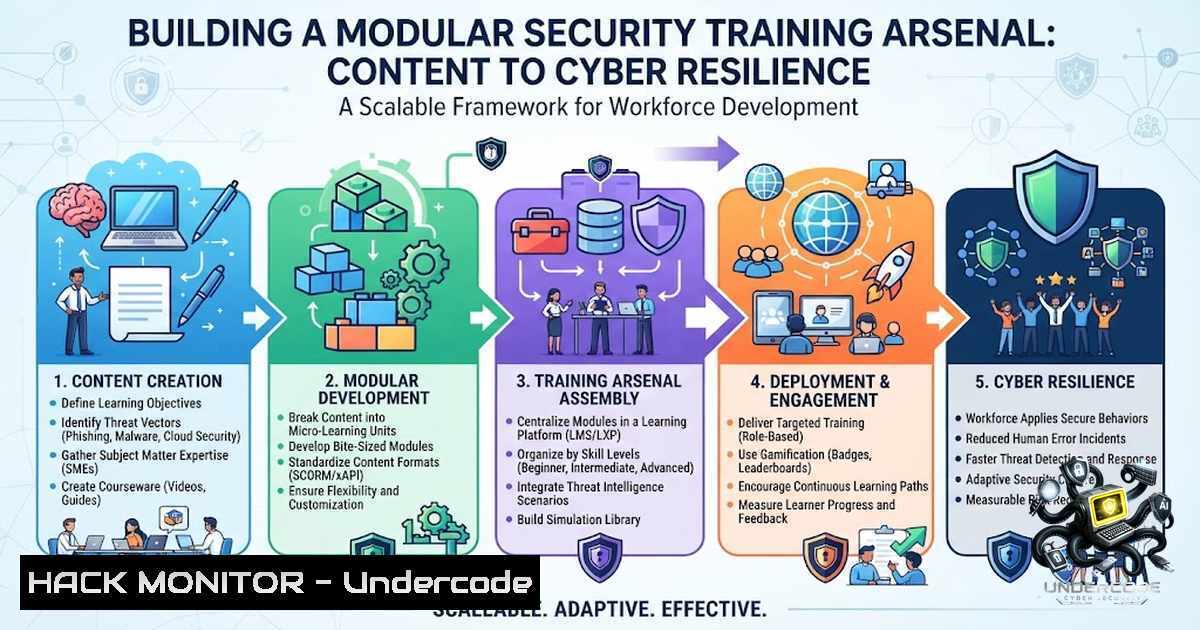
In cybersecurity, treating content as disposable one-off assets is a strategic failure waiting to happen. Most professionals approach content creation—whether it’s threat intelligence reports, incident response playbooks, or security awareness training—as a one-time activity, written, published, and then effectively discarded. This approach does not scale, especially when consistent security posture and team readiness are required over extended periods. A more efficient model is to treat security content as modular components that can be recombined and repurposed across formats, building a library of reusable threat scenarios, exploitation examples, and defensive countermeasures.
Learning Objectives:
- Understand how modular content frameworks can be applied to cybersecurity training, threat intelligence, and incident response documentation
- Master the technical implementation of content-as-code using Linux, Windows, and cloud-1ative automation tools
- Learn to build and maintain a reusable security knowledge base that adapts to emerging threats without reinventing the wheel
- Apply modular principles to API security, cloud hardening, and vulnerability management workflows
- The Modular Security Content Framework: From Theory to Practice
The core premise is simple: instead of generating entirely new material each time, you build a library of reusable insight fragments, threat models, and procedural steps. From a systems perspective, this reduces production cost while maintaining variation—each security update, training module, or playbook becomes a configuration of existing elements rather than a completely new creation.
Step-by-step implementation:
Step 1: Define core security themes aligned with your expertise – Identify the 5–7 persistent threat categories your organization faces (e.g., credential-based attacks, supply chain vulnerabilities, insider threats, API abuses, cloud misconfigurations). Map these to the NICE Framework Task, Knowledge, and Skill statements for workforce development.
Step 2: Break experiences into reusable insight fragments – Document every incident response, penetration test, and security audit as discrete, tagged components. Use YAML or JSON frontmatter to store metadata (CVE IDs, MITRE ATT&CK techniques, severity scores, remediation timelines).
Step 3: Store examples and data points for repeated use – Maintain a version-controlled repository of:
– Attack narratives (e.g., “how an SSRF vulnerability led to cloud credential exfiltration”)
– Defensive playbooks (e.g., “isolation steps for ransomware outbreak”)
– Configuration templates (e.g., hardened nginx.conf, `iptables` rule sets, Terraform modules)
Step 4: Reassemble components into different post structures – Use a templating engine (Jinja2, Handlebars) or a content management system with modular capabilities to dynamically generate tailored content for different audiences—executive briefings, technical runbooks, or hands-on lab exercises.
Linux Command: Content Fragment Management with Git and grep
 Initialize a modular content repository
mkdir -p ~/security_content/{threats,defenses,configs,playbooks}
cd ~/security_content
git init

Tag and search fragments by MITRE ATT&CK technique
grep -r "T1059" --include=".md" ./ | cut -d: -f1 | sort -u

Create a modular playbook by concatenating fragments
cat defenses/isolation.md threats/ransomware_narrative.md > playbooks/ransomware_response.md
Windows PowerShell: Content Assembly Automation
 Create modular content structure
New-Item -ItemType Directory -Path "C:\SecurityContent\Threats","C:\SecurityContent\Defenses","C:\SecurityContent\Playbooks" -Force

Search fragments by CVE
Get-ChildItem -Recurse -Filter ".md" | Select-String "CVE-2024-" | Group-Object Path | Select-Object Name

Assemble playbook from fragments
Get-Content "C:\SecurityContent\Defenses\isolation.md", "C:\SecurityContent\Threats\ransomware.md" |
Out-File "C:\SecurityContent\Playbooks\incident_response.md"
2. AI-Powered Modular Training Development
The integration of Generative AI with modular content frameworks is revolutionizing cybersecurity education. Systems like TeachSecure-CTI automate curriculum development while customizing instruction to reflect both emerging threats and individual learner needs. AI Content Generators can turn a vendor access policy into a draft training module—complete with pages and quizzes—in minutes.
Step-by-step implementation:
Step 1: Define your training objectives – Align with frameworks like NIST SP 800-181 (NICE Framework) or the OWASP Top 10 for application security.
Step 2: Create a modular curriculum – Structure your training as discrete, standalone modules that can be delivered separately or combined into a full learning pathway. For example, a 5-day AI & Cybersecurity training program can cover AI fundamentals, security operations, and a secure-AI roadmap.
Step 3: Leverage AI for content generation – Use tools like Hoxhunt’s Content Studio to generate customized training modules from your source materials. The AI processes your existing documentation and produces SCORM-compliant modules that can be reused across Learning Management Systems.
Step 4: Implement continuous feedback loops – Incorporate real-time threat intelligence feeds to dynamically update training content. The TeachSecure-CTI framework integrates dynamic CTI feeds with adaptive learning mechanisms, ensuring your training remains relevant to the current threat landscape.
Linux Command: Automating Training Module Generation
 Use a CLI utility for threat model component creation (content-as-code approach)
 ISRA (IriusRisk Security Research Assistant) helps build threat modeling components
 with rich metadata

Example: Generate a threat model component for OWASP Top 10
isra generate --framework owasp --component "SQL Injection" --output ./modules/sql_injection.yaml

Batch process multiple modules
for c in $(cat threat_categories.txt); do
isra generate --framework owasp --component "$c" --output "./modules/${c// /_}.yaml"
done

Validate SCORM package integrity
python3 -m scorm_validator ./training_package.zip
3. API Security as Modular Components
APIs are the backbone of modern modular architectures—and a primary attack surface. A modular approach to API security means treating each security control (authentication, authorization, rate limiting, input validation) as a reusable component that can be applied consistently across all endpoints.
Step-by-step implementation:
Step 1: Implement defense in depth – Layer multiple security controls: network-level (L3/L4) firewalls, application-level WAF, and API-specific gateways.
Step 2: Apply zero trust principles – Never trust, always verify. Authenticate every request using OAuth2/OIDC with short-lived tokens.
Step 3: Prevent BOLA (Broken Object Level Authorization) – Implement proper authorization checks at every endpoint. Never rely on client-side controls.
Step 4: Secure sensitive data in transit and at rest – Never place sensitive elements in URLs; move filters to request bodies and use non-sensitive internal identifiers.
Step 5: Implement a Generative Application Firewall (GAF) – For AI-powered APIs, deploy a dedicated security layer that protects against prompt injection and malicious context manipulation.
Linux Command: API Security Testing with OWASP ZAP
 Install OWASP ZAP
sudo apt-get install zaproxy

Run automated API security scan
zap-cli --zap-host localhost --zap-port 8090 quick-scan \
--spider -r "https://api.yourdomain.com/v1/" \
--api-key YOUR_API_KEY

Generate a modular security report
zap-cli report -o api_security_report.html -f html
Windows PowerShell: API Endpoint Discovery and Security Assessment
 Discover API endpoints using Invoke-WebRequest (note: PowerShell 5.1 now shows security prompts for this cmdlet)
Invoke-WebRequest -Uri "https://api.yourdomain.com/openapi.json" -OutFile "openapi_spec.json"

Parse OpenAPI spec to identify endpoints without authentication
$spec = Get-Content "openapi_spec.json" | ConvertFrom-Json
$spec.paths.PSObject.Properties | ForEach-Object {
$path = $<em>.Name
$</em>.Value.PSObject.Properties | ForEach-Object {
$method = $<em>.Name
$security = $</em>.Value.security
if (-1ot $security) {
Write-Warning "Endpoint $path [$method] lacks security definition"
}
}
}
- Cloud Security Hardening Through Modular Infrastructure as Code
Cloud security is inherently modular—infrastructure as Code (IaC) tools like Terraform allow you to define security controls as reusable modules that can be applied consistently across environments.
Step-by-step implementation:
Step 1: Apply the principle of least privilege – Define IAM roles and policies as reusable modules that grant only the minimum permissions required.
Step 2: Adopt a defense-in-depth strategy – Layer network security controls: VPC segmentation, security groups, network ACLs, and WAF.
Step 3: Model threat actors and trust boundaries – Use threat modeling to identify potential attack paths and design controls accordingly.
Step 4: Implement continuous compliance monitoring – Use tools like Microsoft Defender for Cloud to produce prioritized security recommendations based on industry benchmarks (e.g., Microsoft Cloud Security Benchmark).
Step 5: Automate security testing in CI/CD pipelines – Integrate security scanning (SAST, DAST, SCA) as reusable pipeline stages.
Terraform Module Example: Reusable Security Group
 modules/security_group/main.tf
variable "name" { description = "Security group name" }
variable "vpc_id" { description = "VPC ID" }
variable "ingress_rules" { type = list(object({
from_port = number
to_port = number
protocol = string
cidr_blocks = list(string)
}))
}

resource "aws_security_group" "this" {
name = var.name
vpc_id = var.vpc_id

dynamic "ingress" {
for_each = var.ingress_rules
content {
from_port = ingress.value.from_port
to_port = ingress.value.to_port
protocol = ingress.value.protocol
cidr_blocks = ingress.value.cidr_blocks
}
}

egress {
from_port = 0
to_port = 0
protocol = "-1"
cidr_blocks = ["0.0.0.0/0"]
}

tags = { Name = var.name }
}

Usage in root module
module "web_sg" {
source = "./modules/security_group"
name = "web-sg"
vpc_id = module.vpc.vpc_id
ingress_rules = [
{ from_port = 443, to_port = 443, protocol = "tcp", cidr_blocks = ["0.0.0.0/0"] },
{ from_port = 80, to_port = 80, protocol = "tcp", cidr_blocks = ["0.0.0.0/0"] }
]
}
- Vulnerability Exploitation and Mitigation as Reusable Training Scenarios
The most effective security training is hands-on and scenario-based. Modular cyber ranges allow organizations to create, share, and deploy realistic cyber scenarios without vendor lock-in.
Step-by-step implementation:
Step 1: Build a modular cyber range – Platforms like CyberRangeCZ enable hands-on training through a community-driven environment.
Step 2: Develop reusable exploitation scenarios – Create scenarios covering OWASP Top 10 vulnerabilities, network exploitation, and cloud-specific attack vectors.
Step 3: Implement a Helical Build Framework – This agile methodology creates reliable, modular, and reusable scenarios for effective cybersecurity training.
Step 4: Use a training asset management portal – Platforms like Foundry (CMU SEI) connect training content users, sponsors, and developers, allowing content to be registered, rated, and added to playlists.
Step 5: Continuously update scenarios with real threat intelligence – Adapt training to reflect emerging threats using dynamic CTI feeds.
Linux Command: Setting Up a Local Penetration Testing Lab
 Install common penetration testing tools
sudo apt-get update
sudo apt-get install -y nmap metasploit-framework sqlmap burpsuite wireshark

Create a modular lab environment using Docker Compose
cat > docker-compose.yml <<EOF
version: '3'
services:
vulnerable-webapp:
image: vulnerables/web-dvwa
ports:
- "8080:80"
vulnerable-api:
image: swaggerapi/petstore
ports:
- "8081:8080"
vulnerable-db:
image: mysql:5.7
environment:
MYSQL_ROOT_PASSWORD: root
EOF

docker-compose up -d

Run a modular vulnerability scan
nmap -sV -p- 127.0.0.1
nikto -h http://127.0.0.1:8080
Windows PowerShell: Incident Response Collection Script
 Comprehensive Incident Response script that gathers common forensic info from a Windows system
 Save as AIO-IR.ps1

$outputDir = "C:\IR_Collection_$(Get-Date -Format 'yyyyMMdd_HHmmss')"
New-Item -ItemType Directory -Path $outputDir -Force

Collect system information
systeminfo > "$outputDir\systeminfo.txt"
Get-Process | Export-Csv "$outputDir\processes.csv" -1oTypeInformation
Get-Service | Export-Csv "$outputDir\services.csv" -1oTypeInformation

Collect network information
ipconfig /all > "$outputDir\network_config.txt"
netstat -ano > "$outputDir\netstat.txt"
Get-1etTCPConnection | Export-Csv "$outputDir\tcp_connections.csv" -1oTypeInformation

Collect security logs (last 7 days)
$endDate = Get-Date
$startDate = $endDate.AddDays(-7)
Get-WinEvent -FilterHashtable @{LogName='Security'; StartTime=$startDate; EndTime=$endDate} |
Export-Csv "$outputDir\security_logs.csv" -1oTypeInformation

Collect PowerShell history
Get-Content (Get-PSReadlineOption).HistorySavePath | Out-File "$outputDir\ps_history.txt"

Write-Host "IR collection complete. Output saved to: $outputDir"
6. Human-Certified Module Repositories for the AI Age
As AI-driven development workflows become mainstream, we need repositories of reusable modules that are curated, security-reviewed, provenance-rich, and equipped with explicit interface contracts.
Step-by-step implementation:
Step 1: Establish a module certification process – Implement human review gates for all security-related modules before they enter production use.
Step 2: Maintain provenance tracking – Record who created each module, when it was last reviewed, and what vulnerabilities were addressed.
Step 3: Define explicit interface contracts – Document inputs, outputs, side effects, and security assumptions for every module.
Step 4: Implement continuous security scanning – Automatically scan modules for known vulnerabilities using tools like Snyk, Trivy, or Grype.
Step 5: Create a feedback loop – Allow users to rate modules and report issues, creating a community-driven quality assurance process.
Linux Command: Module Security Scanning
 Install Trivy for container and filesystem scanning
sudo apt-get install trivy

Scan a module repository for vulnerabilities
trivy fs --severity HIGH,CRITICAL ./modules/

Generate a Software Bill of Materials (SBOM) for a module
trivy sbom ./modules/ --format cyclonedx > module_sbom.json

Verify module signatures (if using GPG-signed modules)
gpg --verify module.signature module.tar.gz
7. Operationalizing the Modular Content Pipeline
The final step is to treat your modular security content as a product, not a project. This means establishing CI/CD pipelines for content updates, implementing version control, and measuring the effectiveness of your training and documentation.
Step-by-step implementation:
Step 1: Version control everything – Store all security content (playbooks, training modules, configuration templates) in Git repositories.
Step 2: Implement automated testing – Validate that modules render correctly, links are functional, and technical commands work as expected.
Step 3: Establish a release cadence – Schedule regular content reviews and updates, aligned with threat intelligence feeds and patch cycles.
Step 4: Measure engagement and effectiveness – Track which modules are most used, which scenarios result in the best learning outcomes, and where gaps exist.
Step 5: Continuously refine – Use analytics and user feedback to improve content quality and relevance.
CI/CD Pipeline Example (GitHub Actions):
name: Security Content CI/CD

on:
push:
paths:
- 'content/'
schedule:
- cron: '0 0   1'  Weekly review

jobs:
validate:
runs-on: ubuntu-latest
steps:
- uses: actions/checkout@v3
- name: Validate Markdown
run: |
npm install -g markdownlint-cli
markdownlint 'content//.md'
- name: Check for broken links
run: |
npm install -g markdown-link-check
find content -1ame ".md" -exec markdown-link-check {} \;
- name: Scan for secrets
run: |
docker run --rm -v $(pwd):/repo trufflesecurity/trufflehog \
--filesystem /repo --only-verified
- name: Build modular content
run: |
python3 build.py --output ./dist/
- name: Deploy to LMS
run: |
 SCORM package deployment to your LMS
curl -X POST -F "file=@./dist/training.zip" https://your-lms.com/api/upload
What Undercode Say:
- Modularity is the foundation of scalable security operations – Treating security content (playbooks, training, threat intelligence) as reusable components reduces production cost, improves consistency, and enables rapid adaptation to new threats.
-
AI accelerates but doesn’t replace human curation – While AI can generate training modules and threat models at scale,human certification, security review, and provenance tracking remain essential for maintaining quality and trust.
The modular content strategy aligns perfectly with modern cybersecurity practices. Just as we treat infrastructure as code, we must treat security knowledge as code—versioned, testable, reusable, and continuously improved. Organizations that adopt this approach will find themselves more resilient, more responsive, and better equipped to face the evolving threat landscape. The key insight is that content is no longer an output—it is a set of components that can be recomposed as needed. This systems-thinking approach transforms security training from a costly, one-off activity into a strategic asset that delivers consistent value over time.
Prediction:
+1 The modular content approach will become the de facto standard for cybersecurity training programs within 18–24 months, driven by AI-powered content generation tools and the need for rapid threat adaptation.
+1 Organizations that implement modular content pipelines will see 40–60% reduction in training development costs while improving content quality and consistency, as measured by learner engagement and retention metrics.
-1 The proliferation of AI-generated training modules may lead to a “content deluge” where quality assurance and human certification become critical bottlenecks, potentially introducing new risks if modules are deployed without proper review.
+1 The convergence of modular content with cyber range platforms will enable real-time, threat-driven training that adapts to the latest attack techniques, creating a new generation of security professionals who are battle-ready from day one.
-1 Without standardized interfaces and certification processes for security modules, organizations may face interoperability challenges and vendor lock-in, undermining the very benefits of modularity.
▶️ Related Video (78% Match):
🎯Let’s Practice For Free:
🎓 Live Courses & Certifications:
Join Undercode Academy for Verified Certifications
🚀 Request a Custom Project:
Secure, high-velocity infrastructure and disruptive technological engineering. Contact our engineering team for high-tier development and proprietary systems:
[email protected]
💎 Smart Architecture | 🛡️ Secure by Design | ⭐ Trusted by Thousands
IT/Security Reporter URL:
Reported By: Tylerrob1 Contentstrategy – Hackers Feeds
Extra Hub: Undercode MoN
Basic Verification: Pass ✅


