Listen to this Post
Introduction:
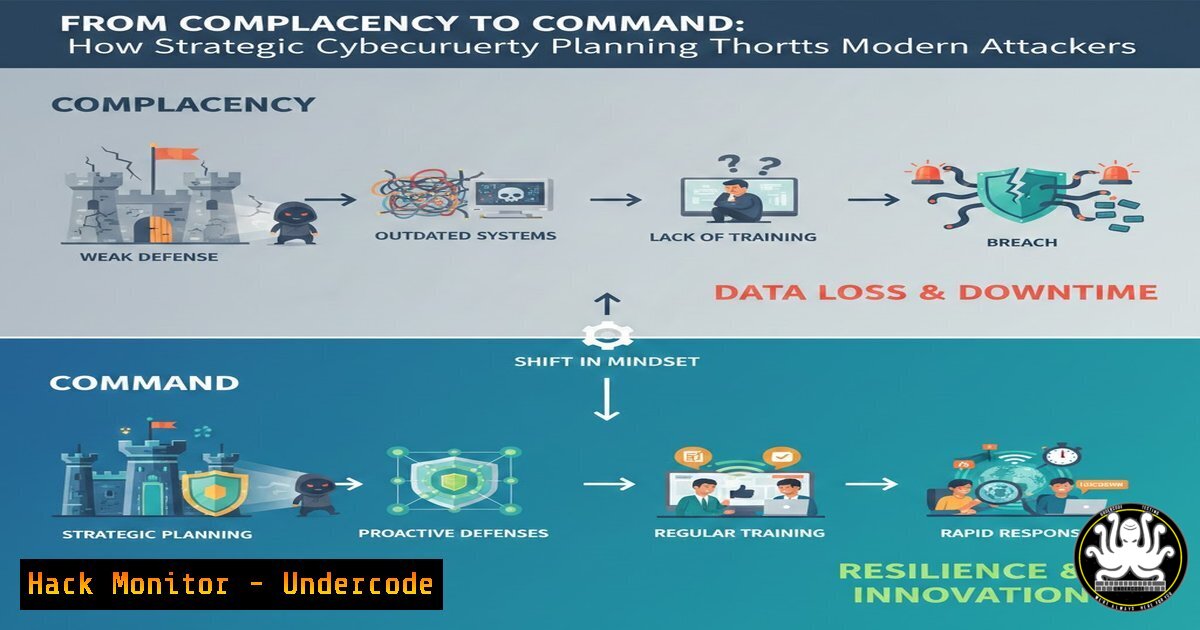
In cybersecurity, Terence McKenna’s axiom “If You Don’t Have a Plan, You Become A Part of Someone Else’s Plan” transforms from motivational quote to operational mandate. Without a robust security strategy, your organization inevitably becomes a data point in an attacker’s campaign, a compromised node in their botnet, or a line item in their ransomware ledger. This article details the technical plans you must implement to transition from a target to a defender.
Learning Objectives:
- Objective 1: Develop and deploy active monitoring to detect adversary reconnaissance and initial access attempts.
- Objective 2: Harden critical infrastructure against common exploitation paths, including misconfigured cloud storage and unpatched services.
- Objective 3: Implement automated containment and response procedures to disrupt an attacker’s operational plan during an incident.
You Should Know:
- Proactive Threat Detection: Seeing the Adversary Before They Strike
A strategic plan begins with visibility. Attackers follow a plan—the Cyber Kill Chain or MITRE ATT&CK framework—which starts with reconnaissance. Your plan must detect these early stages.
Step-by-step guide:
- Deploy a SIEM or Log Aggregator: Use tools like the Elastic Stack (ELK) or Wazuh to centralize logs from endpoints, network devices, and cloud services.
- Ingest Critical Log Sources: Ensure firewall deny logs, DNS query logs, web server access logs, and cloud audit trails (e.g., AWS CloudTrail) are flowing into your SIEM.
- Create Detection Rules: Write alerts for activities indicative of reconnaissance and scanning.
Example Sigma Rule (for use in SIEMs like Elastic SIEM or Splunk) to detect Nmap-style TCP SYN scanning:
title: Nmap TCP SYN Scan Detection
status: experimental
description: Detects a large number of TCP SYN packets to different ports from a single source, indicating a port scan.
logsource:
category: firewall
detection:
selection:
action: deny
protocol: TCP
tcp_flags: 'S'  SYN flag set
condition: selection | count() by src_ip > 50
falsepositives:
- Legitimate network scanning tools
level: medium
Linux Command to simulate and detect scanning (using tcpdump):
 Attacker Simulating a scan (on their machine):
 nmap -sS target_IP

Defender Monitoring on the target (run with sudo):
sudo tcpdump -i any 'tcp[bash] & (tcp-syn) != 0 and tcp[bash] & (tcp-ack) == 0' -c 100
 This captures pure SYN packets (SYN scan) and will show the scanning IP.
2. Hardening Your Public Attack Surface
Your public-facing assets are the primary entry points in an attacker’s plan. A strategic defense involves systematically reducing this attack surface.
Step-by-step guide:
- Discover Assets: Use tools like `amass` or `subfinder` to map all your domains and subdomains.
Basic subdomain enumeration
amass enum -d yourcompany.com -passive
- Scan for Vulnerabilities: Use `nmap` and `nikto` to identify open ports and known web vulnerabilities.
Scan for open ports and service versions
nmap -sV -sC yourcompany.com -oN scan.txt
Basic web vulnerability scanning
nikto -h https://yourcompany.com
3. Harden Configurations:
Cloud Storage: For AWS S3 buckets, ensure they are not publicly readable unless absolutely necessary. Use bucket policies.
Web Servers: Disable unnecessary HTTP methods (e.g., OPTIONS, TRACE). For Nginx/Apache, this is done in the virtual host configuration.
Windows Security: Implement the principle of least privilege. Use Group Policy to restrict PowerShell execution policies and enable constrained language mode where possible.
 Check current execution policy
Get-ExecutionPolicy -List
 Set a restrictive policy for the Local Machine scope
Set-ExecutionPolicy -ExecutionPolicy Restricted -Scope LocalMachine
3. API Security: The Silent Backdoor
APIs are critical infrastructure that are often poorly planned into security models, making them a favorite for attackers.
Step-by-step guide:
- Inventory All APIs: Use API gateways or SAST tools to discover all endpoints, including shadow APIs.
- Enforce Strict Authentication and Authorization: Always use standards like OAuth 2.0 and validate JWT tokens on every request. Implement rate limiting to prevent brute-force attacks.
- Validate Input Rigorously: Never trust client-side input. For a login API, ensure robust server-side validation.
Example Python (Flask) code snippet for input validation:
from flask import request, jsonify
import re

@app.route('/api/login', methods=['POST'])
def login():
data = request.get_json()
username = data.get('username')
password = data.get('password')

Input validation: check for type, length, and format
if not isinstance(username, str) or not isinstance(password, str):
return jsonify({"error": "Invalid input type"}), 400
if len(username) > 50 or len(password) > 100:
return jsonify({"error": "Input too long"}), 400
if not re.match("^[a-zA-Z0-9_]+$", username):  Alphanumeric check
return jsonify({"error": "Invalid username format"}), 400

... proceed with authentication logic ...
4. Incident Response: Executing Your Plan Under Fire
When a breach is detected, your pre-defined plan is the only thing standing between a contained incident and a catastrophic breach.
Step-by-step guide:
- Containment: Isolate affected systems. On a Linux endpoint, this could mean blocking network traffic.
Isolate a compromised Linux host by dropping all network traffic (run with sudo)
iptables -P INPUT DROP
iptables -P OUTPUT DROP
iptables -P FORWARD DROP
- Evidence Acquisition: Preserve volatile memory and logs for analysis.
Create a memory dump using LiME (Linux Memory Extractor)
First, insert the LiME kernel module
sudo insmod lime.ko "path=/tmp/memdump.lime format=lime"
- Eradication & Recovery: Identify the root cause (e.g., a vulnerable web app), patch it, and then restore systems from a known-good backup.
5. Security as Code: Automating Your Defensive Plan
A plan that isn’t automated is just a suggestion. Use Infrastructure as Code (IaC) to enforce a secure baseline configuration across all environments.
Step-by-step guide:
- Define Security Baselines: Use compliance frameworks (CIS Benchmarks) as a starting point.
- Write Enforceable Code: Use tools like Terraform to define secure infrastructure.
Example Terraform code for a secure AWS S3 bucket:
resource "aws_s3_bucket" "secure_log_bucket" {
bucket = "my-company-secure-logs"

Enable versioning for recovery
versioning {
enabled = true
}

Enable default server-side encryption
server_side_encryption_configuration {
rule {
apply_server_side_encryption_by_default {
sse_algorithm = "AES256"
}
}
}
}

Block ALL public access
resource "aws_s3_bucket_public_access_block" "secure_log_bucket_block" {
bucket = aws_s3_bucket.secure_log_bucket.id

block_public_acls = true
block_public_policy = true
ignore_public_acls = true
restrict_public_buckets = true
}
3. Integrate into CI/CD: Scan this IaC with tools like `tfsec` or `checkov` before deployment to catch misconfigurations early.
What Undercode Say:
- A defensive strategy is not a document; it is a living, automated system of enforcement, detection, and response.
- The cost of automating your security posture is always less than the cost of a breach, both financially and reputationally.
The central failure in modern cybersecurity is the “set-and-forget” mentality, where policies are written but not actively enforced or monitored. The adversary’s plan is dynamic, iterative, and automated. If your defense is static and manual, you have already lost. The only path to resilience is to build a security program that is equally dynamic, pervasive, and automated—treating your defensive strategy as the most critical product your IT organization develops and maintains.
Prediction:
The divergence between organizations that survive the next decade of cyber threats and those that fail will be defined by strategic planning depth. As AI-powered attacks become mainstream, manually responding to threats will be impossible. The future belongs to organizations that have codified their security plans into autonomous defensive systems—AI-driven SOCs, self-healing networks, and immutable, code-defined infrastructure that can adapt and react to novel attacks at machine speed. Those without such a plan will not just become part of someone else’s plan; they will become automated casualties in it.
🎯Let’s Practice For Free:
IT/Security Reporter URL:
Reported By: Lalit Kumar – Hackers Feeds
Extra Hub: Undercode MoN
Basic Verification: Pass ✅


