
Listen to this Post
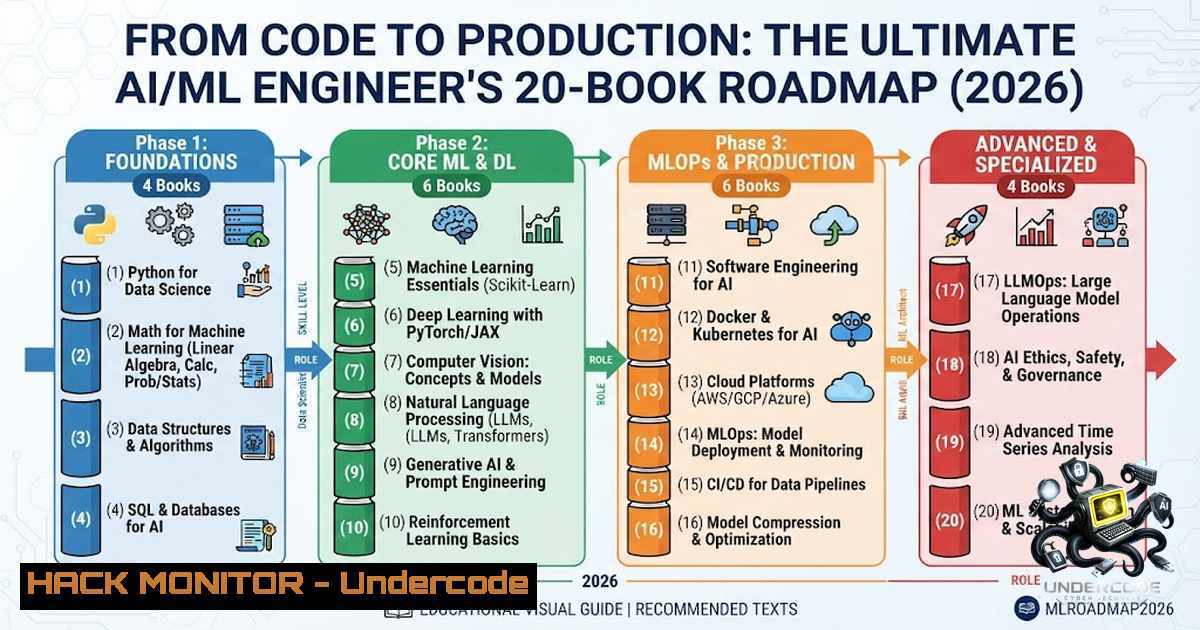
Introduction:
The modern AI/ML engineer must navigate a labyrinth of evolving technologies, from foundational algorithms to production-grade system design. The recently curated “complete AI/ML curriculum” consolidates this entire journey into a single, 20-book stack, spanning five critical categories: Fundamentals, Time Series, System Design, Generative AI, and Product Strategy. This stack is not just a reading list; it’s a comprehensive blueprint for building, deploying, and securing intelligent systems at scale. Here is a breakdown of the key pillars and the technical expertise they unlock.
Learning Objectives:
- Master the end-to-end machine learning project lifecycle using Scikit-Learn, Keras, and TensorFlow.
- Architect reliable, scalable, and maintainable ML systems that adapt to changing business requirements.
- Develop and deploy production-ready applications using foundation models, including prompt engineering, RAG, and fine-tuning.
You Should Know:
- Laying the Groundwork: From Fundamentals to Time-Series Analysis
Every AI engineer’s journey begins with a solid grasp of core concepts. The curriculum’s foundation is built upon “Hands-On Machine Learning with Scikit-Learn, Keras, and TensorFlow” by Aurélien Géron. This bestseller uses concrete examples and minimal theory to guide you through the entire ML project pipeline—from simple linear regression and support vector machines to deep neural networks, including CNNs, RNNs, and Transformers. It provides the essential toolkit for any data scientist.
For those working with sequential data, the “Modern Time Series Forecasting with Python” book is indispensable. Time-series analysis is critical for anomaly detection, predictive maintenance, and financial forecasting—all domains with significant security implications. A key security practice when handling time-series data is ensuring data integrity. You can implement a simple checksum verification in Python to detect tampering:
import hashlib
def verify_data_integrity(file_path, expected_hash):
with open(file_path, 'rb') as f:
file_hash = hashlib.sha256(f.read()).hexdigest()
return file_hash == expected_hash
 Example: verify_integrity('sensor_data.csv', 'a1b2c3...')
On Windows, you can use `CertUtil -hashfile sensor_data.csv SHA256` to generate a file’s hash for verification.
2. Architecting for Production: The System Design Pillar
Moving from a working model to a production system is where many projects fail. This is addressed by two critical books: “Designing Machine Learning Systems” and “AI Engineering,” both by Chip Huyen. “Designing Machine Learning Systems” provides a holistic framework for creating systems that are reliable, scalable, and maintainable. It covers crucial decisions like data engineering, feature selection, model retraining frequency, and monitoring. Meanwhile, “AI Engineering” bridges the gap to the modern AI stack, focusing on building applications with readily available foundation models. It explains the process of developing an AI application, from simple techniques to more sophisticated methods like Retrieval-Augmented Generation (RAG) and fine-tuning.
A core component of system design for AI is the MLOps pipeline. Here is a conceptual step-by-step guide to setting up a basic CI/CD pipeline for a model using GitHub Actions and Python:
– Step 1: Structure your repository with src/, tests/, and `models/` directories.
– Step 2: Write unit tests for your data preprocessing and model prediction functions.
– Step 3: Create a `.github/workflows/ml-pipeline.yml` file.
– Step 4: Define a workflow that triggers on `push` to the `main` branch.
– Step 5: The workflow should: a) Check out the code; b) Set up Python; c) Install dependencies from requirements.txt; d) Run linting (e.g., flake8); e) Run the test suite (e.g., pytest).
– Step 6: If tests pass, the workflow can build a Docker image of the model API and push it to a container registry (e.g., Docker Hub, Google Container Registry).
– Step 7: The final step can trigger a deployment to a staging environment using a tool like `kubectl` for Kubernetes or a simple script.
- Mastering the Generative AI Frontier: LLMs, LangChain, and Agents
The most explosive growth in AI is in the generative space. The curriculum dedicates a significant portion to this, covering everything from design patterns to practical frameworks. “LLM Design Patterns” by Ken Huang offers reusable solutions for common challenges, including data-centric approaches, model fine-tuning, and advanced prompting techniques like RAG. To build production-ready applications, “Generative AI with LangChain” is essential. This book provides hands-on guidance on using the LangChain framework to build LLM applications and advanced agents. It covers reasoning techniques like Tree-of-Thoughts and agent handoffs, complete with error handling.
Building on this, “AI Agents in Practice” teaches you how to design, implement, and scale autonomous AI systems. It offers a comparative tour of leading agent frameworks like LangChain and LangGraph, covering each tool’s strengths and ideal use cases. Implementing these agents requires secure API key management. On Linux/macOS, you can set environment variables securely in your shell profile (e.g., export OPENAI_API_KEY="your_key_here"). For a more robust approach, especially in production, use a secrets management tool like HashiCorp Vault. A simple Python example using the `os` module to read an API key is:
import os
api_key = os.getenv("OPENAI_API_KEY")
if not api_key:
raise ValueError("OPENAI_API_KEY environment variable not set")
On Windows, you can set this permanently using `setx OPENAI_API_KEY “your_key_here”` in an administrator command prompt.
- The Architectural Backbone: Securing and Scaling AI Systems
To ensure these complex systems are robust and secure, “Architecting AI Software Systems” provides a definitive guide. It emphasizes balancing AI’s capabilities with traditional software architecture principles. This book is critical for software and systems architects responsible for integrating AI into existing and new systems. It provides strategies to mitigate risks like underperformance and cost overruns, and covers tools to design and integrate AI.
Security in AI architecture is paramount. When deploying a model as an API, you must protect against injection attacks and data exfiltration. A foundational step is implementing input validation and sanitization. For example, when accepting user input for a text-based model, you should strip or escape any potentially malicious characters. Here’s a basic Python function using `re` to sanitize input:
import re
def sanitize_input(user_input: str) -> str:
 Remove any non-alphanumeric, non-space, non-basic punctuation characters
sanitized = re.sub(r'[^a-zA-Z0-9\s.,!?]', '', user_input)
return sanitized
Additionally, for containerized deployments, ensure your Dockerfiles follow best practices: use a non-root user, keep images small by using multi-stage builds, and regularly scan images for vulnerabilities using tools like Trivy or Snyk.
- Beyond the Code: Strategy, Product, and the Human Element
The final piece of the curriculum addresses the business and strategic side of AI. Books like “The Profitable AI Advantage” and “Reimagined: Building Products with Generative AI” focus on how to translate technical capabilities into business value. Understanding the product lifecycle and strategy is crucial for any AI engineer who wants to see their work have a real-world impact. As the post states, this stack “mass-covers everything” from the code to the boardroom. For security professionals, this means understanding compliance requirements like GDPR or HIPAA, which are non-1egotiable aspects of product strategy. Implementing data anonymization and pseudonymization techniques early in the design phase is a key security control that aligns with product and legal requirements.
What Undercode Say:
- The modern AI/ML curriculum is a multi-disciplinary journey that requires equal proficiency in software engineering, data science, and system architecture.
- Security is not an afterthought but must be “shifted left” and integrated into every stage of the ML lifecycle, from data integrity checks to secure API deployment and container hardening.
Expected Output:
This 20-book stack represents a comprehensive, battle-tested path for any aspiring or practicing AI/ML engineer. By systematically working through the fundamentals, mastering system design, delving into generative AI, and understanding the architectural and strategic imperatives, one can build not just models, but robust, secure, and impactful AI systems. The key takeaway is that true expertise lies in the synthesis of these diverse skills, creating a holistic understanding that is far greater than the sum of its parts. This roadmap is the definitive guide for 2026 and beyond.
Prediction:
- +1 The democratization of AI through model-as-a-service and accessible frameworks will lead to an explosion of innovation, but will also create a massive demand for professionals who can bridge the gap between a prototype and a secure, scalable production system.
- +1 Security will become a primary differentiator for AI products. Organizations that can demonstrate robust, secure, and ethical AI systems will gain a significant competitive advantage and customer trust.
- -1 The rapid pace of AI evolution will outstrip the ability of traditional security frameworks to adapt, leading to a “wild west” period where new vulnerabilities and attack vectors emerge faster than they can be patched.
- -1 The complexity of multi-agent systems and LLM chains will create unpredictable failure modes and security loopholes, making AI system resilience and monitoring the most critical (and underfunded) area of investment.
▶️ Related Video (84% Match):
🎯Let’s Practice For Free:
🎓 Live Courses & Certifications:
Join Undercode Academy for Verified Certifications
🚀 Request a Custom Project:
Secure, high-velocity infrastructure and disruptive technological engineering. Contact our engineering team for high-tier development and proprietary systems:
[email protected]
💎 Smart Architecture | 🛡️ Secure by Design | ⭐ Trusted by Thousands
IT/Security Reporter URL:
Reported By: Curiouslearner The – Hackers Feeds
Extra Hub: Undercode MoN
Basic Verification: Pass ✅


